💶 Economic Carrying Capacity
The level of tourism beyond which the economic benefits to locals begin to be outweighed by the costs such as rising house prices, loss of local businesses and over-reliance on tourism income.
Sign up to access the complete lesson and track your progress!
Unlock This CourseImagine a beach. It's beautiful, warm and perfect for a holiday. Now imagine 10,000 people turning up on that same beach on the same day. Suddenly it's not so beautiful. The sand is covered, the water is dirty, the car park is full and the local fish and chip shop has a two-hour queue. This is what happens when a destination exceeds its carrying capacity.
Key Definitions:
Tourism is one of the world's biggest industries. In 2019, there were 1.5 billion international tourist arrivals globally. When too many people visit the same places, it can destroy the very things that made those places worth visiting in the first place. Carrying capacity is about finding the right balance enough tourists to support the local economy, but not so many that the destination is damaged.
Carrying capacity isn't just one simple number. It has several different dimensions, each measuring a different kind of pressure that tourism places on a destination.
The maximum number of people that can physically fit in a space at any one time. For example, a beach, a car park, or a museum gallery. This is the most straightforward type to measure.
The level of tourist activity beyond which the natural environment begins to suffer permanent damage such as coral reef bleaching, soil erosion on footpaths, or wildlife disturbance.
The point at which local residents feel their way of life, culture, or community is being negatively affected by tourists. This is harder to measure but very important.
The level of tourism beyond which the economic benefits to locals begin to be outweighed by the costs such as rising house prices, loss of local businesses and over-reliance on tourism income.
The point at which tourists themselves feel the destination is too crowded and their experience is ruined. This varies some tourists prefer quiet, others don't mind crowds.
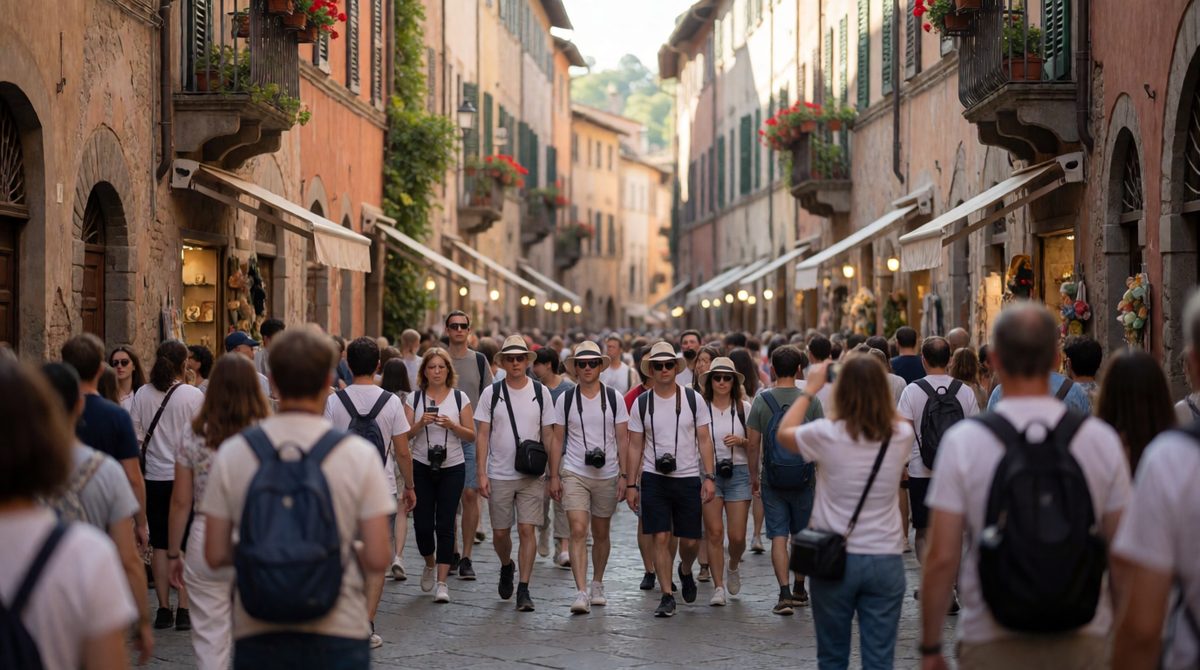
Overtourism can overwhelm popular places
Overtourism happens when a destination becomes so popular that it causes serious problems. It's not just about numbers it's about the impact of those numbers. A small village can be overwhelmed by 500 visitors. A large city might handle millions with few problems. Context matters.
Several factors have combined in recent decades to create the overtourism crisis seen in many destinations:
Low-cost carriers like Ryanair and EasyJet made air travel affordable for millions more people, dramatically increasing visitor numbers to European destinations.
Instagram and TikTok have made certain locations go viral overnight. Places like the Faroe Islands or Iceland saw visitor numbers explode after becoming popular online.
Platforms like Airbnb have converted residential housing into tourist accommodation, reducing housing for locals and changing the character of neighbourhoods.
Location: North-east Italy a historic city built on 118 small islands connected by canals.
The Problem: Venice receives around 30 million visitors per year but has a resident population of only about 50,000 people and falling. In the 1950s, around 175,000 people lived there. Locals are leaving because of high rents, tourist crowds and the loss of everyday shops replaced by souvenir stalls.
Impacts:
Management Responses: In 2024, Venice introduced a day-tripper entry fee of €5 on busy days. Cruise ships over a certain size have been banned from the main lagoon. Visitor numbers are monitored using sensors and cameras.
When carrying capacity is exceeded, the consequences can be serious and long-lasting. These impacts fall into three main categories:
Location: A small volcanic island in the Aegean Sea, famous for its white buildings and blue-domed churches.
The Problem: Santorini has a permanent population of around 15,000 people but receives over 2 million visitors per year, including huge numbers arriving by cruise ship. On peak days, up to 18,000 cruise passengers arrive at once.
Impacts:
Management Responses: The Greek government has introduced a cap of 8,000 cruise passengers per day. Local authorities have restricted the number of donkey rides permitted and introduced weight limits for riders.
Destinations use a wide range of strategies to manage visitor numbers and reduce the impacts of overtourism. These can be grouped into hard management (physical controls) and soft management (education and persuasion).
Location: A remote archipelago in the Pacific Ocean, 1,000 km off the coast of Ecuador. Famous for unique wildlife including giant tortoises, marine iguanas and blue-footed boobies.
Why It Matters: The Galápagos inspired Charles Darwin's theory of evolution. The islands are a UNESCO World Heritage Site and one of the world's most ecologically sensitive destinations.
Management Strategies:
Outcome: The Galápagos is often cited as a model for sustainable tourism management. Visitor numbers have grown but are carefully controlled and conservation funding has increased significantly.
The Butler Model (1980) is a useful framework for understanding how tourism destinations develop over time and how overtourism can lead to decline if not managed properly.
Small numbers of adventurous tourists discover the destination. Few facilities exist. The environment and culture are largely undisturbed.
Local people begin to provide services for tourists. Numbers grow slowly. The destination starts to develop a tourist identity.
Rapid growth in visitor numbers. Large companies invest. The destination becomes well-known. Infrastructure is built quickly.
Growth slows. The destination is established but beginning to show signs of wear. Carrying capacity may be approaching its limit.
Visitor numbers plateau. The destination has a poor reputation. Environmental and social problems are evident. Overtourism may have occurred.
Without intervention, the destination declines. With good management (new attractions, sustainability measures), it can be rejuvenated and the cycle begins again.
Location: A seaside resort on the Lancashire coast, north-west England.
The Story: Blackpool was once Britain's most popular holiday resort, attracting millions of working-class visitors during the 20th century. It is a classic example of a destination that reached stagnation in the Butler Model. As cheap package holidays to Spain became available from the 1970s onwards, visitor numbers fell sharply. The resort became associated with poor-quality accommodation, litter and social problems.
Rejuvenation Attempts: Blackpool has invested in new attractions (Pleasure Beach, the Illuminations, conference tourism) and regeneration of the promenade. However, full rejuvenation has proved difficult, showing that recovery from decline is not guaranteed.
Managing carrying capacity involves many different groups, all with different interests and priorities. Understanding these different viewpoints is important for exam answers.
Want to balance economic benefits of tourism with protecting the environment and quality of life for residents. May introduce laws, fees and visitor limits.
Generally want more visitors as this means more profit. May resist restrictions. However, some businesses recognise that overtourism damages their long-term interests.
Often most directly affected by overtourism. May support restrictions on visitor numbers, especially if they feel tourism is damaging their community or pricing them out of housing.