🌎 Preservation, Conservation and Regeneration
When a place becomes popular with tourists, it faces a tricky problem: the more people visit, the more damage can be done. Managing destinations sustainably means finding ways to keep a place attractive, healthy and welcoming now and in the future. Three big ideas sit at the heart of this: preservation, conservation and regeneration.
Key Definitions:
- Preservation: Keeping something exactly as it is, preventing any change or damage. Think of it as putting a place in a protective bubble.
- Conservation: Managing and protecting a place or resource so it can still be used and enjoyed, but in a careful and sustainable way.
- Regeneration: Rebuilding or improving a place that has declined, become run-down, or been damaged often bringing new economic and social life to an area.
- Sustainable tourism: Tourism that meets the needs of visitors today without damaging the destination for future generations.
- Carrying capacity: The maximum number of visitors a destination can handle before damage occurs to the environment, culture or visitor experience.
🔒 Preservation
Preservation is the strictest form of protection. It means no change keeping something in its original state. This approach is used for highly sensitive or irreplaceable sites. For example, certain ancient cave paintings in France are completely closed to the public to prevent damage from breath and body heat. Preservation says: "This is too precious to risk."
🌿 Conservation
Conservation is more flexible. It allows people to visit and use a place, but with careful management to prevent harm. National parks, wildlife reserves and heritage sites are often managed through conservation. The aim is balance enjoying the resource and protecting it at the same time. Conservation says: "We can use this, but wisely."
🔄 Regeneration: Giving Places a Second Chance
Not every destination is in danger of being loved to death some have been neglected. Regeneration is about reviving these places. It might mean restoring old buildings, cleaning up polluted waterfronts, creating new tourist attractions, or improving transport links. Regeneration often happens in post-industrial areas or seaside resorts that have fallen out of fashion.
🏛 Physical Regeneration
Restoring buildings, improving public spaces, cleaning up derelict land. Example: converting old docks into museums and restaurants.
💰 Economic Regeneration
Attracting new businesses, creating jobs, boosting visitor spending. Tourism can be the engine that drives economic recovery.
👪 Social Regeneration
Improving quality of life for local residents better facilities, community pride, reduced unemployment and crime.
🏭 Case Study: The Eden Project, Cornwall, UK
The Eden Project is a brilliant example of regeneration. It was built in a disused china clay pit near St Austell in Cornwall a huge hole in the ground that had been abandoned after mining stopped. Rather than leaving it as wasteland, it was transformed into one of the UK's most visited tourist attractions, featuring giant biomes housing plants from around the world. Since opening in 2001, it has attracted over 22 million visitors, created thousands of local jobs and pumped over £2 billion into the Cornish economy. It is a perfect example of how tourism-led regeneration can transform a declining area.
⚖ Carrying Capacity and Visitor Pressure
One of the biggest challenges in sustainable destination management is knowing when enough is enough. Every destination has a carrying capacity a limit to how many visitors it can handle. Go beyond that limit and things start to go wrong: footpaths erode, wildlife is disturbed, local people get frustrated and the visitor experience gets worse.
🚫 Types of Carrying Capacity
🌿 Physical Capacity
The actual space available. A beach can only hold so many people before it becomes overcrowded and unpleasant.
🐸 Environmental Capacity
The level of visitor activity the natural environment can absorb without being permanently damaged.
👪 Perceptual Capacity
The point at which visitors feel the experience is spoiled too crowded, too noisy, too commercialised.
⚠ Case Study: Venice, Italy Overtourism Crisis
Venice is one of the world's most famous cities and one of its most pressured. Built on a lagoon in northern Italy, it receives around 30 million visitors per year, but only has a resident population of about 50,000. The city is sinking, the canals are polluted by boat traffic and local people are being priced out of their homes as properties are converted to tourist accommodation. Venice has gone well beyond its carrying capacity. In response, the city has introduced:
- 📌 A day-tripper entry fee (introduced in 2024) tourists pay to enter the historic centre on busy days
- 🚫 Bans on large cruise ships entering the main lagoon
- 📷 Turnstiles and barriers at key entry points to control crowd flow
- 📋 Campaigns encouraging visitors to spread out to less-visited areas of the city
Venice shows that even the most iconic destinations can be damaged by too much tourism and that bold management decisions are sometimes needed.
🏛 Managing Heritage Sites
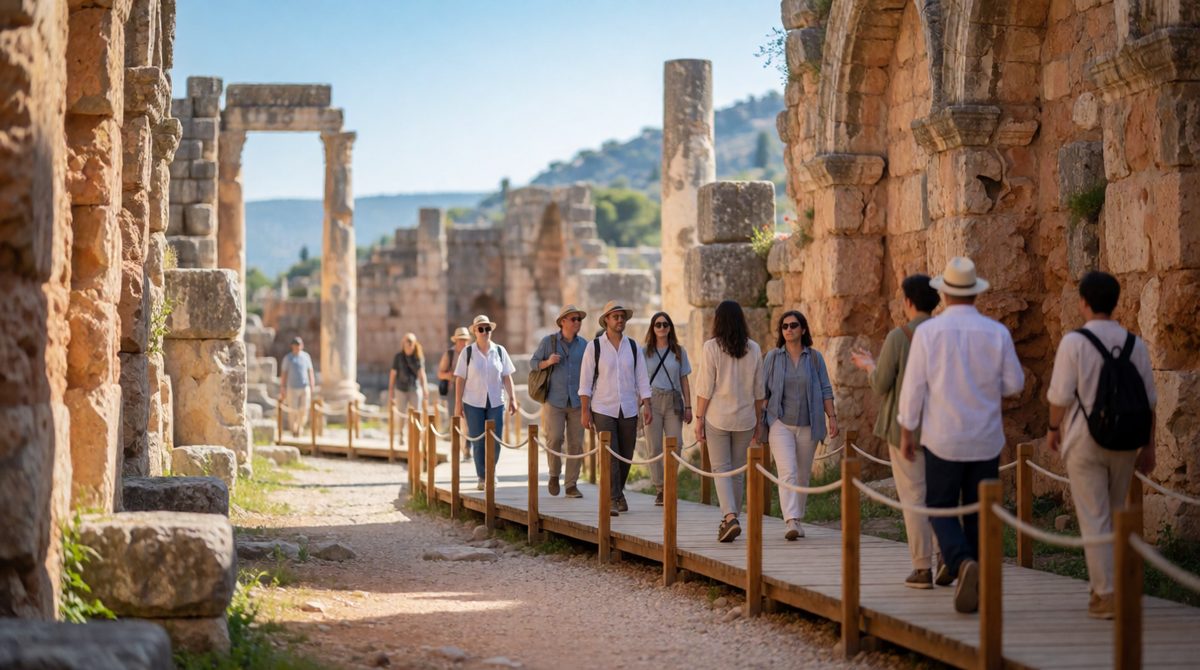
Heritage sites need careful management
Heritage sites whether natural wonders or historic buildings need especially careful management. Many are listed as UNESCO World Heritage Sites, which brings international recognition but also enormous visitor pressure. Managers must balance access with protection.
📋 Hard Management Strategies
These involve physical structures or strict rules:
- Fencing off fragile areas
- Building boardwalks to keep feet off sensitive ground
- Limiting visitor numbers with timed entry tickets
- Banning photography with flash in caves or galleries
- Closing sites completely during sensitive seasons
💬 Soft Management Strategies
These rely on education and persuasion:
- Information boards and guided tours
- Visitor centres explaining why protection matters
- Codes of conduct for tourists
- Encouraging visitors to use public transport
- Promoting off-peak visits to reduce peak pressure
🏛 Case Study: Machu Picchu, Peru
Machu Picchu, the ancient Inca citadel high in the Andes, is one of the world's most visited heritage sites. By 2019, it was receiving over 1.5 million visitors per year far more than the site could comfortably handle. Erosion of paths, damage to stone structures and overcrowding became serious problems. Management responses have included:
- ⏱ Timed entry slots visitors must book a specific entry time to spread the flow
- 🚫 A daily visitor cap of around 4,000 people (reduced from higher levels)
- 📌 One-way walking routes through the site to reduce congestion
- 🌎 Restrictions on the Inca Trail only 500 people (including guides and porters) per day
Peru's government has had to make tough choices to protect this irreplaceable site for future generations.
🌎 Sustainable Destination Management in Practice
Sustainable management isn't just about saying no to tourists it's about finding smart ways to keep destinations thriving. Different stakeholders all play a role: governments, local communities, tourism businesses and visitors themselves.
📈 Tools and Techniques Used by Destination Managers
Destination managers have a toolkit of strategies they can use. Some control numbers, some change behaviour and some improve the destination itself.
💰 Pricing Strategies
Charging higher entry fees during peak times discourages mass tourism and raises funds for conservation. Differential pricing (locals pay less than foreign tourists) is also common.
📌 Zoning
Dividing a destination into zones some open to all visitors, some restricted, some completely off-limits. This protects the most sensitive areas while still allowing tourism.
♻ Sustainable Transport
Encouraging visitors to use buses, trains or bikes instead of private cars reduces congestion, pollution and carbon emissions at popular destinations.
🏭 Case Study: Bhutan High Value, Low Volume Tourism
The small Himalayan kingdom of Bhutan has one of the most radical approaches to sustainable tourism in the world. Rather than trying to attract as many visitors as possible, Bhutan deliberately limits tourist numbers and charges a Sustainable Development Fee currently $100 per person per day (reduced from $200 after the pandemic). This fee funds free healthcare, education and environmental conservation for Bhutanese citizens. Visitors must travel with a licensed Bhutanese guide. The result? Tourism revenue is high, environmental damage is low and Bhutan's unique culture and landscapes remain largely intact. It is the ultimate example of "high value, low volume" tourism philosophy.
🌟 The Role of Local Communities
Sustainable destination management only really works when local communities are involved. If local people don't benefit from tourism or worse, if they suffer because of it they have no reason to support conservation efforts. Community-based tourism puts local people in charge of how tourism develops in their area.
👪 Why Community Involvement Matters
When local communities are involved in tourism management, several good things happen:
- ✅ Tourism income stays in the local economy rather than going to large foreign companies
- ✅ Local people become guardians of their own environment and culture
- ✅ Tourism products become more authentic and interesting for visitors
- ✅ Communities develop skills and confidence to manage their own futures
- ✅ There is less conflict between tourists and residents
🐸 Case Study: Namibia Community Conservancies
Namibia in southern Africa has developed a world-leading system of community conservancies. Local communities are given legal rights to manage wildlife on their land and to benefit from tourism revenue. There are now over 86 communal conservancies covering nearly 20% of Namibia's land area. Wildlife numbers have recovered dramatically lions, elephants, rhinos and cheetahs have all increased. Local people earn income from tourism lodges, guiding and craft sales. This model shows that conservation and community development can go hand in hand.
📋 Summary: Preservation, Conservation and Regeneration
Managing destinations sustainably is one of the most important challenges in modern tourism. The key ideas to remember are:
- 🔒 Preservation = strict protection, no change allowed
- 🌿 Conservation = careful management that allows sustainable use
- 🔄 Regeneration = reviving declining or damaged places through investment and tourism
- 🚫 Carrying capacity must not be exceeded physical, environmental and perceptual limits all matter
- 📈 A mix of hard and soft management strategies is usually most effective
- 👪 Local communities must be involved and must benefit for sustainability to work
- 🌎 Case studies like Venice, Machu Picchu, Bhutan, the Eden Project and Namibia show different approaches in action