🌡 Temperature
It is hot all year, usually between about 26 and 28 degrees C. The temperature hardly changes from month to month, so there is no winter. Plants can grow all year.
Sign up to access the complete lesson and track your progress!
Unlock This Course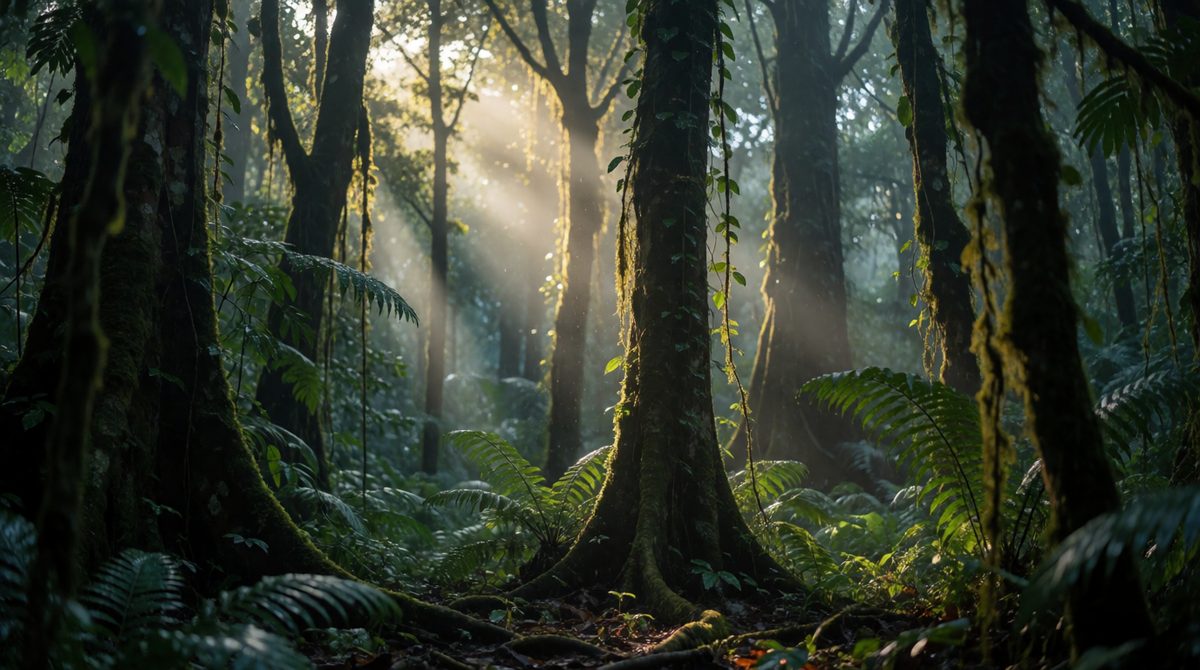
Rainforests are hot and wet all year, with tall trees forming layers
You met the tropical rainforest as one of the world's biomes in the last lesson. Now we look closely at what makes it special. Tropical rainforests grow close to the equator, in a belt roughly between the Tropic of Cancer and the Tropic of Capricorn. This lesson covers the physical features of the forest: its climate, layers and soils. Then we see how all the parts fit together.
Key terms:
Because the rainforest is near the equator, the Sun is high in the sky all year. The weather is hot and wet, with almost no change between seasons.
It is hot all year, usually between about 26 and 28 degrees C. The temperature hardly changes from month to month, so there is no winter. Plants can grow all year.
There is a lot of rain, often more than 2000 mm a year. Rain falls in every month. Many afternoons bring a heavy downpour as the hot, damp air rises, cools and forms storm clouds.
Hot and wet conditions are perfect for plant growth. This is why the rainforest is so green and so dense. When you describe a climate in the exam, always give figures, such as the temperature range and the rainfall total.
A rainforest is built in layers. Each layer gets a different amount of light, so each one has different conditions.
The canopy is the key to the whole forest. It is so thick that it shades everything below it and slows the rain before it hits the ground.
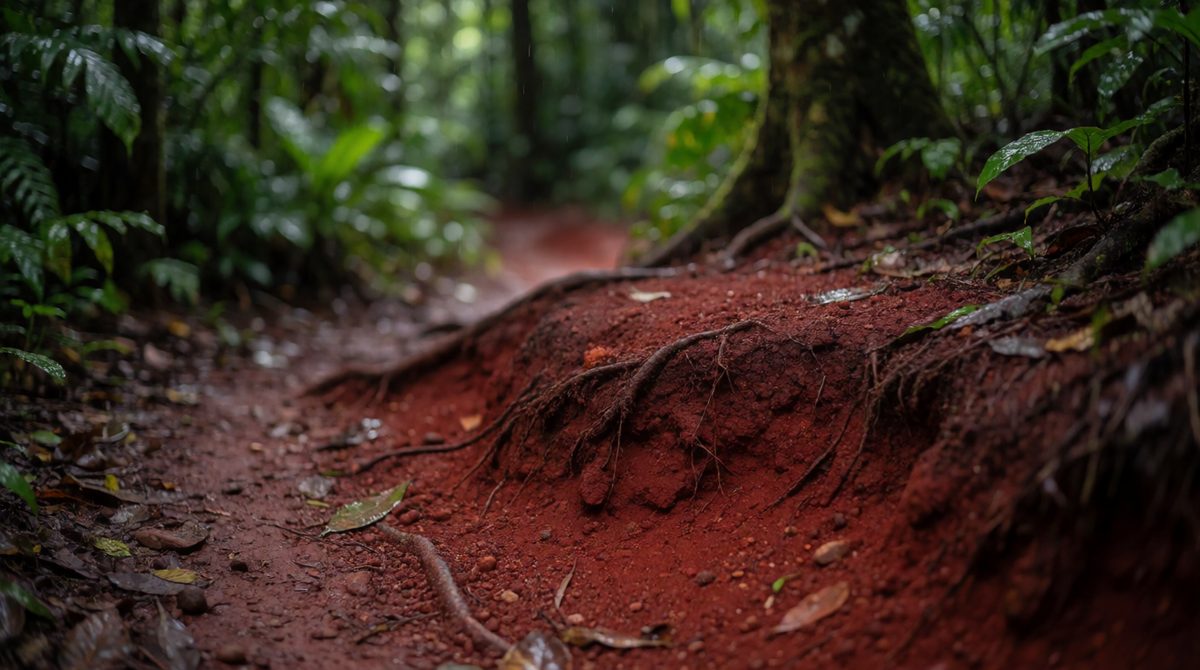
Rainforest soils are thin and not very fertile, as nutrients are used up fast
You might expect such a green forest to have rich soil. In fact, rainforest soils are usually poor in nutrients. The heavy rain causes leaching, washing nutrients down and away. The nutrients are mostly held in the plants and in a thin layer of fallen leaves on the surface, not deep in the soil.
Why is the soil poor even though the forest is lush? Step 1: heavy rain falls all year. Step 2: the rain washes (leaches) nutrients down through the soil. Step 3: the plants take up what is left very quickly. So the nutrients are in the plants, not in the soil.
Remember, nutrient cycling means nutrients are passed around the ecosystem and reused. In the rainforest this happens very fast. There are three main stores:
Dead leaves fall all year round. The heat and damp let decomposers break them down very fast. Nutrients are released and shallow tree roots take them up again almost straight away. Rain adds a little, and leaching removes some.
Large store. Plants take up nutrients and grow quickly.
Small store. Leaves fall and rot within weeks.
Small store. Nutrients are leached or taken up fast.
Everything in the rainforest depends on everything else. This is called interdependence. Change one part and the others are affected.
Here is one chain to show how it all links. Heavy rain feeds the trees. The trees feed the animals. The animals spread seeds. The seeds grow into trees that hold the soil and protect it from the rain.
Many students say the soil is fertile because the forest is so green. It is not. The nutrients are stored in the plants and the litter. Another mistake is to say the rainforest has a rainy season and a dry season. It is wet all year.
(a) Describe the climate of a tropical rainforest. [2 marks]
(b) Explain why the soils in a tropical rainforest are poor in nutrients. [3 marks]
(a) It is hot all year, about 26 to 28 degrees C (1). It has heavy rainfall, often over 2000 mm a year, with rain in every month (1).
(b) Heavy rain washes nutrients down through the soil (1). This is called leaching (1). Dead leaves rot very quickly in the heat and damp, and the nutrients are taken up by plants straight away, so few stay in the soil (1).
On an 'explain' question, join your points with 'because' or 'so'. In part (b), link the rain to the leaching and the leaching to the poor soil.