🍃 Drip tips
Many leaves are smooth and waxy with a long pointed end. Rain runs off the leaf quickly. This stops water sitting on the leaf, where it could let algae and fungi grow and cut out the light.
Sign up to access the complete lesson and track your progress!
Unlock This Course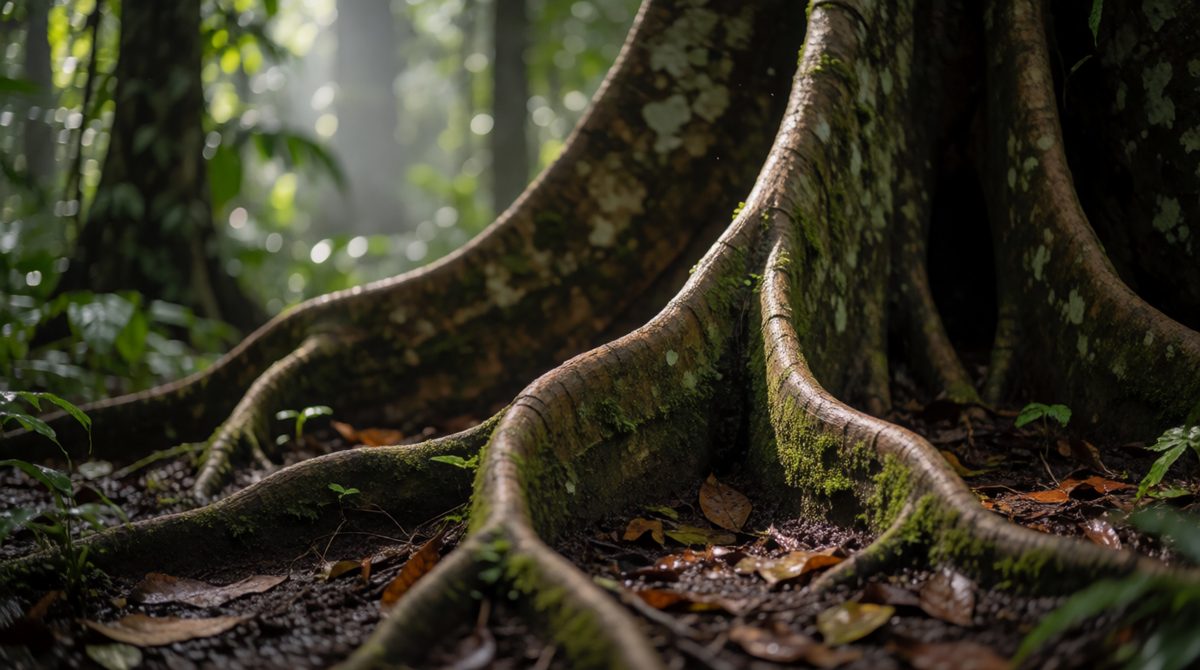
Buttress roots help hold up tall rainforest trees
The rainforest is hot and wet all year round. It is also very crowded. Thousands of plants fight for light, and thousands of animals fight for food and space. To survive, plants and animals have developed adaptations. These are features that help a living thing cope with its physical conditions.
The main physical conditions in the rainforest are heavy rain, constant heat, very little light on the forest floor and soils with few nutrients. Each adaptation in this lesson helps with one of these problems.
Key terms:
Plants make their own food using sunlight, so winning the race for light is everything. Water is never a problem, but too much of it can be.
Many leaves are smooth and waxy with a long pointed end. Rain runs off the leaf quickly. This stops water sitting on the leaf, where it could let algae and fungi grow and cut out the light.
Rainforest soil is thin and poor in nutrients, so most roots stay near the surface. Tall trees could easily fall over. Buttress roots spread out wide, hold the tree up in thin soil.
A liana roots in the ground, then climbs up a tree trunk. It does not waste energy growing a thick trunk of its own. Once it reaches the canopy, its leaves get plenty of sunlight.
Some orchids and bromeliads grow on tree branches high in the canopy. This puts them in the light. They take water from the rain and damp air, and nutrients from the fallen leaves and debris that collect around them.
Many trees also have tall, straight trunks with branches only at the top. They put their energy into growing upwards fast, to reach the canopy where the light is.
Animals face different problems. Food is plentiful, but there are many predators and a lot of competition. Many animals live in the canopy, where most of the fruit, flowers and leaves are found.
Explain how a drip tip helps a plant. Step 1: state the feature, a pointed leaf end. Step 2: link it to the condition, heavy rainfall all year. Step 3: say what it does, water drains away quickly, so the leaf stays clear and can still get light. Always link the feature to the condition and the benefit.
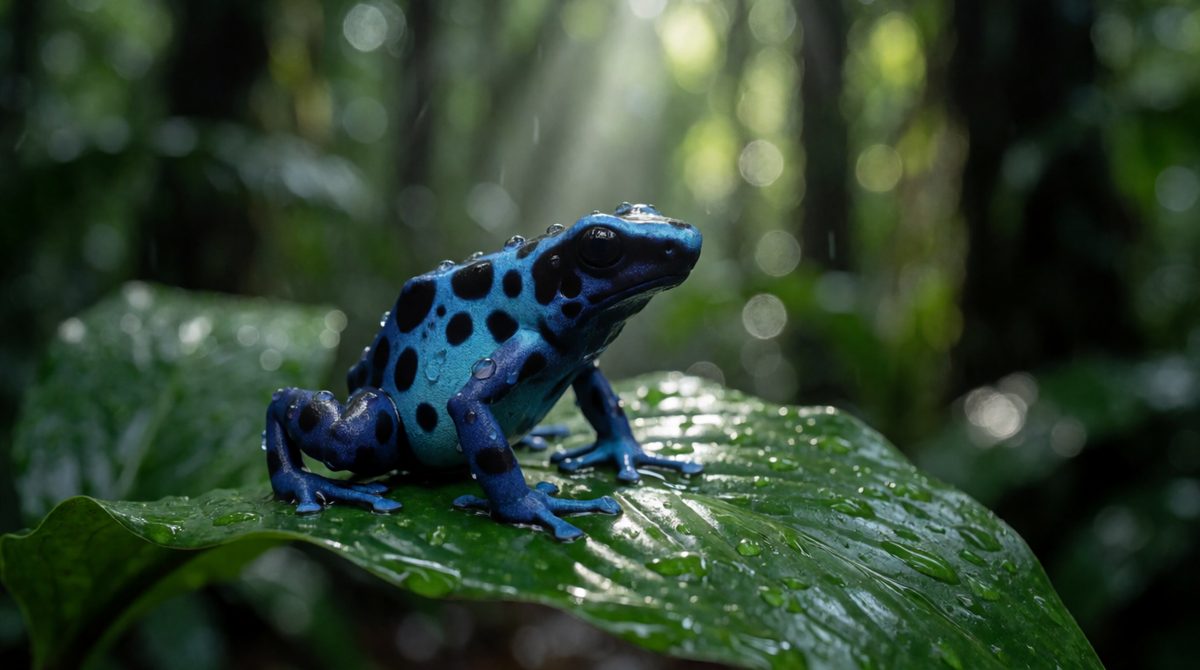
Rainforests have huge biodiversity, the variety of living things in an area
Biodiversity is the variety of living things in an area. A place with many different species has high biodiversity. Tropical rainforests have some of the highest biodiversity on Earth.
There are good reasons for this:
Species also depend on each other. Many insects feed on only one type of plant, and many predators depend on one type of prey.
High biodiversity is valuable, but it is also fragile. Several issues put it at risk.
When forest is cleared, animals and plants lose their home. Many species live in only one small area, so they have nowhere else to go. The reasons forest is cleared are covered in the lesson on the Amazon.
If a species loses its habitat, its numbers fall. A species that dies out is gone for ever. Some may disappear before scientists have even discovered them.
Because species depend on each other, losing one affects others. If a plant that an insect feeds on is lost, the insect suffers. If the insect goes, the animals that eat it may lose their food too.
Some species may die out before scientists have studied them. Once they are gone, we can never learn from them.
Do not say buttress roots take water from deep in the ground. They are shallow and spread wide for support. Biodiversity is not just animals. It includes plants and all other living things.
(a) Describe one way in which a plant is adapted to life in the tropical rainforest. [2 marks]
(b) Explain why tropical rainforests have high biodiversity. [3 marks]
(c) Explain how the loss of one species could affect other species in the rainforest. [2 marks]
(a) Buttress roots spread out wide from the base of tall trees (1). They support the tree in thin soil so it does not fall over (1). Also accept: drip tips let rain run off quickly (1) so the leaf is not covered in water and can still get light (1).
(b) It is hot and wet all year, so plants can grow all year (1). The layers of the forest give many different habitats (1). Lots of food means many different animals can live there (1).
(c) Species depend on each other for food (1). If one is lost, species that rely on it may lose their food and may die out too (1).
In an 'explain' question like part (b), each mark needs a reason, not just a fact. Use the words 'because' or 'so' to link each point back to biodiversity.