🌳 Selective logging
Only some trees are cut. The canopy stays mostly closed, so soil is shaded and held in place by roots. Animals keep their homes. The forest can slowly recover.
Sign up to access the complete lesson and track your progress!
Unlock This Course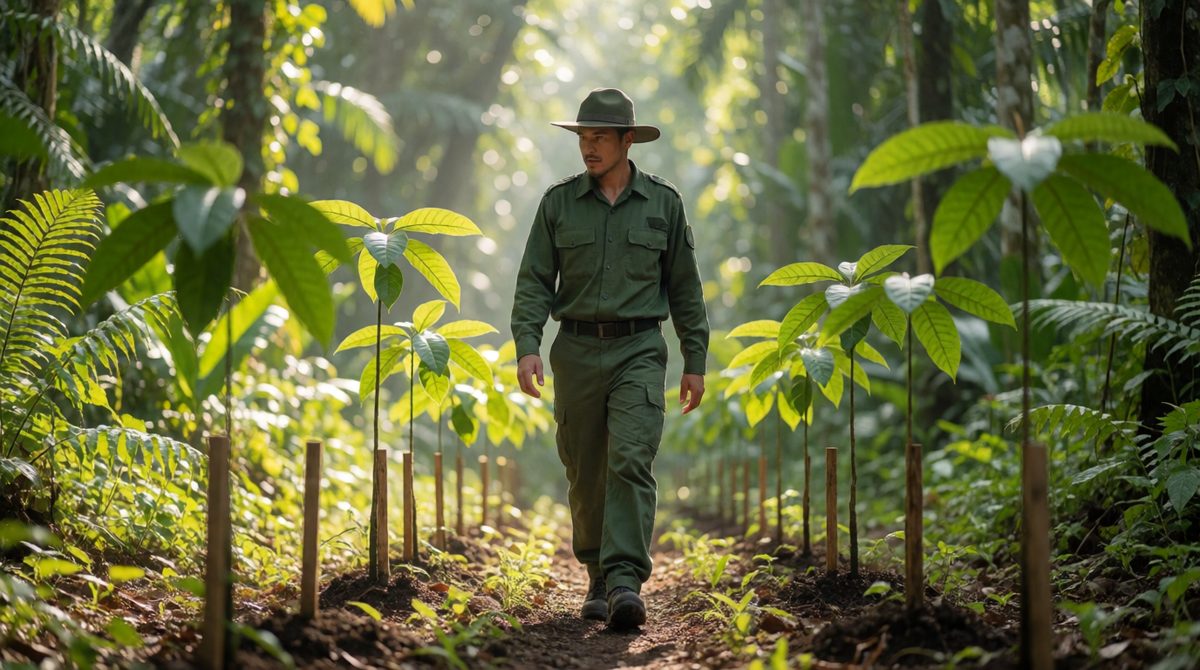
Replanting trees is one way to manage rainforests sustainably
The last two lessons showed how much rainforest is cleared and why. The spec says tropical rainforests need to be managed to be sustainable. That means using the forest in a way that meets the needs of people today, without damaging it so much that it cannot meet the needs of people in the future.
The forest is worth a lot to people living in it, to the countries that own it and to the whole planet. So the aim is not to stop all use of it. The aim is to use it carefully so that it lasts. There are five main strategies to know.
Key terms:
Earlier you met logging as a cause of deforestation. Clear felling removes every tree in an area. Selective logging is different. Loggers choose only the mature trees that are worth the most and leave the younger trees and smaller plants standing.
Only some trees are cut. The canopy stays mostly closed, so soil is shaded and held in place by roots. Animals keep their homes. The forest can slowly recover.
New trees are planted to replace those that were cut. This keeps a supply of timber for the future. Trees take many decades to grow, so it is a long-term job.
Together they let people keep earning money from timber while the forest keeps growing back.
Strengths: jobs and income continue, and far less damage is done than by clear felling.
Weaknesses: it is still logging, so machines and tracks damage some of the forest. It needs careful checking, and illegal loggers may ignore the rules. Replanted areas are often less varied than natural forest.
Conservation means protecting the forest. Governments can set up national parks and reserves where logging, mining and farming are banned or tightly controlled. Rangers and satellite images can be used to spot illegal clearing.
Education is just as important. If local people, farmers and visitors understand why the forest matters, they are more likely to protect it. Schools, community groups and charities can teach people how to farm and use forest products without destroying the trees. Children who learn about the forest today become the decision makers of tomorrow.
Strengths: it protects wildlife and biodiversity directly, and it can change how people think.
Weaknesses: protected areas are very large and hard to patrol. Local people may lose land or farming and hunting rights, and may feel unfairly treated if they are not given another way to earn a living.
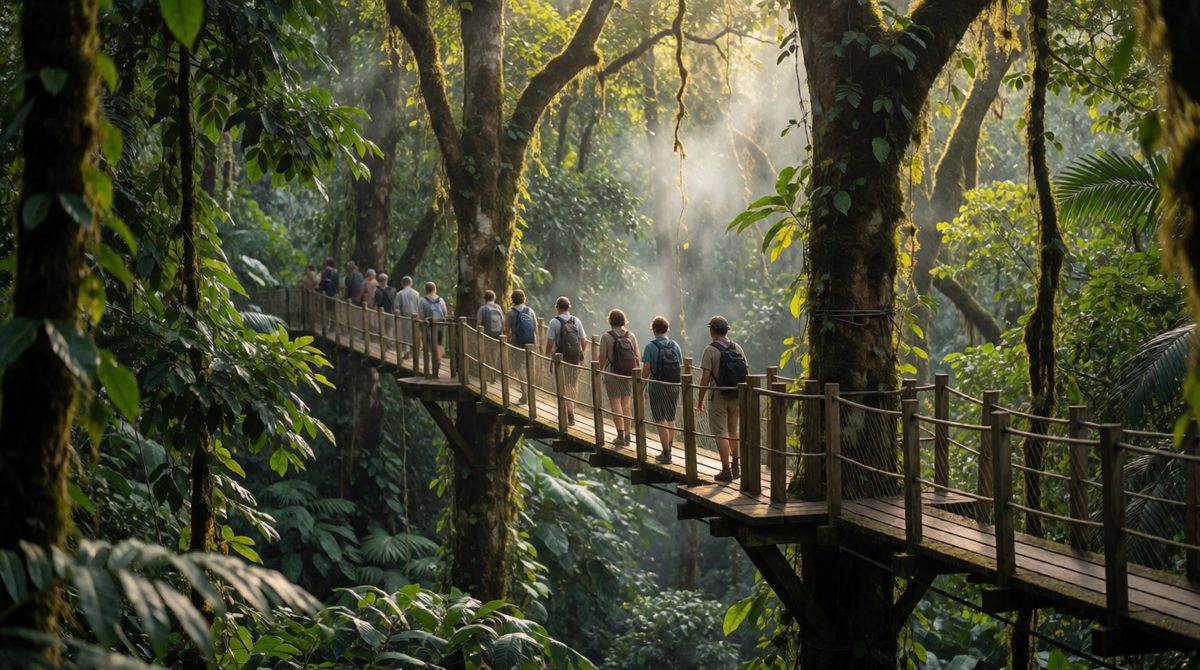
Ecotourism earns money from the forest while keeping the trees standing
Ecotourism brings visitors to see the forest without harming it. Groups are small, visitors stay in simple lodges, and guides are often local people. The money that visitors spend pays for conservation and gives local people a reason to keep the forest standing, because a living forest earns more than a cleared one.
Costa Rica in Central America is a well-known example of a country where visitors travel to see rainforest wildlife in national parks.
Jobs for guides, drivers and lodge workers. Income that pays for protecting the forest. Visitors learn why the forest matters.
Flights release carbon dioxide. Too many visitors can cause litter, noise, trampled paths and stressed wildlife. Some profits may go to companies outside the area.
Tropical hardwoods such as mahogany and teak are sold around the world for furniture and flooring. Countries that buy the timber and countries that sell it can agree rules together. These are called international agreements.
Alongside these agreements, there are separate certification schemes such as the Forest Stewardship Council (FSC). Its label tells shoppers that the wood came from a well-managed forest.
Strengths: the rules apply across many countries, and shoppers can choose responsible products.
Weaknesses: agreements are hard to enforce, and illegal timber can be sold with false papers. Countries may sign but not act. Cheaper uncertified wood is still easy to find.
Many poorer countries owe large sums of money to richer countries and banks. Paying the interest can force them to earn money fast, and one quick way is to sell timber, clear land for cattle or mine minerals from the forest.
Debt reduction breaks this link. A country has part of its debt cancelled, and in return it agrees to spend that money on protecting its forest. This is sometimes called a debt-for-nature swap.
Strengths: it gives a government money and a reason to protect the forest, and it takes pressure off the land.
Weaknesses: only some countries are offered deals, and the government must keep its promise. Protecting the forest may not bring the quick income that the country needs.
Writing that selective logging stops logging. It does not, it only takes some trees. Another mistake is saying ecotourism has no negative impacts. Always give a benefit and a problem. Do not just say a strategy is good: explain how it helps the forest last.
(a) Describe what is meant by selective logging. [2 marks]
(b) Explain how ecotourism can help to manage a tropical rainforest sustainably. [4 marks]
(a) Only some mature trees are cut down (1) and the rest of the forest is left standing so it can recover (1).
(b) Visitors pay to see the forest, which brings income to local people (1). This gives them jobs as guides and lodge workers, so they do not need to clear the forest to earn money (1). Some of the money pays for conservation such as park rangers (1). Visitors also learn why the forest is valuable, so more people want to protect it (1).
For an explain question, link each point with a word like because, so or which means. Each link earns a separate mark, so a list of benefits is not enough.