Hot deserts: an optional topic
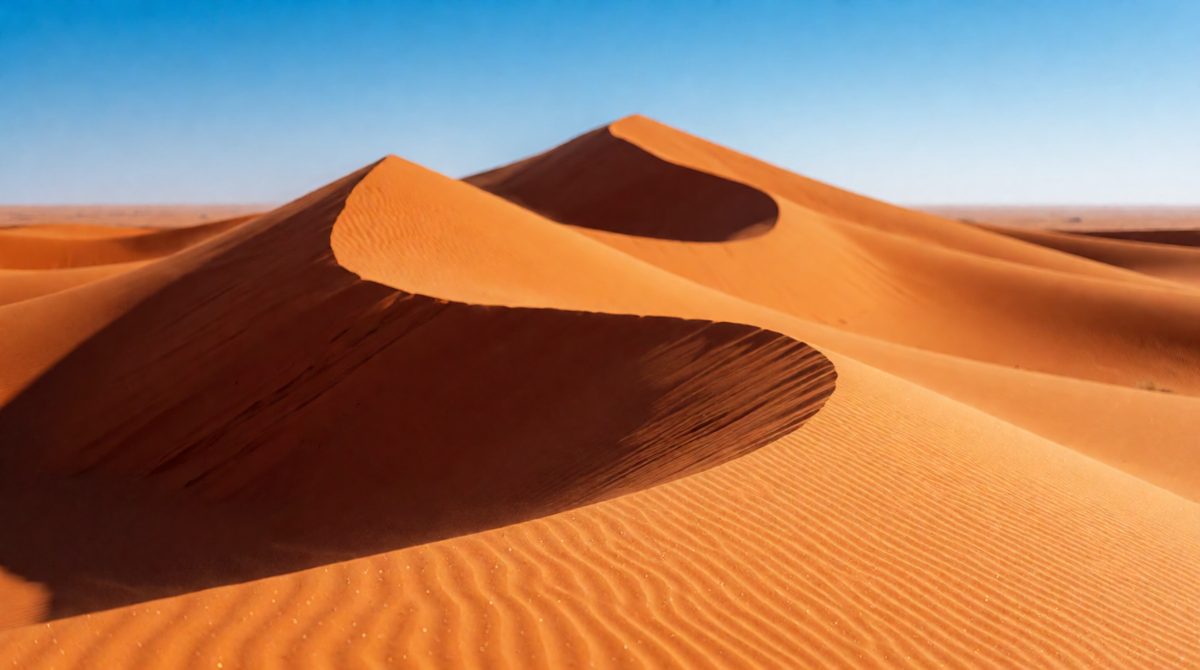
Hot deserts get very little rain and can be scorching by day but cold at night
In the Living World unit, AQA students study either hot deserts or cold environments. This lesson and the next three cover hot deserts. If your class does cold environments, skip ahead to that part of the course.
A hot desert is an ecosystem with very little rain and very high temperatures. It is not always sandy. Many deserts are rocky or stony. What makes a place a desert is a lack of water.
Key terms:
- Hot desert: a hot, dry ecosystem that receives very little rainfall.
- Evaporation: when liquid water turns into water vapour and rises into the air.
- Interdependent: depending on each other, so a change in one part affects the others.
Where are hot deserts?
Hot deserts are found in bands on either side of the equator, roughly between 15 and 30 degrees north and south. Look in an atlas and you will find them in:
- North Africa and the Middle East (the Sahara and the Arabian Desert)
- Southern Africa (the Kalahari and the Namib)
- Australia (the Great Sandy and Great Victoria deserts)
- South America (the Atacama, on the west coast of Chile and Peru)
- North America (the Mojave and Sonoran deserts)
Many of them sit close to the Tropics of Cancer and Capricorn. The reason is high pressure. Air sinks over these latitudes, so it warms up and clouds do not form. You met this in the lesson on global atmospheric circulation.
The climate of a hot desert
☀ Temperature
It is very hot in the day, often 40 degrees C or more in summer. Skies are clear, so the Sun beats down. At night the heat escapes quickly because there is no cloud to trap it, and temperatures can fall close to freezing. This big gap between day and night is called a large daily temperature range.
🌧 Rainfall
Deserts get less than 250 mm of rain a year. Rain is also unreliable. There may be no rain for years, then one short, heavy storm. The water runs off the hard, dry ground and can cause flash floods.
Evaporation is very high because of the heat, so even when rain falls, much of it is lost quickly. Water is the main thing that is missing in a desert.
Desert soils
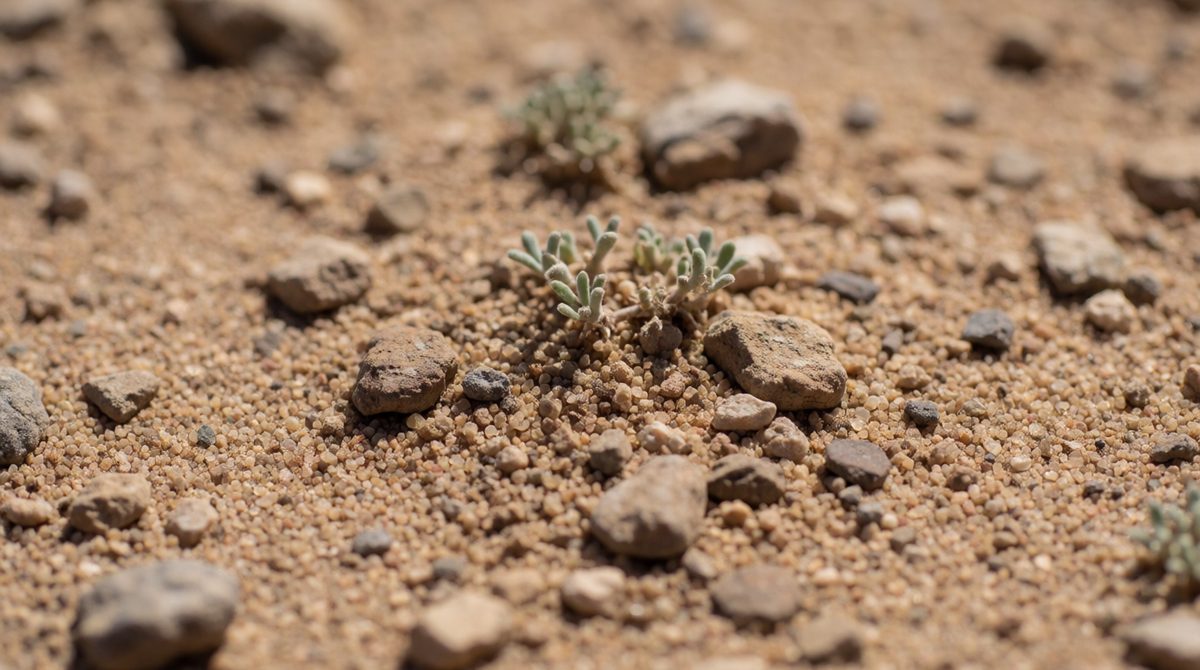
Desert soils are dry and sandy with little organic matter
Desert soils are usually sandy or stony, and often thin. They have these features:
- Coarse and dry: they have large particles, so water drains straight through.
- Low in nutrients: there are few plants, so very little dead material rots down to feed the soil.
- Often salty: when water evaporates in the heat, it leaves salts behind near the surface.
Compare this with the rainforest, where heavy rain leaches nutrients away. In a desert there is too little rain for leaching. The problem is that there is hardly any dead plant material to start with.
Everything depends on everything else
The parts of a hot desert are interdependent. Change one and the others change too. Follow the chain:
☀ Climate and water
High pressure means little rain. Heat means fast evaporation. Water is scarce and often found only underground or at an oasis (a place where water reaches the surface).
🌱 Soils and plants
With little water, few plants can grow. Few plants means little dead material, so soils stay poor. Poor soils then make it even harder for plants to survive.
🐫 Animals and people
Animals rely on the few plants and the water holes. People rely on the same water, and on animals such as camels. Where water runs out, people and animals must move on.
Here is one example. If rain fails for a year, plants die and the soil is no longer held together by roots. The wind can blow it away. Animals that ate the plants must travel or die. Local herders then have less food for their goats and have to move too. One change in the climate spreads through the whole system.
Common mistakes
Do not say that all deserts are sandy, or that deserts are hot all the time. Many are rocky, and nights can be very cold. Also, do not say there is no rain at all. Deserts have low and unreliable rainfall, not none.
Exam-style question
(a) Describe the climate of a hot desert. [3 marks]
(b) Explain how the climate of a hot desert affects its soils and plants. [4 marks]
Model answer
(a) Rainfall is very low, less than 250 mm a year (1). Days are very hot, often over 40 degrees C (1). Nights are much colder, so the daily temperature range is large (1).
(b) Low rainfall means little water is available for plants (1), so few plants can grow and the ground has little vegetation (1). Few plants means little dead material to rot down, so the soil is low in nutrients (1). Heat causes high evaporation, which leaves salts in the soil and makes it harder for plants to grow (1).
Exam tip
In a four mark "explain" question, link your points with "so" or "because". Climate leads to water, which leads to soils, which leads to plants.