Hot Deserts » Desertification
What you'll learn this session
Study time: 30 minutes
AQA spec: 3.1.2.3
- What desertification is and which areas are at risk
- Six causes: climate change, population growth, removal of fuel wood, overgrazing, over-cultivation and soil erosion
- Strategies to reduce the risk: water and soil management, tree planting and appropriate technology
🔒 Unlock Full Course Content
Sign up to access the complete lesson and track your progress!
Unlock This CourseWhat is desertification?
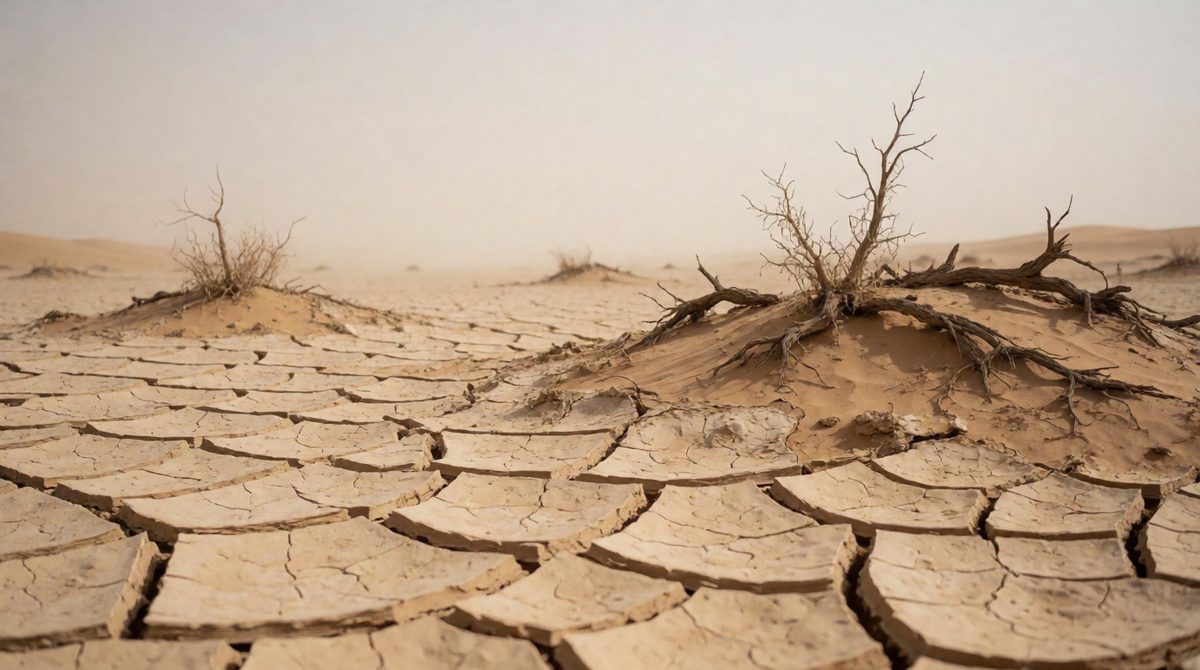
Desertification turns dry land into desert, through things like overgrazing and climate change
Hot deserts are not fixed in size. Their edges can creep outwards when the land next to them is damaged. This is called desertification. The land becomes drier, the plants die and the soil blows away, until the area looks like desert.
The areas at risk are on the fringe (the edge) of hot deserts. These places are already dry, with low and unreliable rainfall. They are not true desert, but they are close to it, so a small change can push them over the edge. A well-known example is the Sahel, the strip of land along the southern edge of the Sahara.
Key terms:
- Desertification: the process by which land on the edge of a desert becomes more like desert, drier and less able to grow plants.
- Fringe: the edge of a desert, where the land is dry but not yet true desert.
Causes of desertification
Desertification is caused by a mix of natural changes and human activity. Most of the time, people and climate work together to make it worse.
1. Climate change
Higher temperatures mean more water evaporates from the soil. In some fringe areas, rainfall is also falling or becoming less reliable. Longer droughts kill plants, and without plants the soil is left bare.
2. Population growth
More people need more food, water and fuel. Fringe areas are often used by fast-growing populations, and the land has to support more people than before. The extra demand makes fuel wood removal, overgrazing and over-cultivation worse.
3. Removal of fuel wood
Many families in these areas cook and heat using wood. Trees and bushes are cut down faster than they can grow back. Tree roots hold the soil together and leaves shade the ground, so when the trees go the soil dries out and is easily blown away.
4. Overgrazing
Overgrazing means too many animals feeding on the land. Goats, sheep and cattle eat the plants down to the roots. The plants cannot recover, and the animals' hooves pack down the bare soil.
5. Over-cultivation
Over-cultivation means growing crops on the same land too often, without giving it time to rest. The crops use up the nutrients in the soil. The soil becomes weak and crops fail, so more land is cleared and the damage spreads.
6. Soil erosion
Once the plants have gone, the bare soil has nothing to protect it. Strong winds blow the dry topsoil away, and sudden heavy rain washes it off the land. Topsoil is the most fertile layer, so losing it makes it very hard for plants to grow again.
How the causes link together
The causes feed each other in a cycle. A growing population cuts more trees and keeps more animals. The plants vanish, the soil is eroded, and crops fail. Hungry people then clear more land, and the cycle starts again. A drought from climate change makes every step of this cycle quicker.
Strategies to reduce the risk
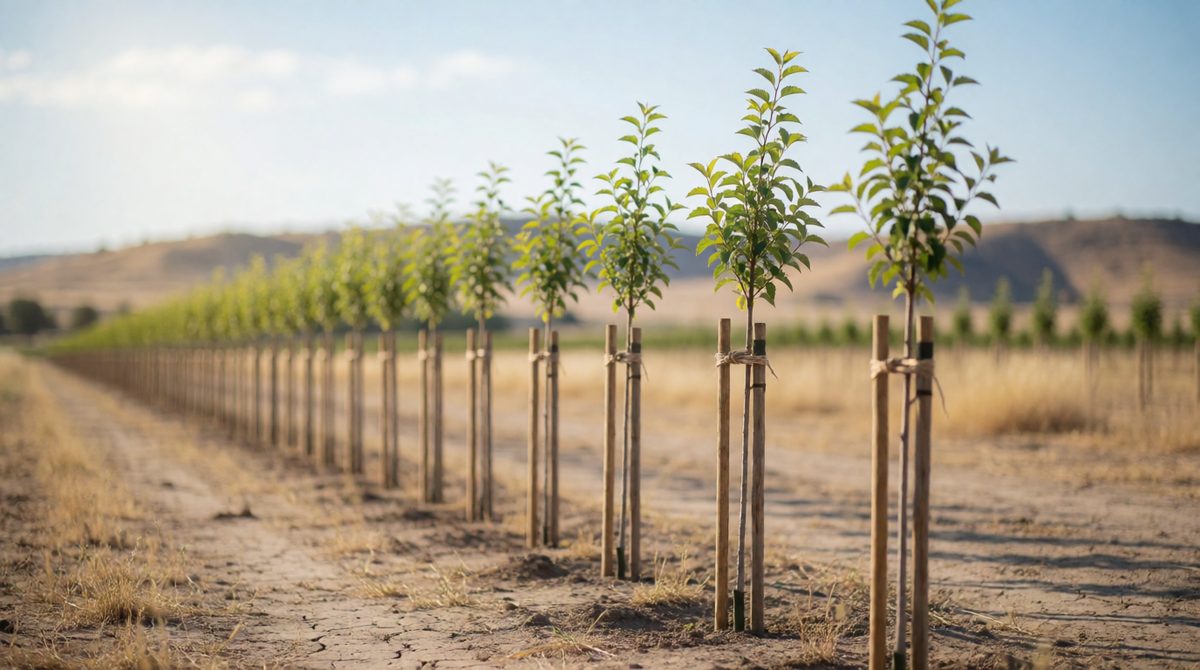
Planting trees helps hold soil together and slow desertification
Desertification can be slowed or even reversed. The strategies below work best when local people are involved and they are cheap enough for poor farmers to use.
💧 Water management
Catching and storing the little rain that falls. Farmers build small walls of stone across the slope, following the contour, to slow the water running off the land so it soaks in. Water can also be collected in tanks and pits and used carefully.
🌾 Soil management
Looking after the soil so it stays fertile. Farmers can add manure, rotate crops, let fields rest and leave plant stalks on the ground to hold the soil in place.
🌳 Tree planting
Trees act as rows that shelter the soil from the wind, shade the soil and their roots bind it together. They also give people fuel wood, food and animal feed.
Appropriate technology
Appropriate technology means simple, low-cost tools that suit local people, skills and money. It can be built, used and repaired locally, without expensive machines or outside experts.
- Fuel-efficient stoves: these use less wood for cooking, so fewer trees are cut down.
- Drip irrigation: small pipes or containers drip water straight to the roots of crops, so very little is wasted.
- Hand-dug wells and simple pumps: these give a local water supply that people can maintain themselves.
Worked example
Question: how does a farmer's stone line reduce desertification? Answer: the stone line slows the water running down the slope (1). More water soaks into the soil (1) and soil and seeds are trapped behind the stones (1), so plants can grow again and hold the soil together (1).
Common mistakes
Students often say that desertification is "the desert growing" because of climate change alone. Give the human causes as well, such as overgrazing and removal of fuel wood. Also, do not mix up overgrazing (too many animals) with over-cultivation (growing crops on the same land too often).
Exam-style question
(a) Explain two ways in which overgrazing can lead to desertification. [4 marks]
(b) Describe one strategy that could be used to reduce the risk of desertification. [3 marks]
Model answer
(a) Animals eat the plants down to the roots (1) so the plants die and the soil is left bare (1). Their hooves pack the soil down (1) so water runs off instead of soaking in and the soil dries out and is eroded by wind (1).
(b) Tree planting (1). Trees shelter the soil from the wind and their roots hold the soil together (1), which reduces soil erosion and also gives local people fuel wood (1).
Exam tip
For "explain" questions, join your points with a linking word such as "so" or "because". Each link between cause and result earns a mark.