Cold environments: an optional topic
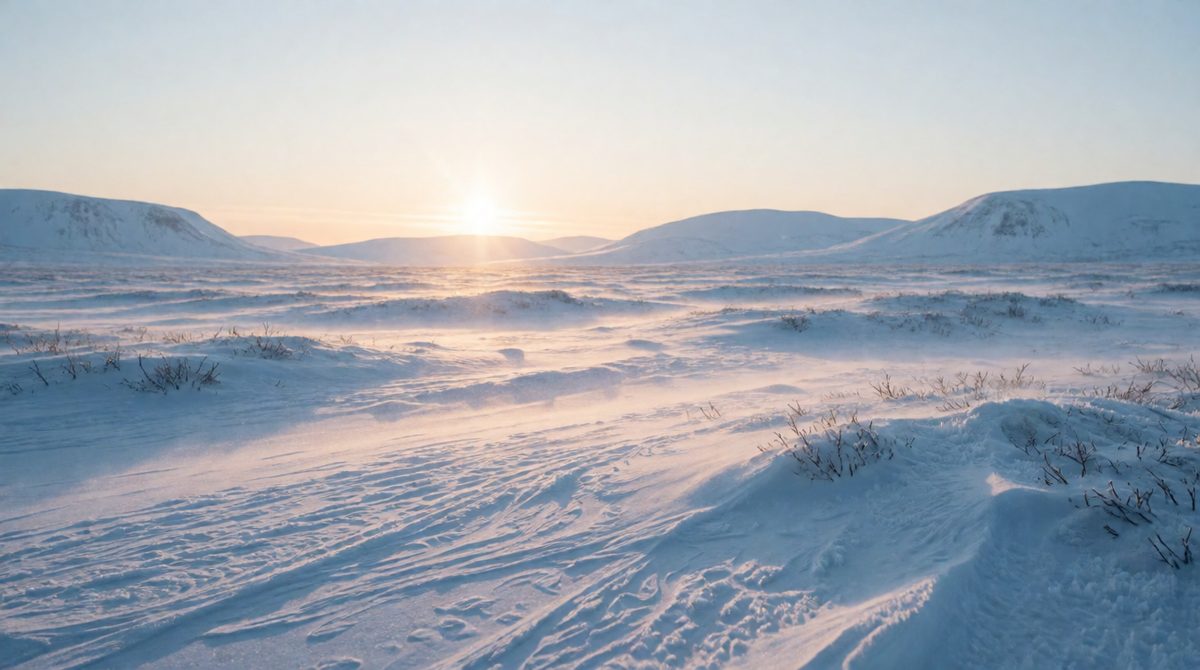
Cold environments have long freezing winters and frozen ground called permafrost
In the Living World unit, AQA students study either hot deserts or cold environments. This lesson and the next three cover cold environments. If your class does hot deserts, you can skip this part of the course.
Cold environments are places where it is cold for most of the year. There are two main types: polar environments and tundra. They look different, but they share many features.
Key terms:
- Polar environment: a very cold area around the North and South Poles, often covered by ice and snow.
- Tundra: a cold, treeless environment found south of the polar ice in the northern hemisphere.
- Permafrost: ground that stays frozen all year round.
- Active layer: the top layer of soil that thaws in summer, above the permafrost.
- Tree line: the point beyond which it is too cold for trees to grow.
Where are cold environments?
Cold environments are found at high latitudes, close to the poles. You met latitude in the lesson on global ecosystems.
- Polar environments include Antarctica in the south, and the Arctic Ocean, Greenland and parts of the far north of Canada and Russia in the north.
- Tundra forms a belt across the far north of Alaska, Canada, Scandinavia and Russia (Siberia), mostly north of the tree line.
Some cold environments are also found high up in mountains, where the air is cold because of the height. This lesson focuses on the polar and tundra areas near the poles.
The climate of a cold environment
❄ Temperature
Winters are long and extremely cold, often far below 0 degrees C. In the tundra, summers are short and cool, with temperatures reaching only about 5 to 10 degrees C. In the polar regions it stays below freezing for most or all of the year.
☁ Precipitation
There is very little precipitation, mostly as snow. The air is so cold that it holds very little moisture. Some polar areas receive less rain and snow than many hot deserts, so they are sometimes called polar deserts.
Daylight changes a great deal through the year. Near the poles the Sun may never set in midsummer, giving almost 24 hours of daylight. In midwinter there may be almost 24 hours of darkness. Even in summer the Sun stays low in the sky, so its heat is weak.
Permafrost and soils
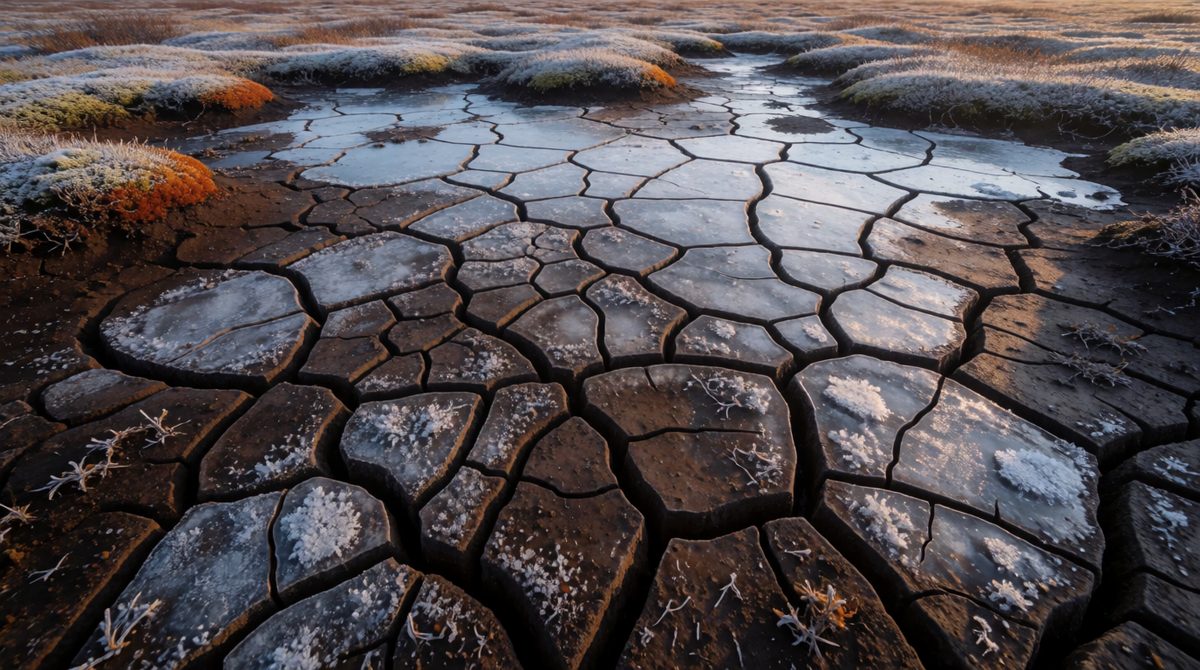
Permafrost is ground that stays frozen all year round
In many cold environments the ground is so cold that the soil and rock below the surface stay frozen all year. This is permafrost. It can be hundreds of metres deep in the coldest places.
In the tundra, the top layer thaws for a few weeks in summer. This is the active layer. It is only a short distance deep, so the soil is thin.
- The permafrost below cannot drain water, so the melted water has nowhere to go. The tundra becomes wet and boggy in summer, with many pools and marshes.
- Cold slows down the breaking down of dead plants, so very little organic matter mixes into the soil. The soil is poor in nutrients.
- For most of the year the soil is frozen solid and plants cannot use it.
In polar areas covered by ice sheets there is hardly any soil at all.
Plants, animals and people
Plants. The tundra has no trees. The ground is frozen and the growing season is only about two or three months long. Plants are small and low, such as mosses, lichens, grasses, sedges and tiny shrubs. In the ice-covered polar areas almost nothing grows. You will see how plants cope with this in the next lesson.
Animals. Few animals can survive the whole year. Those found in the Arctic include reindeer (called caribou in North America), Arctic foxes, polar bears and seals. Many birds only visit in the short summer to feed and breed, then fly away. Plant eaters depend on the tundra plants, and meat eaters depend on them in turn.
People. Very few people live in cold environments. Indigenous peoples have lived in the Arctic for thousands of years, such as the Inuit in northern Canada and Greenland and the Sami in northern Scandinavia. Today there are also small numbers of scientists, miners and oil workers, often living in remote settlements and research stations. Antarctica has no permanent population.
Everything is linked
The parts of a cold environment are interdependent. A change in one part causes changes in the others. Here is how the chain works.
❄ Climate
Very cold temperatures keep the ground frozen and the growing season short, and there is little precipitation.
⛰ Permafrost and soil
Frozen ground makes thin, wet, poor soil that few plants can use.
🌿 Plants and animals
Only small plants grow, so animals have little food, and people depend on both.
Now see what happens if the climate warms. The permafrost starts to thaw and the active layer gets deeper. The ground becomes unstable and soft. Buildings, roads and pipelines built on frozen ground can sink and crack. The wetter ground changes which plants can grow, and that changes which animals can find food. People who hunt or herd animals then have to change how they live. One change moves through the whole system.
Worked example
Describe how permafrost affects plants. Answer: Permafrost stops water draining away, so the soil is waterlogged in summer. Only a thin active layer thaws, so roots cannot go deep. The soil is also low in nutrients. Only small, shallow rooted plants can grow.
Common mistakes
Saying the tundra is covered in thick ice. The tundra is mostly frozen ground covered by low plants such as mosses and lichens, with snow in winter. The thick ice sheets are in the polar areas. Also, do not say there is no water. There is plenty of frozen water, but very little precipitation falls.
Exam-style question
(a) State what is meant by permafrost. [1 mark]
(b) Explain how the climate of the tundra affects the plants that grow there. [3 marks]
Model answer
(a) Permafrost is ground that stays frozen all year round. (1)
(b) Winters are very cold and long, so the ground is frozen for most of the year (1). Summers are short, so the growing season is only a few weeks or months (1). Only small, low plants such as mosses and lichens can grow, and no trees can survive (1).
Exam tip
"Explain" needs a link: climate causes the frozen ground, which causes the plants. Use a word such as "so" or "because" in each point.