🏖 Constructive waves
Low and long, with a long wavelength. They break gently, about 6 to 8 times a minute. The swash is strong and the backwash is weak, so material is carried up the beach and left there. They build up beaches.
Sign up to access the complete lesson and track your progress!
Unlock This Course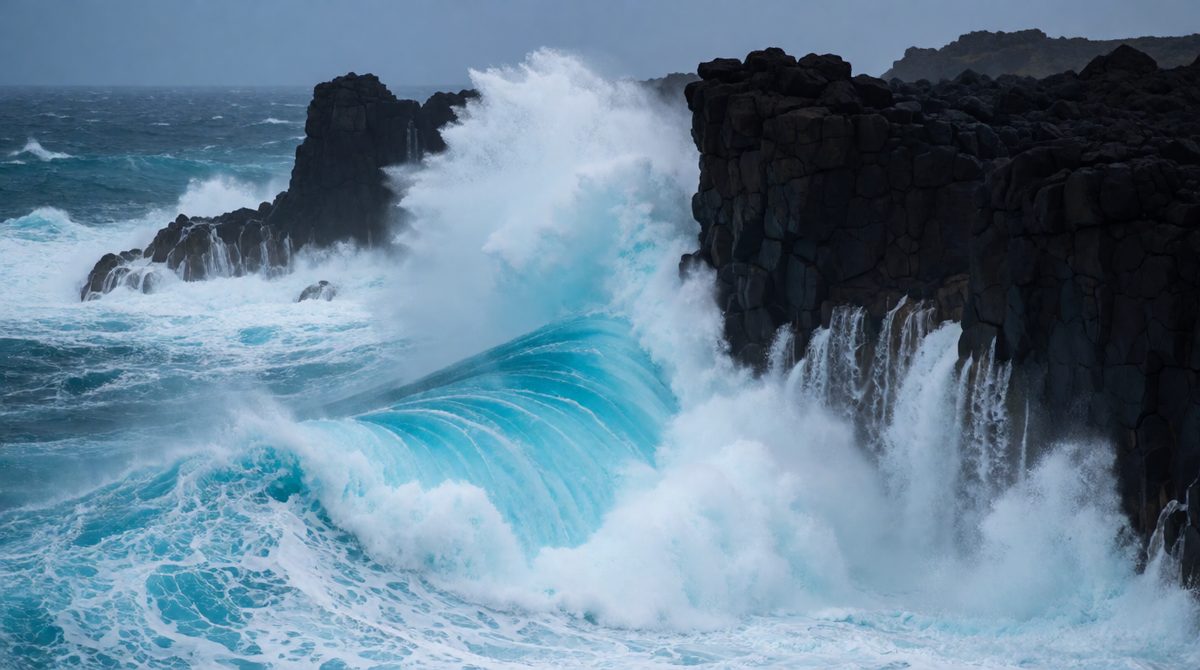
Destructive waves are tall and frequent and wear away the coast
In the Physical Landscapes in the UK section of AQA GCSE Geography you do not study everything. You study two out of three topics: coastal landscapes, river landscapes and glacial landscapes. Check with your teacher which two your class is doing. This lesson starts the coasts topic.
The coast is shaped by a number of physical processes. Waves are the energy behind many of them, so we begin there.
Waves are made by wind blowing over the surface of the sea. The stronger the wind, the longer it blows and the further it blows, the bigger the waves. The distance of open water that the wind blows across is called the fetch. A long fetch means a lot of energy builds up in the waves before they reach the shore.
The UK faces the Atlantic Ocean to the south west. That is a very long fetch, so the south west coast gets large, powerful waves. A coast facing a short stretch of sea gets smaller waves.
Key terms:
Waves do not all behave in the same way. Geographers split them into two types: constructive and destructive.
Low and long, with a long wavelength. They break gently, about 6 to 8 times a minute. The swash is strong and the backwash is weak, so material is carried up the beach and left there. They build up beaches.
High and steep, with a short wavelength. They crash down about 10 to 14 times a minute. The swash is weak and the backwash is strong, so material is dragged back out to sea. They wear away beaches and cliffs.
Constructive = the beach is constructed (built). Destructive = the beach is destroyed. Look at which is stronger, the swash or the backwash.
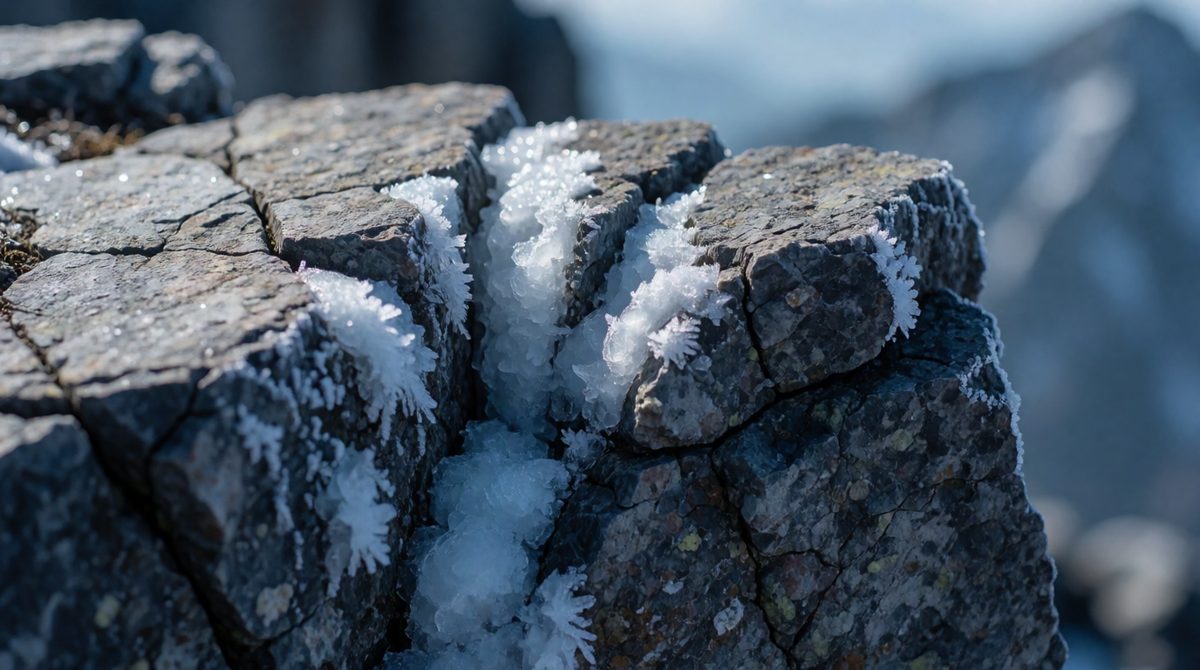
Freeze-thaw weathering splits rock as water in cracks freezes and expands
Weathering is the breakdown of rock where it is, without the rock being moved away. Changes in temperature and the chemistry of rainwater do it. It is not the same as erosion, which you will meet in the next lesson. On the coast, cliffs are weakened by two types of weathering.
Key terms:
Freeze-thaw happens when temperatures swing above and below 0°C. It works in five steps:
Rain water is slightly acidic because carbon dioxide from the air dissolves in it. Some rocks, such as limestone and chalk, are made of calcium carbonate. The weak acid reacts with the calcium carbonate and dissolves it. This is called carbonation. Over time the rock is weakened and small amounts are washed away. It works best on cliffs made of limestone or chalk.
Mass movement is the downhill movement of material under the pull of gravity. Weathering weakens a cliff, then gravity does the rest. Mass movement is most likely when rain soaks into the cliff. The water makes the cliff heavier and also makes the surface slippery, so material slides more easily. Waves that cut away the bottom of the cliff make it even less stable.
Key terms:
Rock moves in one block along a flat surface, such as a crack that slopes towards the sea. It happens on cliffs where the layers of rock tilt downhill. It leaves behind a straight, smooth slope.
Common on soft rock like clay. Rain soaks the clay and makes it heavy. The cliff top slips down along a curved surface and the cliff looks stepped, with a rounded scar at the top.
Happens on steep, hard cliffs. Freeze-thaw weathering loosens pieces of rock, which fall to the bottom. A pile of broken rock called scree builds up at the foot of the cliff.
Question: A cliff of soft clay has a rounded scar at the top and a curved, stepped slope. Which mass movement made it?
Answer: Slumping. Curved surface plus soft clay soaked by rain points to slumping, not sliding, which follows a flat surface.
Mixing up weathering and erosion. Weathering breaks rock down where it stands, erosion carries it away. Another mistake is saying freeze-thaw happens in the sea: it needs air temperatures that go above and below freezing. Also, do not say slumping and sliding are the same. Slumping is curved and rotational, sliding is along a flat line.
(a) Describe one difference between constructive and destructive waves. [2 marks]
(b) Explain how freeze-thaw weathering can lead to a rock fall on a cliff. [4 marks]
(a) Constructive waves are low and gentle with a strong swash (1), while destructive waves are high and steep with a strong backwash (1).
(b) Water gets into cracks in the cliff (1). When it freezes it expands and makes the crack wider (1). When the ice melts the water gets deeper into the crack, and this repeats many times (1). Eventually the rock is so weak that pieces break off and fall down the cliff face as a rock fall (1).
On a 4 mark explain question, write a chain of linked steps using words like "so", "which" and "this leads to". One mark per step in the chain.