🌊 Hydraulic power
Waves crash into a cliff and force water and air into cracks in the rock. The air is squeezed and the pressure builds. Done over and over, the crack widens and pieces of rock break off.
Sign up to access the complete lesson and track your progress!
Unlock This Course
Longshore drift moves material along the beach in a zigzag
Waves never stop working. They wear the coast away, carry the material along the shore and then drop it somewhere else. These three jobs are called erosion, transportation and deposition. This lesson explains how each one works.
Key terms:
Erosion is different from weathering. Weathering breaks rock down where it stands. Erosion needs a moving force, here the waves, to take material away.
The spec asks you to know three ways that waves erode the coast. Destructive waves, which you met in the last lesson, are the most powerful at doing this, because their strong backwash drags material away from the shore.
Waves crash into a cliff and force water and air into cracks in the rock. The air is squeezed and the pressure builds. Done over and over, the crack widens and pieces of rock break off.
Waves pick up pebbles and sand and hurl them at the cliff. This works like sandpaper, scraping and chipping the rock.
The stones and pebbles carried by the waves knock against each other and against the sea bed. They break into smaller pieces and their edges wear smooth. Over time, sharp rocks become small, rounded pebbles and then sand.
Notice that attrition wears down the load the sea is carrying. It does not wear away the cliff itself. Hydraulic power and abrasion attack the cliff.
Hydraulic = Hit with water and air. Abrasion = Attack with rocks, like sandpaper. Attrition = rocks get worn down, small and round.
Large, powerful waves erode more than small ones. Waves are bigger when the fetch is long and the wind is strong. So a coast facing a long stretch of open sea is hit by more powerful waves than a sheltered one.
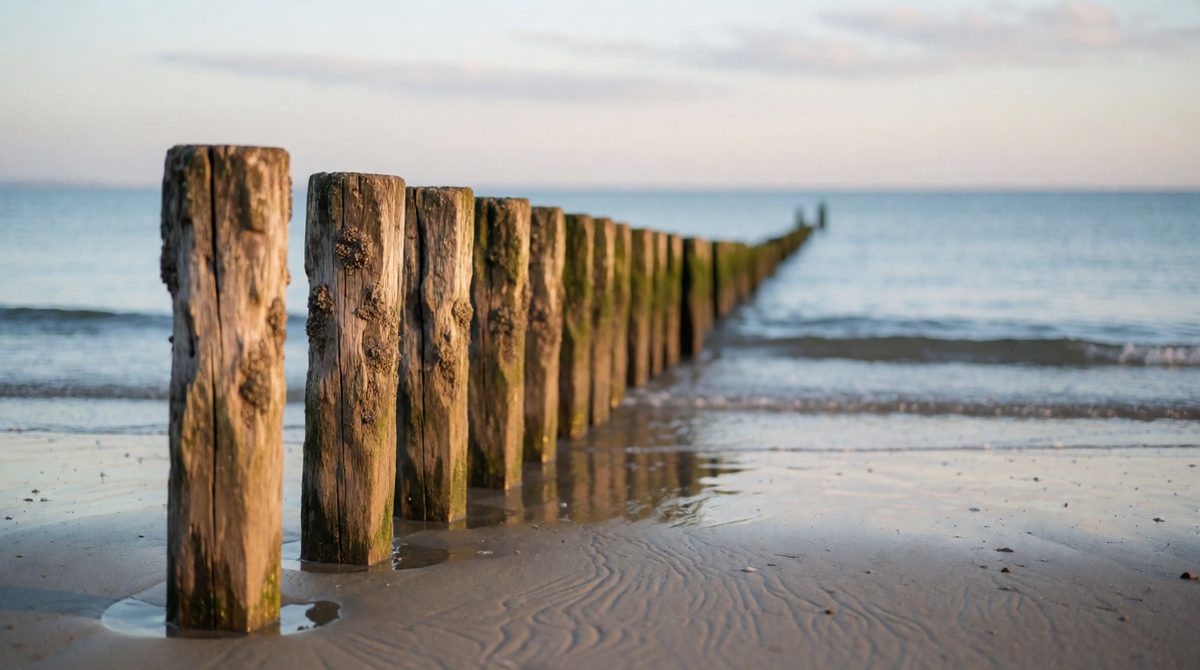
Groynes trap sand carried along the coast by longshore drift
Once material has been eroded, the sea moves it. On a beach, the main way it moves is called longshore drift.
Key terms:
Waves usually arrive at an angle, because they follow the prevailing wind. Here is what happens, step by step:
The overall movement is sideways along the coast, in the same direction as the waves are travelling. Over many years, large amounts of sediment can be moved a long way along the shore.
A strong answer uses the key words in order. "Waves approach the beach at an angle because of the prevailing wind. The swash carries material up the beach at an angle. The backwash moves it back down at right angles, because of gravity. This repeats, so material moves along the beach in a zigzag."
The sea can only carry sediment while it has enough energy. When the waves lose energy, the sediment is dropped. Sediment is deposited in coastal areas for these reasons:
Gentle waves have a weak backwash, so they cannot drag material back out to sea. The swash drops its load on the beach and it stays there.
In a sheltered bay, or where a river meets the sea, the water is calm. The waves are weak, so the sea slows down and drops its sediment.
Where there is plenty of sediment from eroded cliffs or from rivers, the sea cannot carry it all. The extra is dropped.
Deposition builds up beaches and other landforms. You will study how these form in the lesson Coastal Deposition Landforms and the Dorset Coast.
These three jobs link up. Erosion supplies sediment. Attrition makes that sediment smaller and rounder. Longshore drift carries it along the coast. Deposition drops it where the waves are weak. Much of the sand on one beach may have been eroded from a cliff somewhere else.
1. Mixing up attrition and abrasion. Abrasion is rocks hitting the cliff. Attrition is rocks hitting each other.
2. Saying longshore drift moves material straight along the beach. It moves in a zigzag.
3. Saying the backwash goes back at an angle. It goes straight down the slope because of gravity.
4. Writing "erosion" when the question asks about transportation or deposition.
(a) Name one process of coastal erosion. [1 mark]
(b) Explain how longshore drift moves sediment along a beach. [4 marks]
(c) Explain why sediment is deposited in a sheltered bay. [2 marks]
(a) Abrasion, or hydraulic power, or attrition. (1)
(b) Waves approach the beach at an angle because of the prevailing wind (1). The swash carries sediment up the beach at an angle (1). The backwash flows straight back down the beach, at right angles, because of gravity (1). This repeats, so sediment moves along the beach in a zigzag (1).
(c) The waves are weak in a sheltered bay, so they have little energy (1). Without enough energy the sea cannot carry its load, so the sediment is dropped (1).
For a 4 mark "explain" question on longshore drift, write four clear steps in order, using the words swash, backwash, angle and zigzag. A labelled diagram can earn marks too.