🏖 Concordant coast
The bands of rock run parallel to the coast. A strip of hard rock acts like a wall along the shore and protects the softer rock behind it. The coastline is fairly straight and smooth.
Sign up to access the complete lesson and track your progress!
Unlock This Course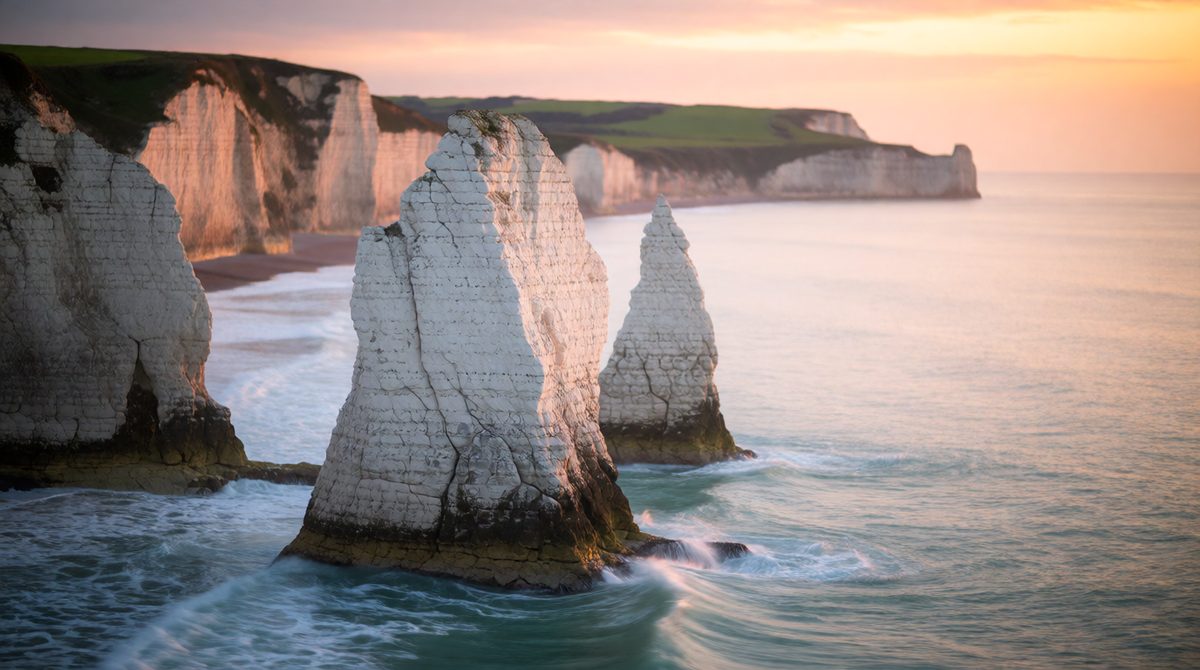
Stacks form when waves erode a headland through caves and arches
Waves do not attack every part of the coast in the same way. The shape of a coastline depends on two things: the rock type and the geological structure. Both decide how quickly the sea can wear the land away.
Key terms:
Remember that waves erode by hydraulic power, abrasion and attrition. Soft rock gives way to these processes much faster than hard rock. That difference is the key to every landform in this lesson. Where the rock is soft, the land retreats quickly. Where it is hard, the land stands out and the coast changes slowly.
Rock layers can run in bands. The way these bands meet the sea gives two kinds of coastline.
The bands of rock run parallel to the coast. A strip of hard rock acts like a wall along the shore and protects the softer rock behind it. The coastline is fairly straight and smooth.
The bands of rock run at right angles to the coast. Hard and soft rock take turns meeting the sea. The coastline is uneven, with headlands and bays.
Students mix up the two words. Think: concordant means "in agreement", so the rock and the coast agree and run the same way. Discordant means they clash and cross each other.
Headlands and bays form on a discordant coast, where bands of hard and soft rock lie side by side.
How they form:
Flamborough Head in Yorkshire is a headland made of chalk. Even a headland is not safe forever. Over time the sea wears it away, which leads us to the next landforms.
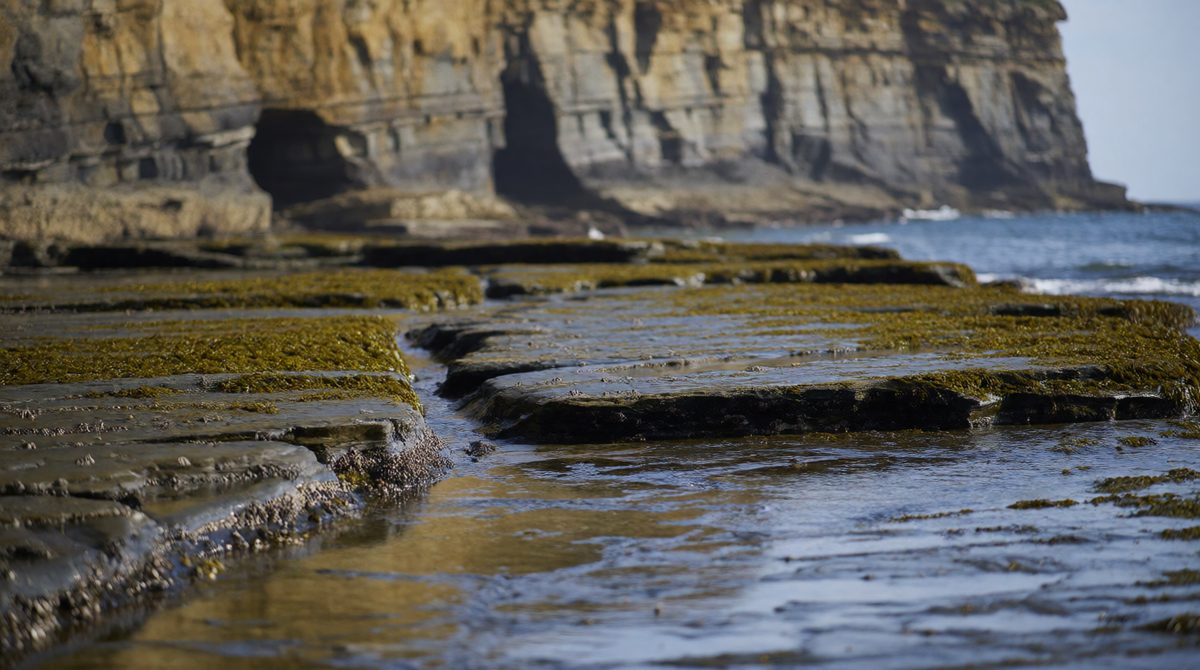
Wave-cut platforms are left behind as cliffs retreat inland
Cliffs and wave cut platforms form where waves break against the foot of a steep coast.
Key terms:
How they form:
Cliffs of chalk, such as Beachy Head in East Sussex, are tall and steep because chalk is a hard rock. Soft rock cliffs are usually lower and more rounded, because they collapse and wear back more quickly.
Describe how a wave cut platform forms.
Waves erode the bottom of the cliff to make a notch (1). The cliff above is unsupported and collapses (1). The cliff retreats and leaves a flat platform at its foot (1).
These landforms form on a headland, where a crack or weak point in the rock is attacked by waves.
Key terms:
Waves attack a crack in the headland. Hydraulic power and abrasion widen the crack into a cave.
The cave gets deeper until it breaks through the headland. This makes an arch. Weathering also wears away the roof.
The arch roof becomes thin and collapses. A tall stack is left. The stack is later worn down into a stump.
The Needles off the Isle of Wight are a row of chalk stacks. Remember that the order is always: crack, cave, arch, stack, stump.
Do not say a stack "falls into the sea" in one go. It is worn down slowly by waves and weathering. Also, an arch does not form from a stack. The order is the other way round.
Rock type and structure set the scene. Soft rock wears back fast and hard rock stands out. On a discordant coast the result is headlands and bays. Cliffs retreat and leave wave cut platforms. Caves, arches and stacks form on the headlands. Each landform is a stage in the same story of the sea wearing the land away.
(a) Explain how the geological structure of a coast can affect its shape. [2 marks]
(b) Describe and explain how a stack forms. [4 marks]
(a) On a discordant coast the bands of hard and soft rock run at right angles to the sea (1). The soft rock erodes faster, so bays form and the hard rock is left as headlands (1).
(b) Waves attack a crack in a headland (1). Hydraulic power and abrasion widen it into a cave (1). The cave is eroded through the headland to form an arch (1). The roof of the arch is weakened and collapses, leaving a tall stack (1).
In a "how does it form" question, write the stages in order and name a process at each stage. Words like "then" and "eventually" help show the sequence.