☀ Sandy beaches
Made of fine sand. They are wide, flat and gentle in slope. They are found in sheltered bays where the waves are weak.
Sign up to access the complete lesson and track your progress!
Unlock This Course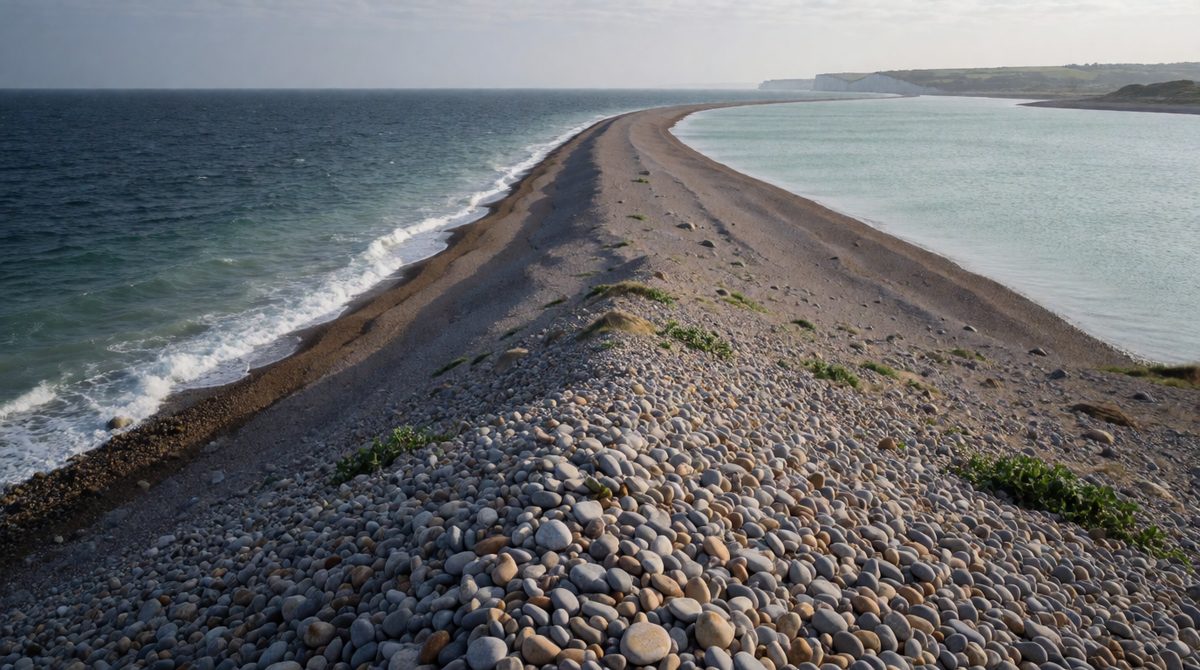
Spits form where the sea drops sediment as the coastline changes direction
Last lesson was about landforms the sea wears away. This lesson is about landforms the sea builds. They form where the sea drops its load of sediment, for example in sheltered bays and where the coastline changes direction. Remember, the dropping of sediment is called deposition.
Key terms:
A beach forms when waves deposit sand and shingle along the shore. Constructive waves are the main builders. Their strong swash carries sediment up the beach and their weak backwash drags very little of it back.
Made of fine sand. They are wide, flat and gentle in slope. They are found in sheltered bays where the waves are weak.
Made of larger pebbles. They are steeper and narrower. They are found where waves are stronger, because only strong waves can move big sediment.
Beaches are never still. Waves and longshore drift keep moving the sediment, so a beach can grow in calm weather and shrink in a storm.
Sand dunes form behind wide sandy beaches. At low tide the sand dries out and the wind blows it up the beach. They form in stages:
The newest dunes are nearest the sea. Dunes further back are older, taller and covered with more plants.
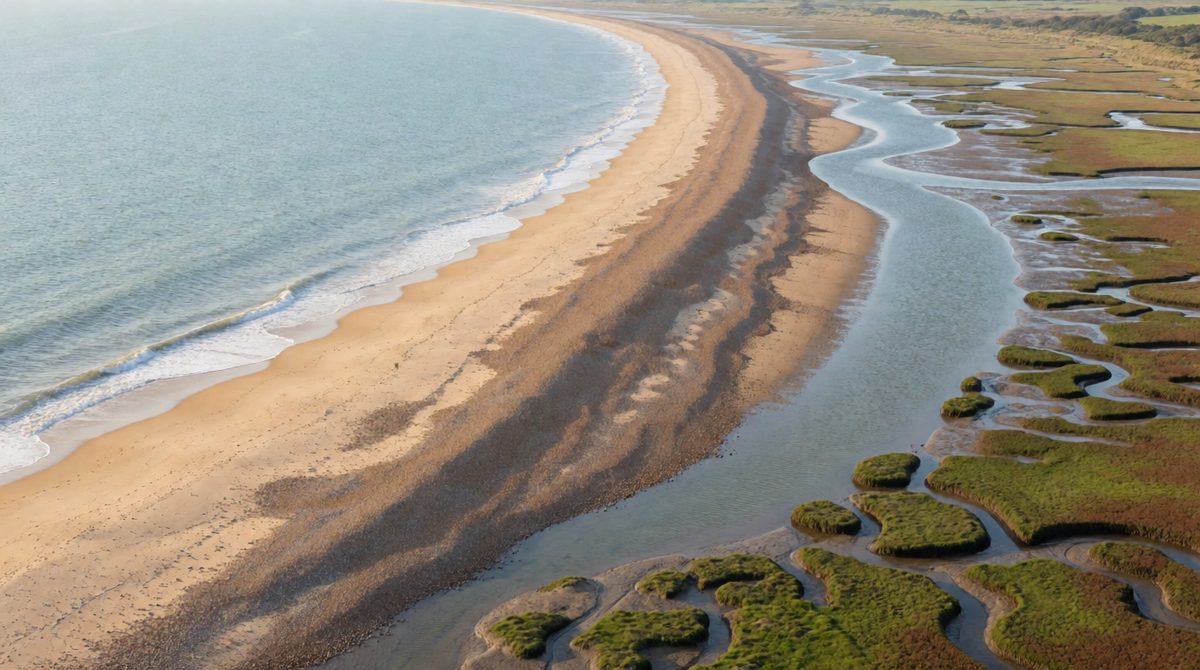
Spits grow where longshore drift carries sediment out into the sea
A spit forms where the coastline suddenly changes direction, such as at a bend in the coast or the mouth of a river. Longshore drift keeps moving sediment along the beach. At the bend, the sediment carries straight on and is deposited in the water beyond the corner.
A famous example is Spurn Head in Yorkshire, which curves across the mouth of the Humber estuary.
A bar forms in the same way as a spit. The difference is that it keeps growing across a bay until it joins two headlands. The bay behind is then sealed off from the sea and becomes a lagoon. Chesil Beach in Dorset is a shingle bar about 29 km long, with the Fleet Lagoon behind it.
Both are built by longshore drift. A spit is joined to land at only one end. A bar is joined at both ends and has a lagoon behind it.
The coast near Swanage in Dorset is a great place to see landforms of both erosion and deposition. Rocks of different strength run in bands that meet the coast at an angle, so this is a discordant coast. The harder rocks (chalk and limestone) are left sticking out and the soft clays and sands have been worn back into a bay.
Old Harry Rocks are chalk stacks at Handfast Point, a headland east of Swanage. The waves attacked cracks in the chalk, making caves and arches. The roofs collapsed to leave stacks. Old Harry's Wife was a stack that fell and is now a stump.
Swanage Bay is a curved bay cut into soft clays and sands, with harder rock headlands either side: chalk at Ballard Point and limestone at Peveril Point. Waves in the sheltered bay drop sediment, forming a sandy beach.
Studland Bay has a long sandy beach with sand dunes behind it. Wind blows dry sand off the beach and marram grass helps the dunes to grow.
The chalk cliffs and stacks show erosion. The beaches and dunes show deposition. Put them together and one short stretch of coast shows both processes at work.
Look at a map or photo of Swanage. Name each landform, say whether it is erosion or deposition, then say how it formed. For example: Swanage Bay is a bay, an erosion landform. Soft clay was eroded faster than the harder rock either side, so the sea cut back into it. The sheltered bay then collected sand, making a beach, a deposition landform.
Mixing up spits and bars. Remember a spit has one free end and a bar goes right across. Another mistake is saying sand dunes are made by waves. Waves bring the sand, but the wind builds the dunes. Finally, do not say that erosion makes beaches. Beaches are deposition landforms.
(a) Name one landform of deposition found on the Dorset coast. [1 mark]
(b) Explain how a spit is formed. [4 marks]
(a) A beach (or sand dunes at Studland). (1)
(b) Longshore drift moves sediment along the coast (1). The coastline changes direction, for example at a bend or river mouth (1). Sediment is deposited beyond the bend in the sheltered water (1) and builds up into a long, narrow ridge of sand or shingle joined to the land at one end (1). Wind and waves may curve the end (1). Behind it, salt marsh can form (1). Any four points.
For a four mark explain question, write a short chain of steps: movement, bend, deposition, ridge. Use words like because and so to link each step.