👁 What they look like
Seen from above, the river winds around ridges of land that poke out from each side of the valley. The ridges alternate, left then right, and overlap like the teeth of a zip. The river twists between them.
Sign up to access the complete lesson and track your progress!
Unlock This Course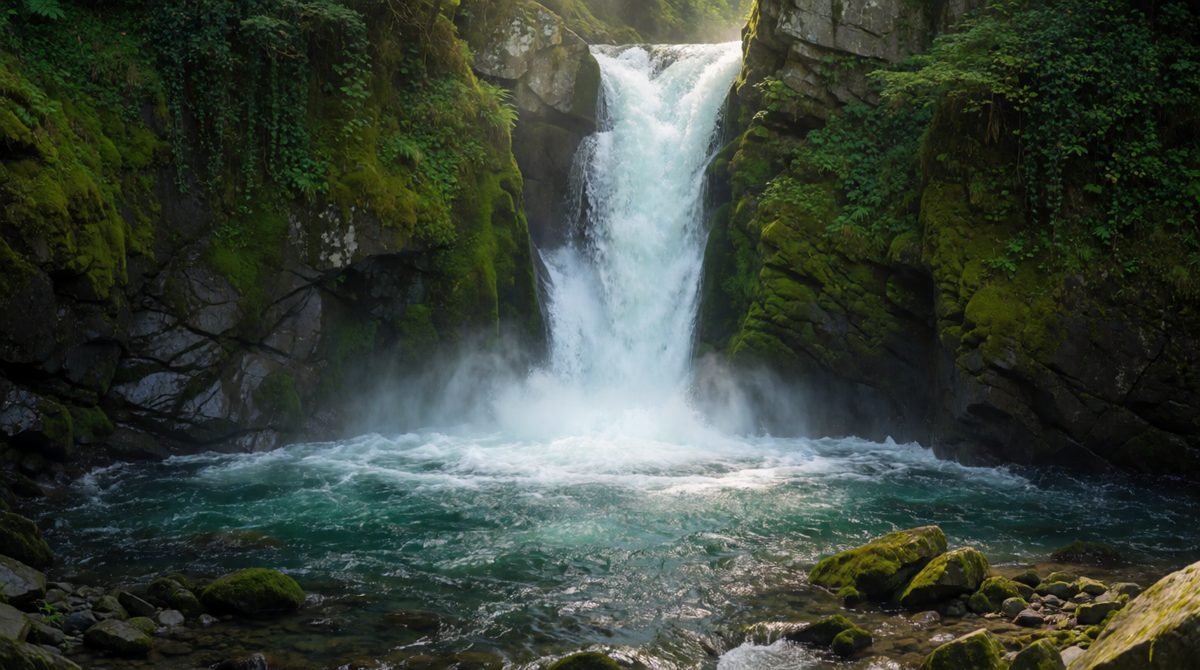
Waterfalls form where a band of hard rock lies over softer rock
Near its source, a river has a steep gradient and cuts downwards. This is vertical erosion, and it makes a steep, V shaped valley. Three landforms of river erosion are on your specification: interlocking spurs, waterfalls and gorges. Each one is the result of the erosion processes you have already met, working on different types of rock.
Key terms:
Seen from above, the river winds around ridges of land that poke out from each side of the valley. The ridges alternate, left then right, and overlap like the teeth of a zip. The river twists between them.
In the upper course, where the valley is steep and narrow. The river is small and has little energy to erode sideways, so it does not cut straight through the ridges.
Here is how they form:
Interlocking spurs are made by vertical erosion. The river goes around the spurs, not through them.
A waterfall forms where a river flows over a band of hard rock that lies on top of a band of softer rock. The two rocks wear away at different speeds. This is differential erosion. The soft rock is eroded faster, and the hard rock is left sticking out.
Here is the formation, step by step:
Each time the overhang collapses, the waterfall moves a little way upstream. We say that the waterfall retreats.
A vertical drop of water, a band of hard rock at the top, softer rock beneath, an overhang and a deep plunge pool at the base.
Say how high it is, what the rock layers are, whether there is an overhang and how big the plunge pool is. A labelled sketch is worth marks.
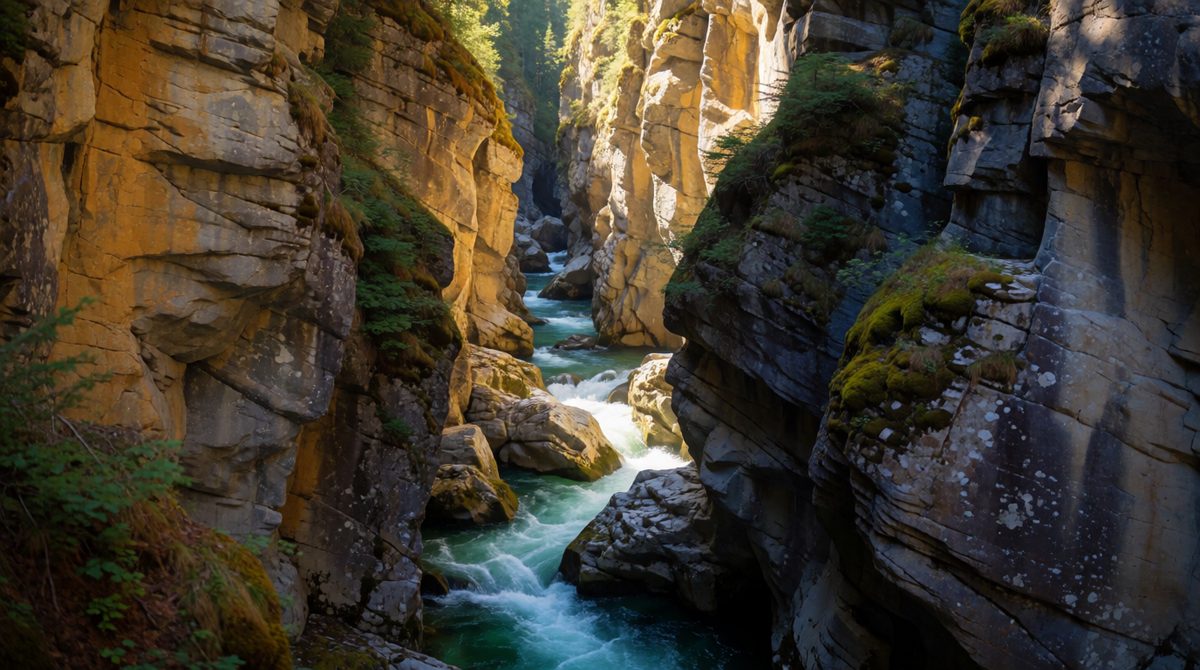
Gorges form as a waterfall retreats upstream over time
A gorge is a steep sided, narrow valley with a rocky floor. It is formed by the retreat of a waterfall.
So a gorge is found downstream of a waterfall. If you stand at the foot of the waterfall and look downstream, you are looking along the gorge that the waterfall has already carved out.
Imagine a river flowing over a layer of hard sandstone resting on soft clay. The clay is eroded more quickly and a step forms. Water falls over it and creates a plunge pool. The pool undercuts the sandstone, which collapses. The waterfall moves upstream, leaving a gorge downstream of it. One process explains both landforms.
Vertical erosion. The river winds around ridges that stick out from alternate sides.
Hard rock over soft rock. Differential erosion makes a step, a plunge pool and an overhang.
Left behind as the waterfall retreats upstream. A steep sided, narrow valley.
1. Saying the hard rock wears away first. It is the soft rock that erodes faster, which is why the hard rock is left behind.
2. Forgetting the plunge pool. It undercuts the hard rock, so it explains the overhang.
3. Saying a gorge forms before the waterfall. The gorge is created by the waterfall as it retreats.
4. Mixing up spurs with the valley. The spurs are the high ridges, and the river is in the gaps between them.
(a) Describe the main features of interlocking spurs. [2 marks]
(b) Explain how a waterfall forms. [4 marks]
(c) Explain how a gorge is linked to a waterfall. [2 marks]
(a) Ridges of land stick out from alternate sides of a V shaped valley (1). They overlap like the teeth of a zip, and the river winds around them (1).
(b) A waterfall forms where hard rock lies on top of softer rock (1). The soft rock is eroded faster, which makes a step (1). Water falls over the step and creates a plunge pool, which undercuts the hard rock (1). The overhang collapses and the waterfall retreats upstream (1).
(c) As the waterfall retreats upstream, it leaves behind a steep sided valley (1). This narrow valley downstream of the waterfall is the gorge (1).
For a 4 mark "explain how" question, write a clear sequence using words like "first", "then" and "eventually". Include the plunge pool and the overhang, as these are the points that score.