🌍 Lower development
Stages 1 and 2. Low income, poor healthcare, poor education and little family planning. Birth rates are high and populations grow fast.
Sign up to access the complete lesson and track your progress!
Unlock This Course
The Demographic Transition Model shows how birth and death rates change as a country develops
As a country develops, its population changes in a pattern. Birth rates and death rates do not stay the same. They change as people get better healthcare, food, education and jobs.
Geographers show this pattern in a graph called the Demographic Transition Model, or DTM. It links the level of development of a country to how fast its population is growing.
Key terms:
You met birth rate, death rate and natural increase in earlier lessons. This lesson shows how they change together.
The DTM graph has a time axis along the bottom and the rates up the side. It has three lines:
Starts high, then falls in the middle of the model.
Starts high, falls first and falls fastest.
Grows most when the gap between the two rates is widest.
The key idea is the gap between the birth rate and the death rate. A wide gap means a large natural increase and a fast-growing population. When the gap is small, the population grows slowly or stays level.
The model has four main stages. Some versions add a fifth.
This is a country with a very low level of development. There is little healthcare, little clean water and not enough food. Disease and famine kill many people, especially babies and children. Families have lots of children because some will not survive and because children can help with work.
Examples: No country is in Stage 1 today. Countries such as the UK were in Stage 1 before the Industrial Revolution. A few small, isolated tribal groups in remote rainforests still fit this pattern.
The death rate falls because development starts to bring improvements:
The birth rate stays high. People are used to large families, there is little family planning, and many parents still want children to work or to look after them when they are old. With births far above deaths, the population rises quickly.
Examples: Low income countries such as Mali and Somalia.
A country has a birth rate of 40 per 1,000 and a death rate of 10 per 1,000.
Natural increase = 40 - 10 = 30 per 1,000. That is 3% a year. This is typical of Stage 2: a big gap and a fast-growing population.
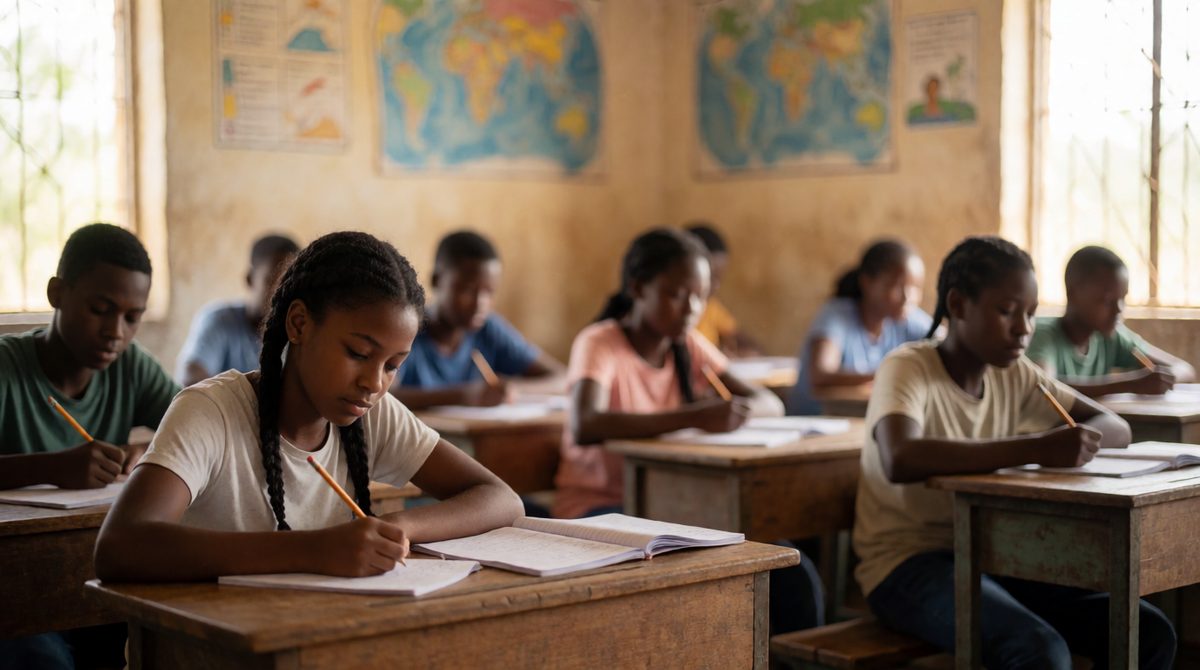
In stage 3 the birth rate starts to fall, often as more girls stay in school
The birth rate falls because:
The population is still growing, but each year it grows by a smaller amount.
Examples: Countries such as Bangladesh and Egypt are often given as examples of Stage 3.
The country is highly developed. Healthcare is good, and most people have access to education and use family planning. Many couples choose to have fewer children, so they can focus on their careers and enjoy a higher standard of living. The birth rate can go up and down a little from year to year.
Examples: High income countries such as the UK and the USA.
Some versions of the model add a fifth stage. The birth rate falls below the death rate, so the total population begins to fall. This happens when there are many older people and few young adults having children.
Examples: Japan and Germany are often used as examples. Both have an ageing population and their total populations have started to fall.
Stage 1: birth rate high, death rate high, natural increase low.
Stage 2: birth rate high, death rate falling, natural increase very high.
Stage 3: birth rate falling, death rate low, natural increase falling.
Stage 4: birth rate low, death rate low, natural increase low.
Stage 5: birth rate below death rate, population falling.
Countries move through the stages as their level of development rises. Here is the link:
Stages 1 and 2. Low income, poor healthcare, poor education and little family planning. Birth rates are high and populations grow fast.
Stages 4 and 5. High income, good healthcare, educated women and widespread family planning. Birth and death rates are both low.
Newly emerging economies sit in the middle, usually in Stage 3, because their development is changing fast.
In Stage 2 the death rate falls quickly while the birth rate stays high. Do not say both rates fall.
Do not say the population falls in Stage 3. It is still rising, but more slowly.
Do not say the population grows fast in Stage 1. Both rates are high and roughly balance, so natural increase is low.
(a) Describe the birth rate and death rate in Stage 2 of the Demographic Transition Model. [2 marks]
(b) Explain why the birth rate falls in Stage 3. [3 marks]
(c) Name one country that is in Stage 4 of the model. [1 mark]
(a) The birth rate is still high (1). The death rate falls quickly (1).
(b) Family planning and contraception become more available (1). More women are educated and go out to work (1). Fewer babies die, so parents choose to have fewer children (1).
(c) The UK (or the USA) (1).
In (b), the command word is explain, so give reasons and link each one to the birth rate falling. Do not just list facts.