💻 Information technology
Software, web design, data and online services. Many firms now sell through websites and apps, which creates jobs in coding and digital marketing.
Sign up to access the complete lesson and track your progress!
Unlock This Course
The UK economy has shifted towards services and high-tech jobs
The UK was the first country in the world to industrialise. Two hundred years ago, mines, mills, shipyards and steelworks employed millions of people. Today, most workers have jobs in offices, shops, hospitals, banks and schools.
These changes have affected, and will keep affecting, where people work and which regions grow. This lesson looks at why the economy changed and where it is heading.
Key terms:
The spec names three causes of economic change. Together they led to deindustrialisation.
Coal, steel, shipbuilding and textiles all shrank. Easy coal seams ran short and cheaper coal came from abroad. Factories and yards closed, and many towns lost their biggest employers.
Companies can now make goods almost anywhere. Wages are lower in many Asian countries, so it became cheaper to make clothes, steel and electronics there and ship them to the UK.
Governments chose how much to support industry. From the 1980s they cut back help for struggling industries and let some close, because they were losing money.
Deindustrialisation did not happen in one place only. It hit coalfields in South Wales, the North East and Yorkshire. It hit steel towns such as Sheffield and shipbuilding areas on the Clyde and the Tyne.
The effects were often harsh:
Machines also played a part. Modern factories need fewer workers than old ones, so even industries that survived often employ fewer people than before.
Take a steelworks. Foreign steel is cheaper because of globalisation. The government decides not to pay out large sums to keep it open. The works closes and the town loses its jobs. Most real examples involve more than one cause.
Globalisation works in both directions. UK firms moved factories overseas to cut costs. Some also moved services, such as customer helplines, to countries like India. At the same time, foreign companies set up in the UK and bring jobs with them.
It means the UK now competes with the whole world. Industries that cannot match the price or quality of overseas rivals tend to shrink. Industries that sell skills, design or financial services to the world can grow.
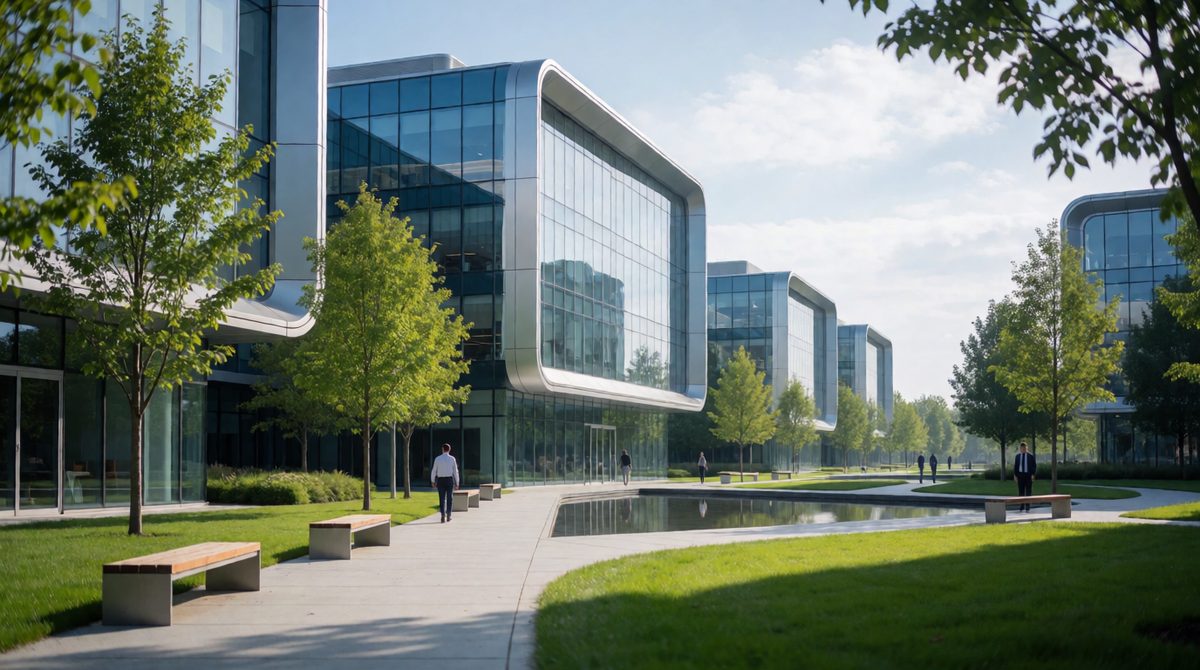
Science parks bring high-tech jobs to the UK
Government decisions shaped the economy in several ways:
As traditional industry shrank, a post-industrial economy grew. Services now make up the large majority of UK jobs and output, around four-fifths of the economy. The main areas of growth are below.
Software, web design, data and online services. Many firms now sell through websites and apps, which creates jobs in coding and digital marketing.
Jobs that help people rather than make things: retail, health care, education, tourism, hotels and leisure. This is by far the biggest part of the economy.
Banking, insurance and investment. London is one of the world's leading financial centres, with the City of London and Canary Wharf full of banks and insurers.
Scientists and engineers in universities and companies develop new medicines, materials and technology. Highly skilled workers and good universities are the key.
Key terms:
Science parks place firms next to universities so they can share ideas, staff and research. The Cambridge Science Park is an example. It is home to many technology and medical research firms.
Business parks are built on cheaper land at the edge of towns. Firms like them because there is space, rents are lower than in city centres, and the roads are less busy. They are often next to a motorway junction.
Both types of park have landscaped surroundings and modern buildings. This attracts skilled workers and gives companies a good image.
Question: give two reasons why a new software company might choose a science park rather than a city-centre office.
Answer: it is close to a university, so the company can recruit skilled graduates and share research (1). It can share ideas and research with other high-tech firms on the same site (1).
1. Saying all industry has gone. The UK still makes things, such as aircraft parts, cars and medicines, but employs far fewer people doing it.
2. Writing about only one cause. Good answers link the decline of traditional industry, globalisation and government policies together.
3. Mixing up science parks and business parks. Science parks are about research and links to universities. Business parks are mainly about offices and easy access.
(a) State what is meant by deindustrialisation. [1 mark]
(b) Explain how globalisation has caused economic change in the UK. [3 marks]
(c) Explain why science parks and business parks have grown in a post-industrial economy. [4 marks]
(a) The decline of manufacturing and traditional industries so that fewer people work in them (1).
(b) Globalisation lets companies make goods in countries where wages are lower (1). Cheaper imports mean UK factories cannot compete and close (1). This reduces manufacturing jobs, while firms that sell services and skills to the world grow (1).
(c) Post-industrial economies rely on research, technology and services, which need skilled workers (1). Science parks put research firms next to universities so they can share ideas and recruit graduates (1). Business parks give modern offices on cheaper land at the edge of towns, with good road access (1). Both have attractive surroundings which draw in skilled staff and give firms a good image (1).
In part (b), use a chain of linked points: cause, then result, then effect on jobs. Words like "so", "which means" and "therefore" help you earn all three marks.