🌊 Where they form
Over warm oceans in the tropics. Common areas include the Caribbean and Gulf of Mexico, the western Pacific near the Philippines, the Bay of Bengal and the seas north of Australia.
Sign up to access the complete lesson and track your progress!
Unlock This Course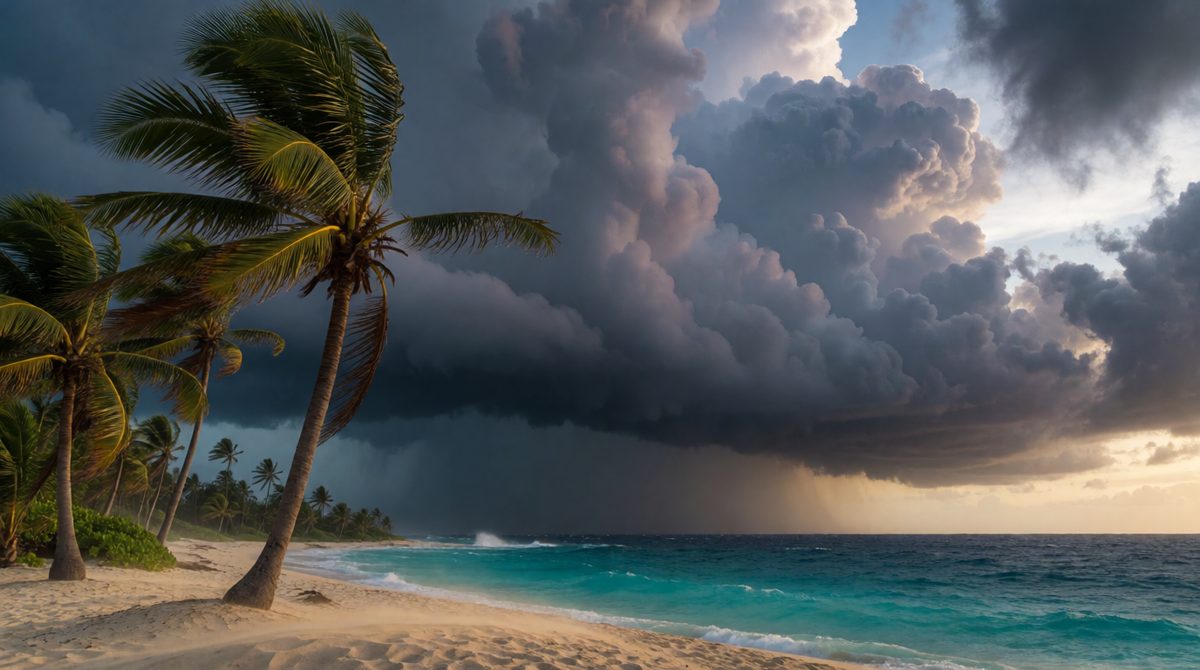
Tropical storms form over warm oceans of at least 27 degrees Celsius
A tropical storm is a huge, spinning storm of very strong winds and heavy rain. It forms over warm tropical oceans. The same type of storm has three different names, depending on where in the world it happens.
Key terms:
A hurricane, a typhoon and a cyclone are all the same thing. Only the name changes with the ocean.
On a world map, tropical storms form in a band on either side of the equator. They are found roughly 5° to 30° north and south of the equator, mostly within the tropics.
Over warm oceans in the tropics. Common areas include the Caribbean and Gulf of Mexico, the western Pacific near the Philippines, the Bay of Bengal and the seas north of Australia.
Very close to the equator, and in cooler seas far from the tropics. The South Atlantic is almost always too cool, so storms there are extremely rare.
Storms form in the late summer and autumn of each hemisphere. This is when the sea has had time to warm up the most.
Once formed, storms are pushed westwards by the trade winds. Then they usually curve away from the equator. If a storm moves over land or over cooler water, it loses its energy and fades away.
You have already met the three-cell model of global circulation. Tropical storms are linked to it in two ways.
This is why storms in the Atlantic usually travel from Africa towards the Caribbean and the east coast of North America.

Warm sea water of at least 27 degrees Celsius is a key condition for a tropical storm
A tropical storm needs particular physical conditions. All of these must be present:
Winds are turned by the Earth's spin, which is called the Coriolis effect. It is very weak at the equator, so air cannot start spinning there. Away from the equator it makes the air spiral. In the northern hemisphere the storm spins anticlockwise. In the southern hemisphere it spins clockwise.
This is the sequence of formation. Learn the order, because exam questions ask you to describe it.
A mature tropical storm is usually a few hundred kilometres across. Look at its structure from the centre outwards.
The centre of the storm, usually about 30 to 50 km across. Air sinks here, so it is calm, dry and often clear, with very low pressure.
The ring of tall thunderclouds around the eye. It has the strongest winds and the heaviest rain. Air rises very fast here.
Spiralling bands of cloud further out. They bring heavy rain, gusty winds and thunderstorms, with gaps of lighter weather between.
Key terms:
Air rises in the eyewall and sinks in the eye. If the centre of a storm passed over you, you would get the strong winds of the first part of the eyewall, then the calm of the eye, then strong winds again as the back of the eyewall passes.
1. Saying the eye has the strongest winds. It is the calmest part. The strongest winds are in the eyewall.
2. Thinking hurricanes, typhoons and cyclones are different storms. They are the same, with different names in different places.
3. Saying storms form at the equator. They form between about 5° and 30° north and south.
4. Forgetting that the storm needs warm sea. It dies over land because it loses its supply of moist air.
(a) Describe the global distribution of tropical storms. [2 marks]
(b) Explain how a tropical storm forms. [4 marks]
(c) Describe the weather in the eye of a tropical storm. [2 marks]
(a) They form in a band either side of the equator, roughly 5° to 30° north and south, mostly in the tropics (1). They are found over warm oceans, such as the Caribbean, western Pacific and Bay of Bengal, but not right on the equator (1).
(b) The sea is heated to 27°C or more and water evaporates (1). Warm, moist air rises and leaves low pressure at the surface (1). The air cools and condenses to form huge clouds, which releases heat that keeps the storm powered (1). The Earth's spin makes the air spiral and the winds speed up as pressure falls (1).
(c) The eye is calm (1) with light winds, dry weather and often clear skies (1).
On a 4 mark 'explain' question, write a chain of linked steps using 'so' or 'which leads to'. Four clear steps in the right order score full marks.