📖 Before the exam
Read the booklet carefully, more than once. Check you understand every map, graph and quote. Make notes on who is affected and what the options are.
Sign up to access the complete lesson and track your progress!
Unlock This Course
The issue evaluation exam uses a resource booklet you see before the exam
Paper 3 is the geographical applications paper. Its first part is Section A: Issue evaluation. It tests your critical thinking and problem-solving. Instead of recalling facts about a case study, you look at a real, current problem and decide what should be done about it.
The issue comes from the compulsory parts of the course, but it can go beyond them. The resources can be about a place you have never studied, called a specific unseen context. You are not expected to know the place. You are expected to use your geography to make sense of it.
Key terms:
A resource booklet is made available twelve weeks before the exam. This gives you time to work through the material and become familiar with it.
Read the booklet carefully, more than once. Check you understand every map, graph and quote. Make notes on who is affected and what the options are.
You cannot take your original booklet into the exam room. You are given a clean copy, so your notes will not be there. Learn the key points beforehand.
You will also have the question paper, which can contain extra information. Use both the booklet and the question paper in your answers.
The booklet can contain many different kinds of source. The spec lists these:
Each type tells you something different. A map shows where things are. A graph or table of statistics shows amounts and trends. A photograph shows what a place looks like. A quote shows what someone thinks.
Quotes are special because they are opinions. Always ask who is speaking and what they want. Two groups can look at the same facts and reach opposite views.
This section is synoptic. You must use what you have learned from more than one of the themes in the physical geography units (natural hazards, the living world and physical landscapes) and the human geography units (urban issues, the economic world and resource management).
For example, an issue about a coastline might need physical ideas about erosion and human ideas about jobs and housing at the same time. Do not keep your ideas in separate boxes. Link them.
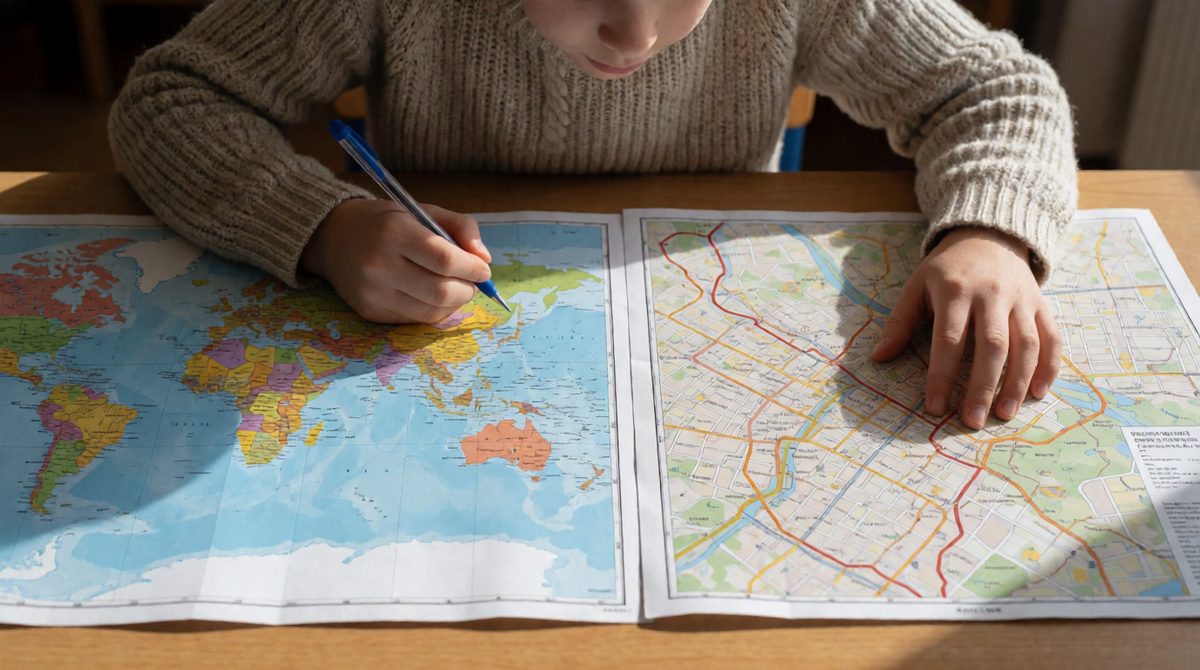
The issue evaluation looks at issues from local to global scale
You must analyse the issue at a range of scales. A scale is the size of the area you are looking at.
The effect on the people and the land right next to the issue.
The effect on the wider area or the whole country, such as jobs, money and transport.
The effect on other countries or on the planet, such as climate or trade.
An option that looks good locally may cause problems further away. Maps at different scales in the booklet help you see this.
The assessment asks you to examine conflicting viewpoints. Different stakeholders want different things. A stakeholder could be local residents, a business, a council, a conservation group or the government.
For each option, think about who gains and who loses. Be fair to each side. Do not just pick your favourite group.
You are asked to make an appraisal of the advantages and disadvantages and to evaluate the alternatives. That means judging each option, not just describing it.
What good would it do, and for whom? Think about people, money and the environment.
What would it cost, who would lose out, and what harm might it do to the environment?
Compare options with each other. Say why one is better than another, not just that it has good and bad points.
The exam also asks you to consider physical and human interrelationships. People affect the physical environment, and the physical environment affects people. A decision must work for both.
When you justify a proposed solution, the spec asks for reasoned justifications in terms of the likely impact on both people and the physical environment. A plan that helps people but badly harms the environment is only half an answer.
The assessment is a series of questions about a contemporary geographical issue. They lead to a longer piece of extended writing that needs an evaluative judgement. Along the way, you use geographical skills to:
The longer answer then asks you to choose an option and justify your decision, using evidence from the resources and your own geographical knowledge.
Imagine a booklet about a village by a lake that gets crowded with visitors. Two options are a big new car park (brings more visitors and money, but takes up fields) and a shuttle bus from a town nearby (keeps the fields, but costs money to run and some visitors may not use it). A strong answer would: (1) state the issue; (2) give an advantage and a disadvantage for each option, with a source as evidence; (3) say who is affected, such as residents and local shop owners; (4) say what happens to the fields and wildlife; (5) choose one option and explain why it is better than the other.
Describing a source without using it to make a point. Giving only one viewpoint. Ignoring the environment, or ignoring people. Listing advantages and disadvantages but never choosing an option. Forgetting that you can use your own knowledge as well as the booklet.
The booklet gives two options for a lakeside nature reserve: build a holiday park, or keep it as a reserve with a small visitor centre. Source A is a quote from a local conservation group opposing the holiday park. Source B is a map of the area.
(a) Give one reason why the quote in Source A may not give the whole picture. [1 mark]
(b) Using Source B, describe one advantage of the holiday park for the nearby village. [2 marks]
(c) Choose one option and justify your decision. Refer to people and to the physical environment. [6 marks]
(a) It is only the opinion of one group, and they want to protect the reserve. (1)
(b) The map shows shops and cafes in the village close to the site (1), so visitors staying at the holiday park would spend money there and bring jobs (1).
(c) I would choose the visitor centre and keep the reserve. It protects the wildlife and the quiet lakeside (1), and a visitor centre still brings some visitors and jobs for local people (1). It also keeps the land natural for future walkers (1). However, a holiday park would bring more money for the village (1), but it would mean building on the habitat and could cause noise and litter (1). The village would gain jobs, but the reserve could be lost for ever (1). Overall the reserve is the better option because the damage from the holiday park cannot easily be undone (1).
In part (c), use words like 'however' or 'but' to show you have weighed up both sides before you give your final decision.