Why can we reduce the effects?
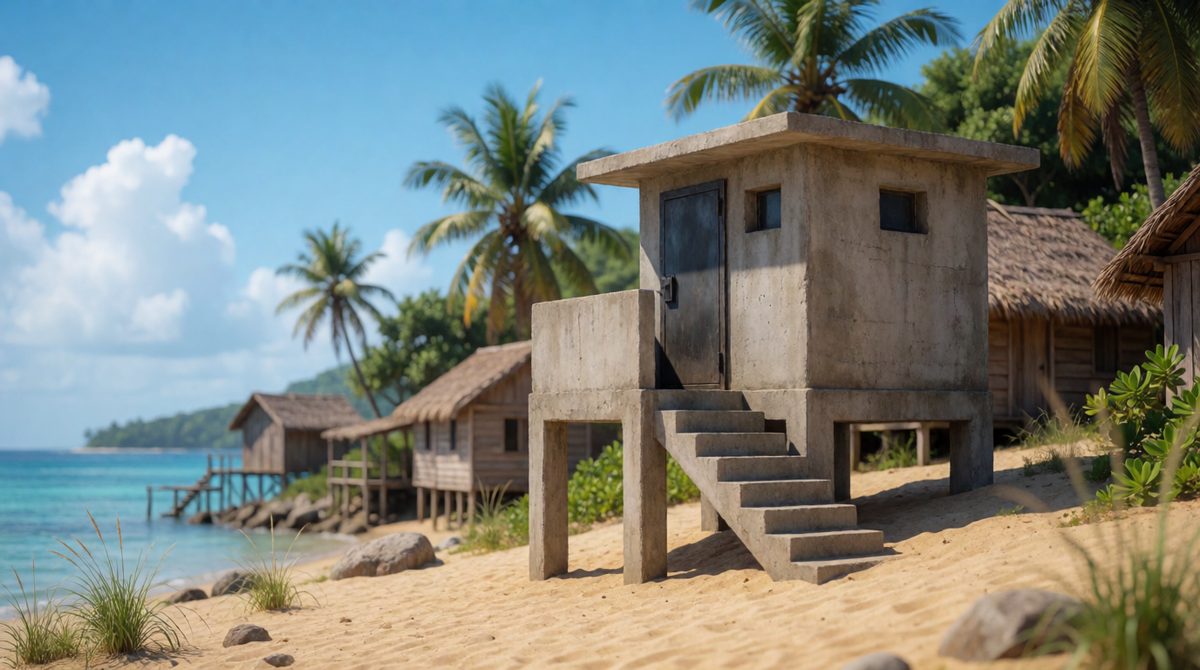
Storm shelters and warnings help protect people when a tropical storm hits
We cannot stop a tropical storm. But we can reduce the harm it does. This is possible because tropical storms are not a surprise. They form over warm oceans, they travel slowly and they can be tracked for days. That gives governments and families time to act.
There are four main ways to reduce the effects: monitoring, prediction, protection and planning. Remember, these are the same four ideas used for tectonic hazards. This time we apply them to storms.
Key terms:
- Evacuation: moving people out of an area at risk before the hazard arrives.
- Storm shelter: a strong building where people can stay safe during a storm.
Monitoring and prediction
Monitoring means watching a storm as it develops. Prediction means using that information to forecast where it will go and how strong it will be.
🛰 Monitoring
Weather satellites photograph storms from space and show them forming. Radar on the coast shows the rain bands and the position of the eye. Specially equipped aircraft can fly into a storm to measure wind speed and air pressure. Ocean buoys record sea temperature.
📊 Prediction
Computers use this data to forecast the storm's track and strength. Forecasters then issue warnings to the public by radio, television, text message and the internet.
The aim is a warning early enough for people to evacuate. A forecast is never perfect, because storms can change direction or strength. But a forecast of the likely path, with a wide area marked as at risk, is far better than no warning at all.
How warnings save lives
People who get a clear warning can board up windows, store food and water, move to higher ground and leave the coast. Without a warning, they are caught at home when the winds and storm surge arrive. This is why countries with good forecasting and warning systems usually have fewer deaths than countries without them.
Protection
Protection means building things to make people and property safer.
- Storm shelters: strong buildings, often built on raised ground, where people from coastal villages can stay during the storm. Bangladesh has built thousands of cyclone shelters for this reason.
- Strong buildings: roofs that are fixed firmly to the walls, shutters over windows and homes built on stilts or raised platforms so floodwater passes underneath.
- Sea walls and flood barriers: these hold back the storm surge and protect low-lying land.
- Natural barriers: coastal trees and reefs slow down waves and reduce the force of the surge before it reaches the land.
Protection costs money. Rich countries can afford strong building codes and large sea walls. Poorer countries often cannot, so many people still live in homes that are easily destroyed.
Planning
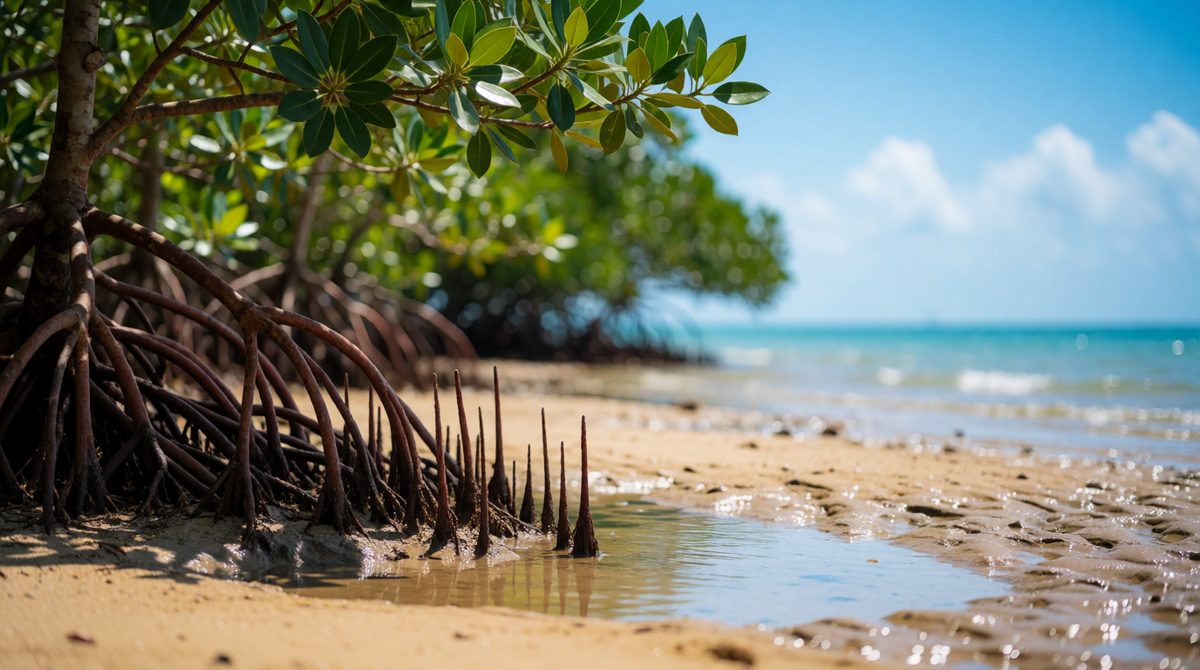
Planning includes protecting mangroves, which slow down storm surges
Planning means getting ready before a storm arrives, so everyone knows what to do.
🗺 Land use
Governments can stop new homes, hospitals and schools being built in the most dangerous low-lying coastal areas. Keeping these areas as open land or farmland leaves fewer people in the way of the surge.
🚗 Evacuation
Authorities mark clear evacuation routes and decide in advance who must leave and where they will go. Transport is arranged for people who have no car.
🏫 Education
People are taught what the warning signals mean, what to put in an emergency kit and where their nearest shelter is.
Emergency services also plan ahead. They stock food, water and medicine and prepare rescue teams so that help reaches people quickly after the storm.
Common mistakes
A tropical storm cannot be stopped or prevented. We can only reduce its effects. Another mistake is to mix up the four ideas. Monitoring and prediction are about information and warning. Protection is about building. Planning is about preparing and organising people.
Climate change and tropical storms
Tropical storms need sea surface temperatures of at least 27°C to form. Climate change is warming the oceans. Scientists therefore think it might change tropical storms in three ways.
🌎 Distribution
As more of the ocean reaches 27°C, storms might form in places that are currently too cool. This could bring storms to areas further from the equator that rarely see them now.
🔄 Frequency
Frequency means how often storms happen. Some scientists think there might be more storms. Others think the number could stay the same or even fall. This is the least certain part.
⚡ Intensity
Intensity means how powerful a storm is. Warmer water gives a storm more energy, so scientists think storms might become stronger, with higher wind speeds and heavier rain.
Notice the word might. Scientists cannot be certain about the future, so in an exam you should use careful words such as "might", "could" and "is predicted to".
Why this matters
Stronger storms or storms in new places would put more people at risk. Places that are not used to storms may have no warning systems, no shelters and no planning. That is why monitoring, protection and planning matter even more in a warming world.
Worked example
A coastal town in a country that rarely gets storms is told that warmer seas might bring them. To prepare, it could (1) use satellite and radar forecasts so it receives early warnings, (2) strengthen roofs and build a storm shelter on high ground, (3) stop new housing on the lowest land and (4) plan evacuation routes. These match monitoring and prediction, protection, and planning.
Exam-style question
(a) Describe one way that monitoring can reduce the effects of a tropical storm. [2 marks]
(b) Explain how planning can reduce the effects of tropical storms. [4 marks]
(c) Suggest how climate change might affect tropical storms. [3 marks]
Model answer
(a) Satellites track the storm from space (1) so forecasters can warn people where it is heading and they can evacuate in time (1).
(b) Planning means preparing before the storm arrives. Authorities can stop building in low-lying coastal areas (1), so fewer homes are in the path of the storm surge (1). They can set up evacuation routes (1), so people know how to leave quickly and fewer people are killed (1).
(c) Warmer oceans might allow storms to form further from the equator (1). Warmer water gives storms more energy, so they might become more intense, with stronger winds (1). It is less certain whether there will be more storms overall (1).
Exam tip
In a 4 mark "explain" question, link each point with a reason: say what is done, then say why that reduces the effects. Use "so" or "because" to show the link.