Why is supply elastic for some goods and not others?
This topic is examined on Paper 1 (Microeconomics and Business Economics). In the last lesson you learned how to measure PES. Now we ask a different question: why can some firms raise output quickly when the price rises, while others cannot?
A firm that wants to supply more needs to get more inputs, turn them into output, and get the goods to market. Anything that makes this quick and cheap makes supply more elastic. Anything that makes it slow or costly makes supply more inelastic.
Key terms:
- Spare capacity: unused ability to produce more, for example machines, workers or factory space that are not fully in use.
- Stocks: goods a firm has already made and is holding, ready to sell.
- Manufactured products: goods made in factories from other materials, such as furniture, clothes and cars.
- Primary products: raw materials taken from the land or sea, such as crops, oil and metal ores.
The four factors that affect PES
🔧 Factors of production
Can the firm get more land, labour and capital easily? If workers and machines can be switched from one job to another, or new ones found quickly, supply is more elastic. If they are very specialised or hard to find, supply is more inelastic.
📦 Availability of stocks
If a firm holds plenty of finished goods in a warehouse, it can put them on sale at once when the price rises. Supply is more elastic. With no stocks, it must make everything from scratch.
🏭 Spare capacity
A firm working below its full ability can raise output quickly by using what it already has. Supply is more elastic. A firm already working flat out has no room to grow, so supply is more inelastic.
⏳ Time
Given more time, firms can hire and train workers, build new factories and buy new machines. Supply is more elastic in the long run than in the short run.
Looking at each factor more closely
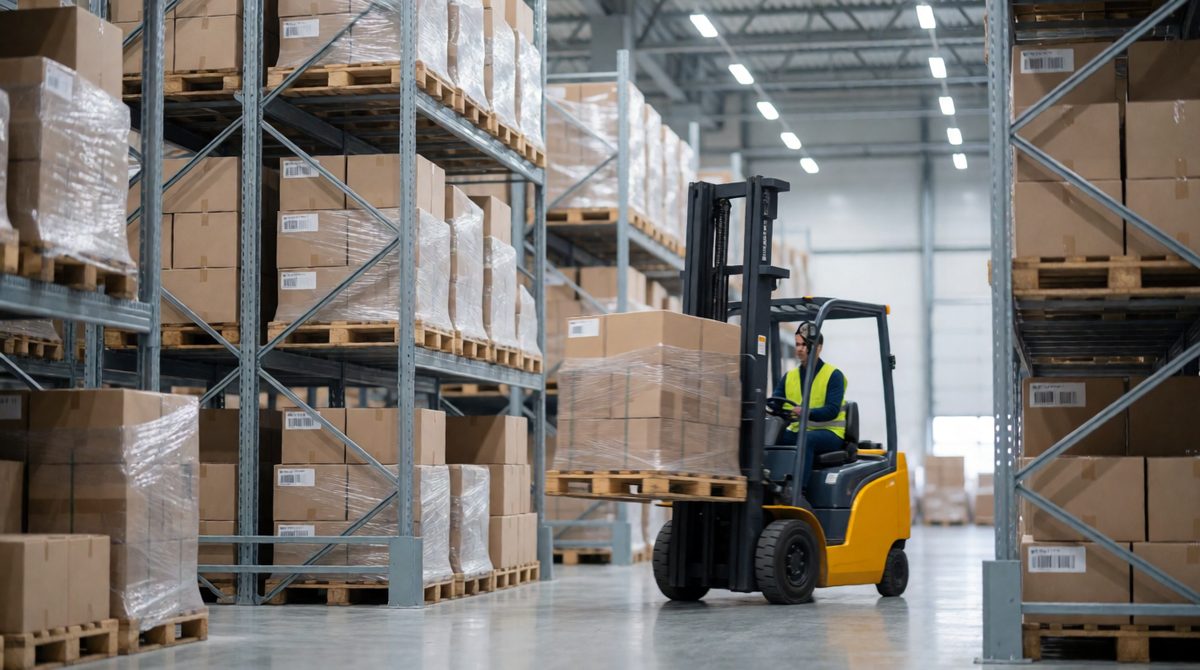
Full warehouse shelves mean stocks are available, so supply can rise quickly when prices go up
Factors of production. Think of a bakery. If its bakers can easily switch from making rolls to making bread, a rise in the price of bread brings more bread quickly. Now think of a firm that makes hand-blown glass and needs skilled glassblowers. There is no quick way to find more of them, so supply cannot respond fast. The easier it is to switch or add inputs, the higher the PES. (Factors of production are covered fully in a later lesson. Here you only need to know that how easily they can be switched affects PES.)
Availability of stocks. A clothes shop has 500 coats in its storeroom. A cold snap pushes the price of coats up, and the shop puts the coats on the shelves the same day. Stocks gave it elastic supply. A firm that bakes fresh cakes to order has no stocks, so it must wait until the next batch is ready. Goods that go off quickly, such as fresh fruit, cannot be stored for long, so their stocks are small.
Spare capacity. A T-shirt printing firm uses its machines for only half of each day. If the price rises, it can run them for longer straight away. Another firm has machines running day and night. To produce more, it would have to buy new ones, which takes time and money. The first firm has a higher PES.
Time. Time is the factor that changes the others. Suppose the price of electric scooters jumps. In one week, a maker can only sell its stock and use some spare capacity, so supply is inelastic. In two years, it can build a new factory and train new staff, so supply is much more elastic. So PES is usually higher in the long run than in the short run.
Manufactured and primary products

Coffee trees take years to grow, so supply of primary products like coffee is inelastic in the short run
These factors help us predict the likely PES for different types of product.
👕 Manufactured products
Usually more elastic. Factories can often run longer shifts, use spare capacity and hold stocks of finished goods. Example: a firm making school bags.
🌾 Primary products
Usually inelastic in the short run. Example: crops. Wheat is planted in one season and harvested months later, so a farmer cannot grow more wheat next week, however high the price goes.
Look at wheat more closely. If the price doubles today, the farmer cannot harvest extra wheat until the next growing season. Stocks may be low after the harvest is sold, and more land can take years to prepare. Over several years, farmers can plant more land, so supply becomes more elastic in the long run. Weather can also reduce the harvest, which makes supply even harder to change.
Other primary products are slow to expand for similar reasons. A mine cannot produce more ore until new tunnels are dug, and that can take a long time. Remember, these are likely patterns, not fixed rules. A manufacturer with no spare capacity and no stocks may be quite inelastic. A primary product that can be stored in large amounts may be more elastic than expected.
Worked example
A firm makes garden chairs. It currently makes 1,000 chairs a month but its factory is only 60% used, and it holds 400 chairs in a warehouse. The price of chairs rises.
Spare capacity: it can raise production using machines already in place.
Stocks: it can sell the 400 chairs immediately.
Both factors point to elastic supply (PES above 1).
Common mistakes
- Saying "supply is elastic because the price is high". The factors in this lesson are about how easily the firm can produce more, not about the price level.
- Forgetting to mention time. Almost every PES answer should say whether it is the short run or the long run.
- Saying all primary products are always inelastic. The spec idea is that they are usually inelastic in the short run.
- Mixing up factors that affect PES with factors that affect PED. Substitutes and necessity affect demand, not supply.
Exam-style question
Read the information, then answer the questions.
Zenda grows coffee beans. Coffee trees take several years to grow before they produce beans. Coffee prices rise sharply this year. Zenda's sister company, Loop Ltd, makes plastic water bottles in a factory that is only half used, and it holds large stocks of finished bottles. The price of water bottles also rises.
(a) State one factor that affects price elasticity of supply. [1 mark]
(b) Explain why supply of coffee beans is likely to be price inelastic in the short run. [3 marks]
(c) Analyse why Loop Ltd's supply of water bottles is likely to be more price elastic than Zenda's supply of coffee beans. [4 marks]
Model answer
(a) Time, or spare capacity, or stocks, or how easily factors of production can be switched. Any one. (1)
(b) Coffee is a primary product (1). Trees take several years to grow, so Zenda cannot increase output quickly when the price rises (1). So in the short run, quantity supplied changes by a smaller percentage than price, which means PES is below 1 (1).
(c) Loop Ltd has spare capacity, so it can raise production straight away using machines it already has (1). It also holds stocks of bottles, so it can sell more immediately (1). Bottles are manufactured products, which can be made quickly in a factory (1). Coffee supply depends on slow tree growth, so it is less able to respond to the higher price (1).
Exam tip
In an analysis answer, link each factor to the firm in the question: name the factor, say what the firm has or lacks, then say what this does to how quickly output can change.