🏭 Pollution
A factory pumps smoke into the air. Nearby families breathe it in and may become ill. The factory does not pay for their treatment.
Sign up to access the complete lesson and track your progress!
Unlock This CourseWhen you buy a cup of tea, you pay for it and you enjoy it. The café sells it and makes a profit. Everyone involved in the deal gets something or pays something. But some deals also affect other people who were not part of the deal at all. This lesson is about those side effects. It is examined on Paper 1 (Microeconomics and Business Economics).
In an earlier lesson you saw that market failure happens when resources are not allocated well. Externalities are one important reason for it.
Key terms:
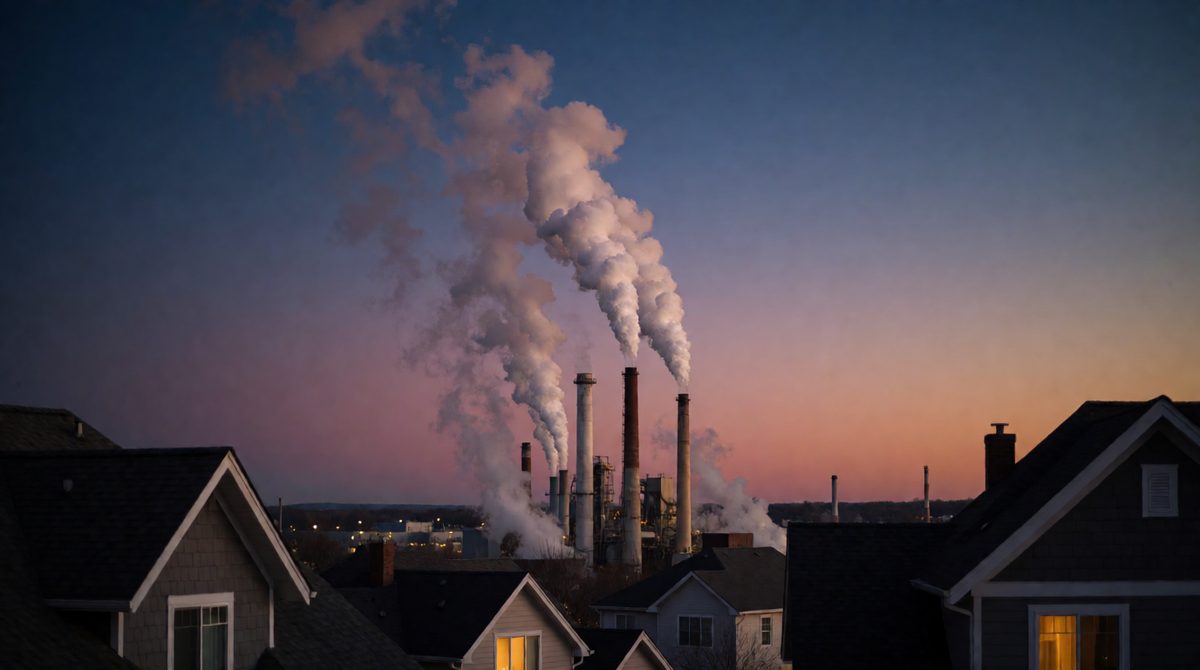
Smoke from a factory harms people nearby who never agreed to pay that cost: an external cost of production
Producers pay for things like wages, materials and electricity. These are private costs. But production can also harm other people, and the producer does not pay for that harm. These are external costs of production.
A factory pumps smoke into the air. Nearby families breathe it in and may become ill. The factory does not pay for their treatment.
A new warehouse sends hundreds of lorries along a town's roads each day. Other drivers sit in traffic, lose time and use more fuel.
A mining company clears a forest and leaves waste in a river. Wildlife is lost and local people cannot use the river.
In each case the people who suffer did not choose the activity and were not paid for putting up with it. That is why the cost is called external.

A vaccination protects other people too, not just the patient: an external benefit of consumption
Externalities can be good too. Sometimes when people consume a good or service, other people gain as well, and they do not pay for it. These are external benefits of consumption.
An educated person earns more, which helps them. But employers get skilled workers and the country gets a more productive workforce.
A person who is treated gets better. Their family does not have to care for them, and they can return to work and help their employer.
A vaccinated person is protected. They are also less likely to pass the disease on, so people around them are safer too.
Economists add up the whole picture. The cost to society is the cost to the producer plus the cost to everyone else. The benefit to society is the benefit to the buyer plus the benefit to everyone else.
Social costs = private costs + external costs
Social benefits = private benefits + external benefits
You can rearrange them. External costs = social costs - private costs. External benefits = social benefits - private benefits.
A chemical firm spends 50 million Zed a year on wages, materials and energy. Its factory pollutes a river. Cleaning the river would cost 12 million Zed a year.
Private costs = 50 million Zed. External costs = 12 million Zed.
Social costs = 50 + 12 = 62 million Zed.
A free flu vaccination programme gives 8 million Zed of benefit to the people who are vaccinated. It also saves 5 million Zed for others, because fewer people catch the illness and miss work.
Private benefits = 8 million Zed. External benefits = 5 million Zed.
Social benefits = 8 + 5 = 13 million Zed.
A bus company's private costs are 400,000 Zed a year. The social costs of its service are 460,000 Zed a year.
External costs = social costs - private costs = 460,000 - 400,000 = 60,000 Zed.
A firm looks at its own private costs and a buyer looks at their own private benefits. They usually ignore the external part. So the market may make too much of a good that causes external costs, such as a polluting product. It may make too little of a good that creates external benefits, such as vaccinations. This is a failure of the market to use resources well. How governments respond is covered later, in the lesson Government Policies for Externalities.
Read the context, then answer the questions. This is a Paper 1 style question.
A cement works in Country M has private costs of 90 million Zed a year. The dust from its chimneys makes people in nearby villages ill. The cost of this illness to the villagers and the local health service is 15 million Zed a year.
(a) Define external costs. [2 marks]
(b) Calculate the social costs of the cement works. [2 marks]
(c) Explain one external benefit of consumption, other than education. [3 marks]
(a) External costs are costs that fall on people other than the producer or consumer (1), who are not paid for them (1).
(b) Social costs = private costs + external costs (1) = 90 + 15 = 105 million Zed (1).
(c) Vaccination is an example. The person who is vaccinated gains protection (1). They are also less likely to pass on the disease, so other people are less likely to catch it (1). These people gain without paying, so this is an external benefit (1).
In a calculation, write the formula first, then your numbers, then the answer with its units. Here that means "105 million Zed", not just "105".