🌾 Land
Land means every natural resource, not just a plot of ground. A fishing boat uses the sea and the fish in it. A mine uses coal or copper in the ground. A wind farm uses windy hillsides. Land is a gift of nature. Nobody made it.
Sign up to access the complete lesson and track your progress!
Unlock This Course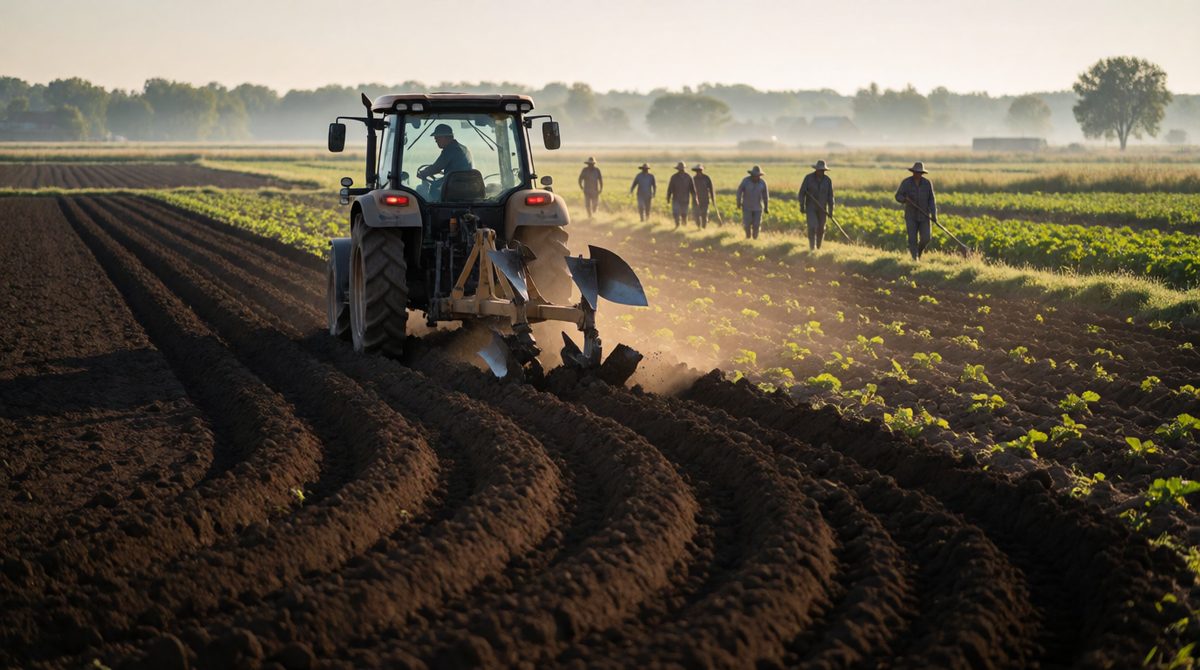
A farm uses all four factors: land, labour, capital like this tractor, and enterprise from the farmer
Every business, from a corner shop to a car factory, needs resources to make goods and services. In Economics these resources are grouped into four types. They are called the factors of production. This topic is part of Business Economics, which is examined on Paper 1.
Remember from the first lessons that resources are finite. The factors of production are the resources a business uses, so they are scarce too, and a firm has to choose how to use them.
Key terms:
Land means every natural resource, not just a plot of ground. A fishing boat uses the sea and the fish in it. A mine uses coal or copper in the ground. A wind farm uses windy hillsides. Land is a gift of nature. Nobody made it.
Labour is the work people do. It covers a surgeon, a bus driver, a coder and a shop assistant. It can be physical, like lifting boxes, or mental, like planning a delivery route. The amount of labour depends on how many people are able and willing to work.
Capital in Economics is not money. It is made things used to make other things. Examples are a baking oven, a lorry, a computer, a factory building and a tractor. Capital goods are made now so that more can be produced later.
An entrepreneur has the idea, brings land, labour and capital together, and takes the risk that the business may fail. Enterprise is what turns the other three factors into a working business.

The entrepreneur takes the risk of starting a business, and the reward for enterprise is profit
People who own a factor of production earn an income when a business uses it. Each factor has its own name for that income.
| Factor | Reward | Who receives it |
|---|---|---|
| Land | Rent | The owner of the land or natural resource |
| Labour | Wages | The worker |
| Capital | Interest | The owner of the capital, or the lender who funded it |
| Enterprise | Profit | The entrepreneur |
Profit is different from the other three. Rent, wages and interest are usually agreed in advance. Profit is what is left after all the other costs are paid, so it can be large, small or even a loss. That is the reward for taking the risk.
Harbour Fish Ltd is a new company on the coast. It rents a harbour-side plot of ground from a landowner for £1,000 a month. It uses a refrigerated van and a freezer worth £30,000, paid for with a loan from a bank. It employs two workers on £1,600 a month each. The owner, Nia, had the idea and risked her savings.
Land: the harbour-side plot, and the fish from the sea. Reward: rent, the £1,000 paid to the landowner.
Labour: the two workers. Reward: wages, £1,600 each a month.
Capital: the van and freezer. Reward: interest, paid to the bank for the loan that paid for them.
Enterprise: Nia. Reward: profit, whatever is left after all costs.
The factors work together. A mobile phone repair shop needs a rented shop site (land), a technician (labour), testing equipment (capital) and someone willing to start the business (enterprise). The building put up on the site counts as capital, because people made it. Take one factor away and the business cannot run. A shop with no technician repairs nothing.
The factors are scarce, so a business must decide how much of each to use. A firm might replace some workers with machines, which means using more capital and less labour.
Rafi starts a food truck selling noodles at a city market. He rents a pitch from the council, buys a van fitted with cooking equipment and hires two cooks. He pays his bank interest each month on the loan for the van and keeps what is left from the takings.
(a) Identify the factor of production that the van and cooking equipment represent. [1 mark]
(b) Define enterprise. [2 marks]
(c) State the reward paid to the two cooks. [1 mark]
(d) Explain why profit is a different kind of reward from rent. [3 marks]
(a) Capital. (1)
(b) Enterprise is the factor of production that takes risks (1) and organises land, labour and capital to start and run a business (1).
(c) Wages. (1)
(d) Rent is a reward usually agreed in advance for the use of land (1) so the landowner knows what they will receive (1). Profit is what is left after all costs are paid, so it is not fixed and can be a loss (1).
When a question asks you to identify a factor from a business story, look for clues: a rented pitch is land, hired cooks are labour, equipment is capital and the risk-taker is enterprise.