Three sectors of the economy
Economists sort all the work in an economy into three groups, called sectors. The sector a business belongs to depends on where it sits in the chain of production, from raw materials to the finished service. This topic is part of Business Economics, which is examined on Paper 1.
A quick warning. This is a different use of the word "sector" from public sector and private sector. Those describe who owns a business. The primary, secondary and tertiary sectors describe what kind of work a business does.
Key terms:
- Primary sector: businesses that extract or grow natural resources from the ground, the sea or the land.
- Secondary sector: businesses that turn raw materials into finished goods, or that build things.
- Tertiary sector: businesses that provide services to consumers and to other businesses.
- Output: the total amount of goods and services a sector or an economy produces.
- Employment: the number of people with a paid job in a sector.
- Developing economy: a country with a lower standard of living and less advanced industry.
- Developed economy: a country with a higher standard of living and a more advanced economy.
The sectors with examples
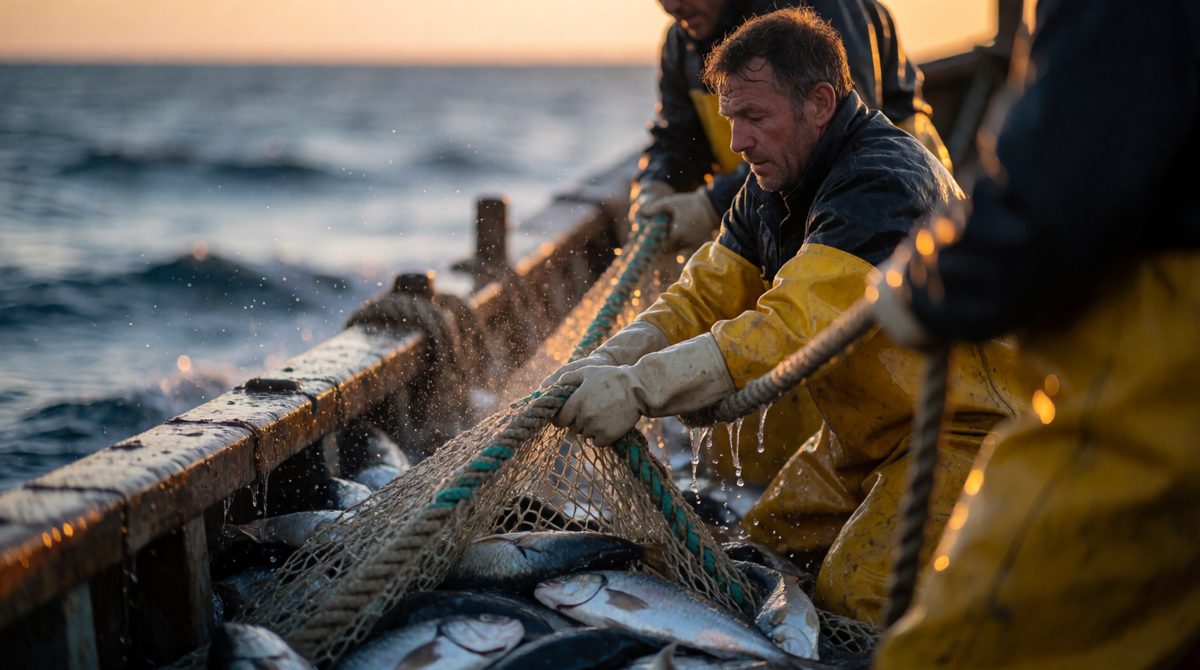
Fishing is primary sector work: taking natural resources straight from the land or sea
🌾 Primary
Farming, fishing, forestry, mining and oil drilling. These jobs start the chain. The output is a raw material or a food, such as wheat, timber, coal or fish.
🏭 Secondary
Manufacturing, construction and food processing. A car plant, a bakery that makes bread from flour and a firm that builds houses are all secondary. They turn raw materials into something more useful.
🛒 Tertiary
Shops, banks, schools, hospitals, hotels, transport and entertainment. Nothing is extracted or made. The business sells a service, or sells goods on to the customer.
Follow one product through all three. A farmer grows wheat (primary). A mill and a bakery turn it into bread (secondary). A supermarket sells the bread to you (tertiary). A single firm can sit in more than one sector, for example a farm that also bakes and sells its own bread.
Developing and developed economies

As economies develop, more people work in the tertiary sector, providing services in offices and shops
The mix of sectors is different in developing and developed economies. The general pattern is similar in many countries, and you should be able to describe it in words. You do not need exact figures.
- Developing economies. The primary sector is large. Many people work in farming or mining and it produces a big share of total output. The secondary and tertiary sectors are usually small.
- As the economy grows. Factories are built and the secondary sector grows. Workers leave the land for jobs in towns. This is often called industrialisation. The tertiary sector begins to grow as well.
- Developed economies. The tertiary sector is the largest, in both employment and output. The primary sector is small. The secondary sector has usually become smaller than it once was. A falling importance of manufacturing is called deindustrialisation.
Why do the sectors change over time?
👷 Employment
Machines and better technology mean a farm needs far fewer workers than it once did. So the share of workers in the primary sector falls. Factories also use robots, so fewer people are needed there too. Workers move to the tertiary sector, where there are more jobs.
💰 Output
As incomes rise, people spend more on services such as restaurants, travel, health care and entertainment. Demand for the tertiary sector grows, so its share of output grows. People do not eat much more food when they get richer, so the primary sector's share of output falls.
Some developed economies buy many of their manufactured goods from other countries, where making them can be cheaper. That is another reason their secondary sector may shrink. Notice that a sector can produce more in total and still have a smaller share, because the other sectors have grown faster.
Worked example
In Country Alva, 60 out of every 100 workers farmed in 1960, 15 worked in factories and 25 in services. By 2020, 4 farmed, 18 worked in factories and 78 in services. (These numbers are made up.) Describe the change.
The primary sector's share of employment fell sharply (60 to 4). The tertiary sector's share rose a lot (25 to 78). The secondary sector rose a little. This fits a country that has moved from developing to developed.
Common mistakes
- Mixing up public and private sector with primary, secondary and tertiary. They are two different ideas.
- Putting a shop in the secondary sector. A shop sells goods but does not make them, so it is tertiary.
- Saying the primary sector disappears in developed economies. It becomes smaller in share, but it still exists.
- Giving only employment, or only output, when the question asks for both.
Exam-style question
Country Delmar has a growing economy. The table shows the share of workers in each sector (the shares add up to 100%). The figures are made up for practice.
| Sector | 1980 | 2020 |
|---|
| Primary | 50% | 12% |
| Secondary | 20% | 28% |
| Tertiary | 30% | 60% |
(a) Identify one example of a primary sector business. [1 mark]
(b) State which sector had the largest share of workers in 1980. [1 mark]
(c) Explain why the share of workers in the tertiary sector may have risen as Delmar became richer. [4 marks]
Model answer
(a) A fishing company, a farm or a coal mine. (1)
(b) The primary sector, with 50% of workers. (1)
(c) As incomes rise, people spend more on services such as restaurants, health care and travel (1). So demand for services grows (1) and tertiary businesses take on more workers to meet it (1). At the same time, machinery on farms means fewer workers are needed in the primary sector, so workers move to service jobs (1).
Exam tip
In part (c), link each point with "so" or "because". A list of facts about rising incomes will not earn the explanation marks. Show the chain from higher incomes to higher demand to more jobs.
Recap
- Primary: extracting and growing. Secondary: making and building. Tertiary: services.
- Developing economies rely most on the primary sector.
- Over time the secondary sector grows, then the tertiary sector becomes the largest.
- Developed economies have a large tertiary sector and a small primary sector, in both employment and output.