🌱 Fertiliser
Adding nutrients to poor soil helps crops grow bigger, so each hectare gives more food.
Sign up to access the complete lesson and track your progress!
Unlock This CourseTwo bakeries can have the same number of staff and the same ovens, yet one makes far more loaves in a day. The busier one is more productive. Productivity is a key idea in Business Economics, which is examined on Paper 1.
Key terms:
The most common measure is labour productivity:
Productivity = total output / number of workers
You can use the same idea for other inputs. Output per hectare of land measures how productive land is. Output per machine measures how productive capital is.
A pottery in the town of Calder employs 12 workers. Together they make 960 mugs a week.
Productivity = 960 / 12 = 80 mugs per worker per week.
The owner buys a faster kiln. The same 12 workers now make 1,200 mugs.
New productivity = 1,200 / 12 = 100 mugs per worker. Productivity has risen by 20 mugs per worker.
A farm grows 90 tonnes of barley on 30 hectares. Output per hectare = 90 / 30 = 3 tonnes per hectare.
Notice that productivity can rise even if output stays the same. If the pottery made 960 mugs with only 8 workers, productivity would be 960 / 8 = 120 mugs per worker. Higher productivity means more is made from the same resources, or the same is made from fewer resources.
Why does this matter? Higher productivity usually means lower cost for each item made, so firms can make more profit or charge lower prices. For a whole country, it means more goods and services from the same resources.
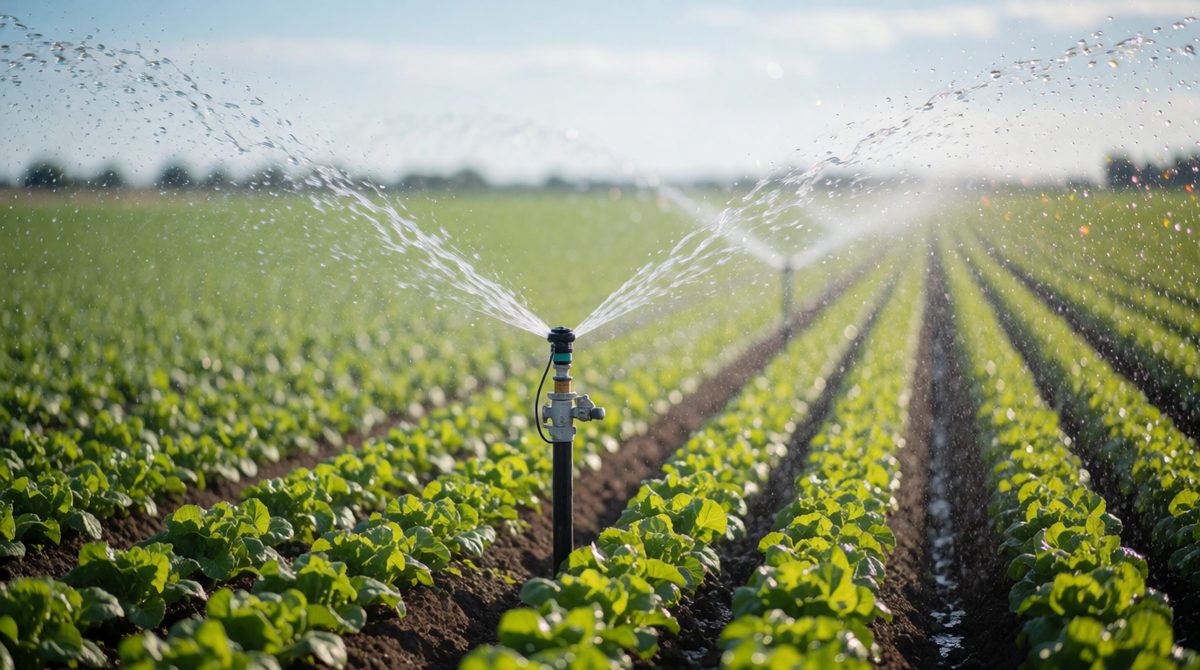
Irrigation brings water to dry fields, raising the output from each hectare: better land productivity
Land means natural resources, so its productivity is how much it can produce per hectare. There are four ways to raise it.
Adding nutrients to poor soil helps crops grow bigger, so each hectare gives more food.
Bringing water to dry land lets farmers grow crops where rainfall is low, or grow them all year round.
Taking water off waterlogged fields stops crop roots rotting, so land that was too wet can grow crops.
Turning unusable land into usable land adds new land. The Netherlands has reclaimed large areas of land from the sea.
Drainage and irrigation are opposites, but they help in different places: irrigation for land that is too dry, drainage for land that is too wet.

Training raises human capital, so each worker can produce more in an hour
Labour productivity depends on the quality of the workers.
Education and training are said to improve a worker's human capital. This simply means the skills and knowledge a worker has. How human capital works in the labour market is covered in a later lesson, Labour Quality and Human Capital.
Capital means the machines, tools and buildings used to make things. There are two main ways to raise productivity.
New technology often costs a lot to buy, and workers may need training to use it. Capital and labour work together, which is why firms often invest in both.
Confusing productivity with output. Output is the total amount made. Productivity is the amount made per worker or per input. A firm can make more in total by hiring more workers, with no change in productivity.
Dividing the wrong way round. Productivity is output divided by workers, not workers divided by output.
Saying that migration always raises productivity. The effect depends on the skills of the migrants and the jobs available, so give a reason either way.
Farmer Idris grows tomatoes in a hot, dry region. Last year he employed 8 workers and produced 4,000 kg of tomatoes. This year he installs a pipe system to water the plants. He trains his 8 workers to use it and produces 5,600 kg.
(a) Calculate the labour productivity last year. [2 marks]
(b) Calculate the percentage increase in labour productivity this year. [2 marks]
(c) Explain two reasons why Farmer Idris's productivity rose. [4 marks]
(a) Productivity = output / workers (1) = 4,000 / 8 = 500 kg per worker (1).
(b) This year: 5,600 / 8 = 700 kg per worker (1). Increase = (200 / 500) x 100 = 40% (1).
(c) Irrigation (1): the pipes bring water to dry land, so each plant grows better and gives more tomatoes from the same land and workers (1). Training (1): trained workers can use the system correctly and work faster, so each worker looks after more plants and output per worker rises (1).
In a "calculate" question, write the formula first and show each step. If you slip on the arithmetic, you can still earn marks for the method.