🎓 Skill
Doing one task again and again makes a worker quicker and better at it. They learn the tricks of the job and make fewer mistakes.
Sign up to access the complete lesson and track your progress!
Unlock This Course
On a production line each worker does one task, which is the division of labour
Think about making a cheese sandwich at home. You do every job yourself: slice the bread, cut the cheese, butter it and wrap it. Now think about a sandwich factory. One worker slices bread, another adds the cheese, another wraps and another packs the boxes. Each person does one small job over and over. This is the division of labour, and it is examined on Paper 1 as part of Business Economics.
Key terms:
The idea works in services too. In a hospital, one person books the appointment, a nurse takes your temperature, a doctor decides on the treatment and a pharmacist gives out the medicine. Each person does the part they are trained for.
Doing one task again and again makes a worker quicker and better at it. They learn the tricks of the job and make fewer mistakes.
A new worker only has to learn one small task, so they can start the job quickly and begin earning sooner.
Skilled specialists whose work is in demand can be paid more. Also, if the business earns more, it may pass some of this on in wages.
Workers can do the task they are best at or enjoy most, instead of every job.
A bakery has 6 workers. When each worker does every job, the bakery makes 120 pies a day.
The owner divides the work. Two workers make pastry, two make fillings and two assemble and bake. The bakery now makes 210 pies a day with the same 6 workers.
Before: 120 / 6 = 20 pies per worker. After: 210 / 6 = 35 pies per worker.
The wage bill has not changed, so the cost of wages for each pie has fallen. This is a clear gain for the business.
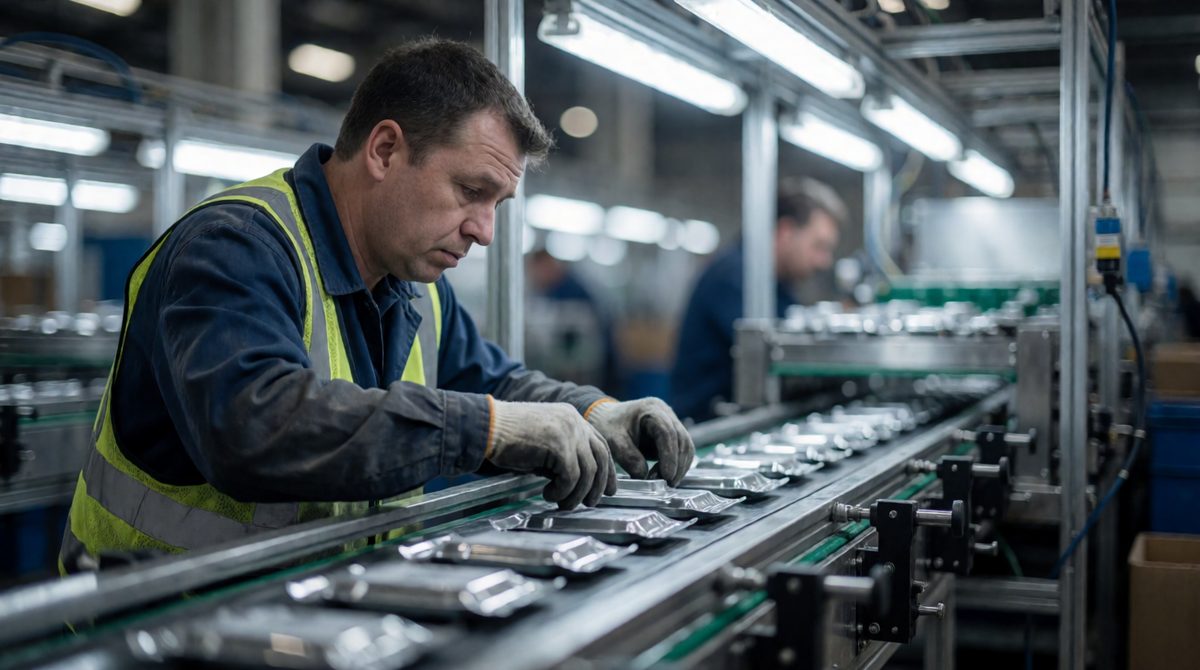
Doing the same small task all day can be boring, a big disadvantage of the division of labour for workers
Repeating one small task all day is dull. Workers may lose interest and enjoy the job less.
A worker who knows only one task has not learned a wide range of skills, so it can be hard to move to another job.
If a machine can do the single task, or the business closes, the specialist may find it hard to get new work.
Doing the same movement over and over can cause tiredness or injury to hands and backs.
Writing only the good points. The spec asks for advantages and disadvantages, so give both when a question asks you to evaluate.
Mixing up who gains. Say clearly whether a point is about workers (skill, boredom) or the business (output, cost per unit, quality).
Saying that the division of labour means workers share the profits. It means dividing the tasks, not the money.
Sunvale Cycles makes bicycles and has 10 workers. Before, each worker built a whole bicycle. It now uses the division of labour: some workers make frames, some fit wheels and some fit brakes and gears. Output rose from 40 to 70 bicycles a week with the same 10 workers.
(a) Define the term 'division of labour'. [2 marks]
(b) Calculate the output per worker after the change. [2 marks]
(c) Explain one advantage and one disadvantage of the division of labour to the workers at Sunvale Cycles. [4 marks]
(a) Dividing the production of a good into separate tasks (1), with each worker specialising in one task (1).
(b) Output per worker = 70 / 10 (1) = 7 bicycles per worker per week (1).
(c) Advantage: workers become more skilled at their one task (1) because they repeat it, so they work faster and make fewer mistakes (1). Disadvantage: the work can become boring (1) because they do the same task all day, so they may lose interest or want to leave (1).
In part (c) the question names the workers, so do not write about the business. Pick one point for workers on each side and explain it.