🛍 Informal economy
Some work is not recorded, such as cash jobs or unpaid care at home. It is left out of GDP, so GDP can understate how much is really produced.
Sign up to access the complete lesson and track your progress!
Unlock This Course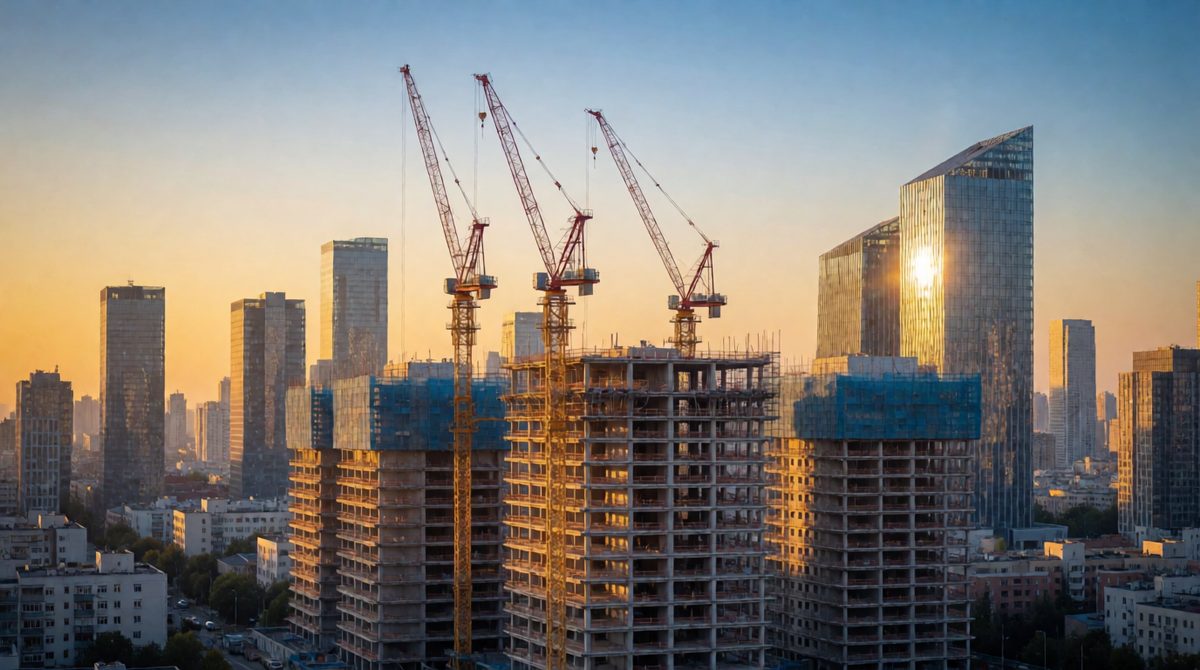
New homes, roads and offices going up are signs of economic growth: the economy is producing more
Every country wants its economy to do well. One of the main things governments aim for is economic growth. This lesson starts Section 2.1, Government and the Economy, which is examined on Paper 2 (Macroeconomics and the Global Economy).
Key terms:
In the lesson on economic growth and shifting the PPF you saw growth as an outward shift of the curve. Here we look at how growth is measured in the real world.
GDP counts goods and services made inside the country's borders, whoever owns the firm. A car made in a factory in the country counts, even if the owner lives abroad. Things that are made but never bought or recorded, like a meal you cook for yourself, are not counted.
We say an economy has grown when its GDP has increased. If GDP falls, the economy has shrunk. This is negative growth.
To compare growth in different years, we turn the change into a percentage. Use this formula:
Economic growth rate (%) = (new GDP − old GDP) ÷ old GDP × 100
Country Tavo had a GDP of 200 billion dollars last year. This year it is 210 billion dollars.
Change in GDP = 210 − 200 = 10 billion
10 ÷ 200 = 0.05
0.05 × 100 = 5%
Tavo's economy grew by 5%.
Country Merin had a GDP of 400 billion dollars. It falls to 388 billion dollars.
Change = 388 − 400 = −12 billion
−12 ÷ 400 = −0.03, so the growth rate is −3%.
A negative answer means the economy shrank.
Always divide by the old figure, not the new one. This is the most common slip.

GDP doesn't count unpaid work like volunteering, one limitation of using it to measure living standards
GDP is easy to measure and compare, but a rise in GDP does not always mean people are better off. Here are the limitations you need to know.
Some work is not recorded, such as cash jobs or unpaid care at home. It is left out of GDP, so GDP can understate how much is really produced.
GDP is a total. It does not show who gets the money. If a few people receive most of the extra income, most people may not feel any better off.
GDP does not measure health, free time, safety or happiness. People could work longer hours to raise GDP and have a worse life.
Pollution and the using up of resources are not taken off GDP. A factory that produces more but damages a river raises GDP.
If GDP rises by 3% but the population rises by 5%, there is less for each person. Total GDP can hide this.
GDP counts the value of output, not whether it is useful. Spending on repairing storm damage adds to GDP, even though nobody is better off.
Country Sael has a GDP of 100 billion dollars and 10 million people. GDP per person is 100 billion ÷ 10 million = 10,000 dollars.
Next year GDP rises to 105 billion (up 5%), but the population rises to 11 million (up 10%). GDP per person is now about 9,545 dollars. Total GDP grew, but each person has less.
Dividing by the new GDP instead of the old GDP. Forgetting the × 100, so the answer is a decimal not a percentage. Saying GDP measures how happy people are. It only measures the value of output.
Country Orla's GDP was 80 billion dollars in 2025 and 84 billion dollars in 2026. Its informal economy is large.
(a) Define economic growth. [2 marks]
(b) Calculate Orla's economic growth rate between 2025 and 2026. Show your working. [2 marks]
(c) Explain two reasons why GDP may not be a good measure of the standard of living in Orla. [4 marks]
(a) Economic growth is an increase (1) in the amount of goods and services an economy produces over time (1).
(b) (84 − 80) ÷ 80 × 100 (1) = 5% (1).
(c) First, Orla has a large informal economy (1), so a lot of work is not recorded and GDP understates what is really produced (1). Second, GDP does not show inequality (1), so most of the extra income could go to a few people and most people would not be better off (1).
In an "explain" question, make your point, then add a second sentence that says why it matters to the question, as in part (c).