🚀 Boom
Growth: high. GDP is rising fast.
Inflation: tends to rise. Spending is strong, so firms can raise prices.
Unemployment: low. Firms are busy and need more workers.
Sign up to access the complete lesson and track your progress!
Unlock This CourseEconomies do not grow smoothly. Some years output races ahead. In other years it slows down or even shrinks. This up-and-down pattern repeats over time. This lesson is part of Section 2.1, Government and the Economy, which is examined on Paper 2 (Macroeconomics and the Global Economy).
Key terms:
The cycle is also called the business cycle or the trade cycle. Remember that growth is measured by the change in GDP, which you met in the lesson on economic growth and GDP.
The cycle is shown as a wavy line. In the exam, draw it like this:
Then the line climbs again towards the next boom, and the pattern repeats. Some students label the lowest point of the wave as a "trough". Your marks come from the four labels boom, downturn, recession and recovery.
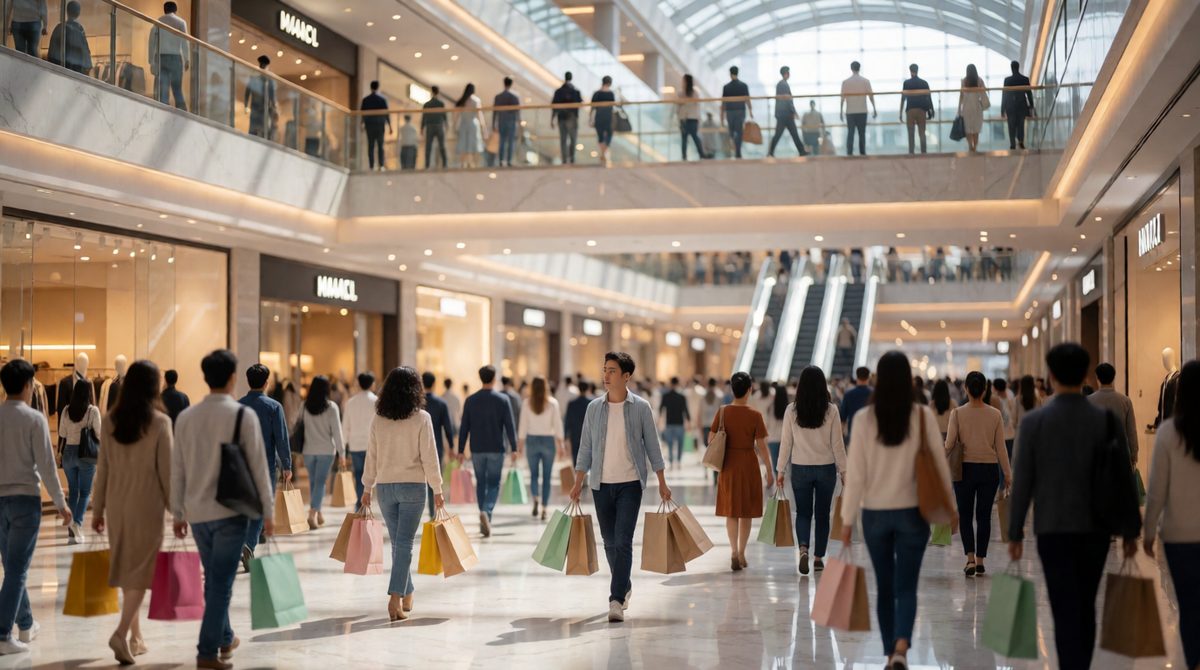
In a boom, shops are busy and spending is high, but prices can start rising fast
Each stage affects three things: economic growth, inflation and unemployment. Learn the pattern for each stage.
Growth: high. GDP is rising fast.
Inflation: tends to rise. Spending is strong, so firms can raise prices.
Unemployment: low. Firms are busy and need more workers.
Growth: slows down. The growth rate falls.
Inflation: starts to slow, as demand weakens.
Unemployment: starts to rise, as firms stop hiring.
Growth: negative. GDP falls.
Inflation: low or falling. Weak demand means firms cannot raise prices.
Unemployment: high. Firms cut output and lay off workers.
Growth: returns and speeds up.
Inflation: starts to rise again, slowly.
Unemployment: starts to fall, as firms hire again.
Notice the link between the three. When growth is strong, firms need workers, so unemployment is low, and busy shops can raise prices, so inflation rises. When growth is weak or negative, the opposite happens.
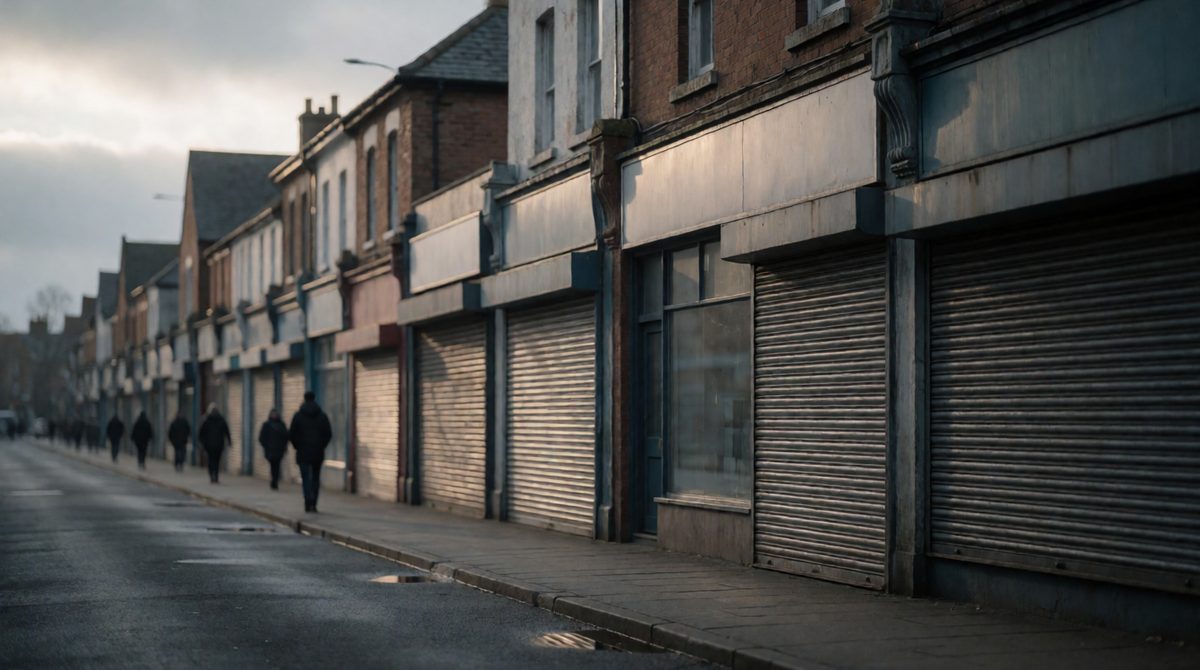
In a recession, spending falls, firms cut back and more shops close their doors
You do not need to explain the causes in detail, but it helps to understand the chain.
Country Veltra's GDP growth over six quarters was: +2.5%, +1.0%, −0.4%, −0.9%, +0.3%, +1.8%.
Quarters 1 and 2: growth is positive but slowing. This is a downturn.
Quarters 3 and 4: growth is negative for two quarters in a row. This is a recession.
Quarters 5 and 6: growth is positive and rising. This is a recovery.
Unemployment would probably be highest around quarters 3 and 4.
1. Saying a downturn means GDP is falling. In a downturn growth slows, but GDP may still be rising. GDP only falls in a recession.
2. Writing "inflation falls" in a boom. In a boom, inflation tends to rise.
3. Mixing up recession and recovery. Recession is the low point where GDP falls. Recovery is the climb back up.
4. Forgetting to label the axes. Always write Real GDP and Time.
Country Zentra's GDP growth rate over six quarters is shown below.
| Quarter | 1 | 2 | 3 | 4 | 5 | 6 |
|---|---|---|---|---|---|---|
| GDP growth rate (%) | +3.0 | +1.5 | −0.5 | −1.2 | +0.6 | +2.0 |
(a) Which one of the following is the stage of the economic cycle that comes straight after a recession? [1 mark]
A Boom B Downturn C Recovery D Inflation
(b) Define the term recession. [2 marks]
(c) Using the table, identify the two quarters that show a recession. [1 mark]
(d) Explain how unemployment is likely to change during a recession. [3 marks]
(a) C, Recovery. (1)
(b) A recession is a period when GDP falls (1), usually for two or more quarters in a row (1).
(c) Quarters 3 and 4. (1)
(d) Unemployment is likely to rise (1). In a recession, spending and demand fall, so firms produce less (1). They need fewer workers, so they lay people off or stop hiring (1).
For part (d), do not just say "unemployment rises". Add the chain of reasons: demand falls, output falls, firms need fewer workers.