💼 Employment
When output rises, firms need more workers to make it. Businesses expand and hire, so more jobs are created and unemployment tends to fall. More people earn wages and pay tax.
Sign up to access the complete lesson and track your progress!
Unlock This CourseGovernments want their economies to grow. But growth is not all good news. It brings benefits and it brings costs. This lesson is part of Section 2.1, Government and the Economy, which is examined on Paper 2 (Macroeconomics and the Global Economy).
Remember from the lesson on economic growth and GDP that growth means a rise in a country's output, measured by an increase in GDP. Here we look at what that rise does to people, firms and the planet.
Key terms:

Growth creates jobs and higher incomes, lifting standards of living
When output rises, firms need more workers to make it. Businesses expand and hire, so more jobs are created and unemployment tends to fall. More people earn wages and pay tax.
More output means more goods and services for people to use. Higher incomes let families afford better food, housing, healthcare and leisure. Governments also collect more tax, so they can spend more on schools and hospitals.
Growth can reduce poverty. More jobs and higher wages lift people out of low income. Extra tax revenue can pay for benefits and public services that help poorer households.
Firms often use growth profits to buy new machines and train workers. This raises the maximum a country can produce, so its productive potential grows. On a production possibility diagram, the curve shifts outwards.
Notice the chain. Growth leads to more jobs. More jobs mean more income. More income means better living standards and less poverty. Examiners reward answers that link the points like this instead of just listing them.
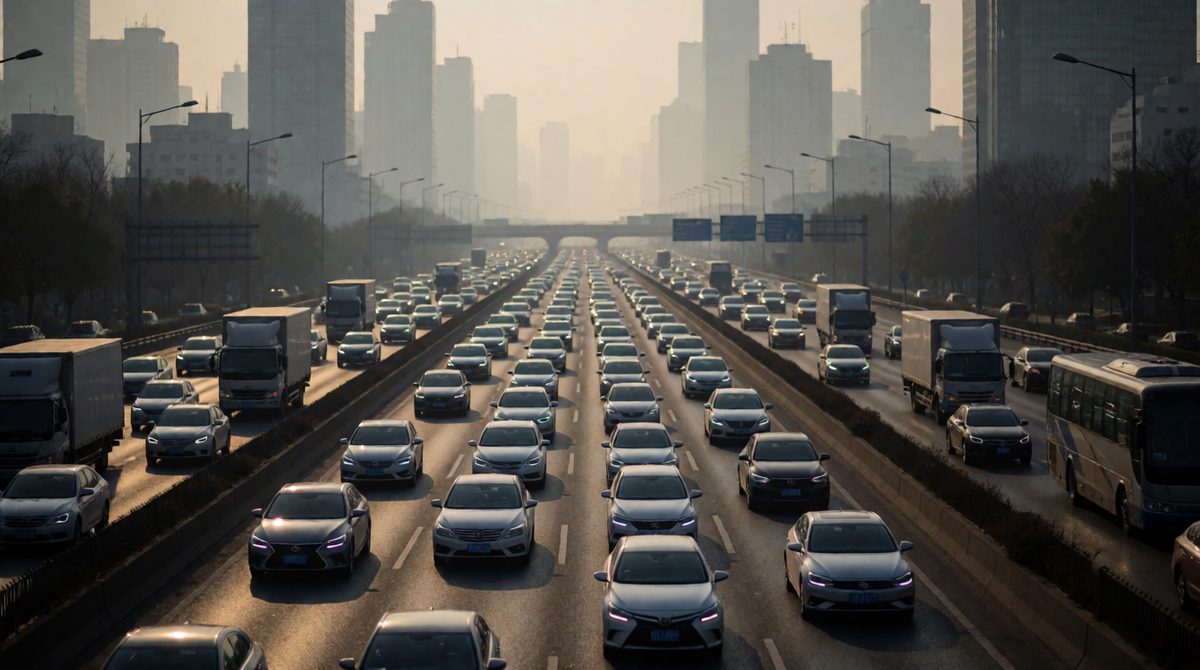
Faster growth often means more traffic and pollution, a cost to the environment
If demand rises faster than the economy can produce, firms cannot supply enough. Firms can raise prices, so inflation may rise. This is most likely in a fast boom, when many firms are already working at full capacity.
More production often uses more resources and energy. This can mean more air and water pollution, more waste and more traffic. Land may be cleared for factories, roads and homes, and some natural resources can run out.
Growth does not always share its gains fairly. Some people may gain a lot while others gain little, so it may not reduce poverty as much as hoped.
Whether growth is good overall depends on what type it is and how it is used. You will see how governments weigh growth against inflation and the environment in the lesson on trade-offs between objectives, so here you only need to describe each cost.
In a longer answer you may be asked whether growth is good for a country. Give the benefits, give the costs, then make a judgement. Your judgement should say what it depends on. For example, growth that creates jobs and new machines, and is shared widely, is far more useful than growth that mainly raises pollution and prices. The answer also depends on how fast the growth is and who gains from it.
A useful way to remember the six areas is to split them into people and planet. People: jobs, living standards, poverty. Output and prices: productive potential and inflation. Planet: the environment.
| Area | Possible benefit | Possible cost |
|---|---|---|
| Employment | More jobs, lower unemployment | None |
| Standard of living | More goods, services and income | Gains may be shared unevenly |
| Poverty | Fewer people on low incomes | Gains may not reach the poorest |
| Productive potential | Maximum possible output rises | Needs money spent on investment |
| Inflation | None | Prices may rise faster |
| Environment | None | More pollution, waste and resource use |
Country Dorvane's GDP grew strongly for five years. New factories opened and many people found work. At the same time, prices rose faster and the air near the factories became more polluted.
(a) Identify one benefit of economic growth shown in the information. [1 mark]
(b) Explain how economic growth could reduce poverty. [3 marks]
(c) Analyse two costs of economic growth for Country Dorvane. [4 marks]
(a) More people found work, or more jobs were created. (1)
(b) Growth means firms produce more and need more workers, so more people get jobs and wages. (1) Higher incomes lift households out of low income. (1) The government also collects more tax, which it can spend on benefits and services for poorer households. (1)
(c) One cost is inflation. (1) Prices have risen faster, which may be because demand grew faster than output, so the cost of living goes up for households. (1) A second cost is damage to the environment. (1) The new factories produce air pollution, which harms health and quality of life for people living nearby. (1)
In an "Analyse" part, name the cost, then add a "because" or "so" that shows its effect. Two named costs with no link to the country earn few marks.