📈 Inflation
Prices in general are rising. Each pound buys less than it did last year. An inflation rate of 3% means prices are 3% higher on average than a year ago.
This topic is examined on Paper 2 (Macroeconomics and the Global Economy). Low and stable inflation is one of the government's main macroeconomic objectives. Before a government can control inflation, it has to measure it. That is what this lesson is about. The causes and effects of inflation come in the next two lessons.
Sign up to access the complete lesson and track your progress!
Unlock This Course
Inflation means the same weekly shop costs more than it did a year ago
Last lesson you met inflation as prices going up. Here is the exact version you should write in the exam.
Key terms:
Inflation is a general rise in prices across the whole economy. If only the price of one product goes up, that is not inflation. Prices of most goods and services must be rising.
Prices in general are rising. Each pound buys less than it did last year. An inflation rate of 3% means prices are 3% higher on average than a year ago.
Prices in general are falling. Each pound buys more than it did last year. The inflation rate is below zero, for example -2%.
Take care with the wording. If the inflation rate falls from 5% to 2%, prices are still rising, only more slowly. That is not deflation. Deflation only happens when the inflation rate drops below zero.
There are millions of prices in an economy, so how do we find out whether they are rising or falling on average? Governments use the consumer price index (CPI). It follows the prices of the goods and services that households typically buy. In the UK the CPI is produced by the Office for National Statistics.
Key terms:
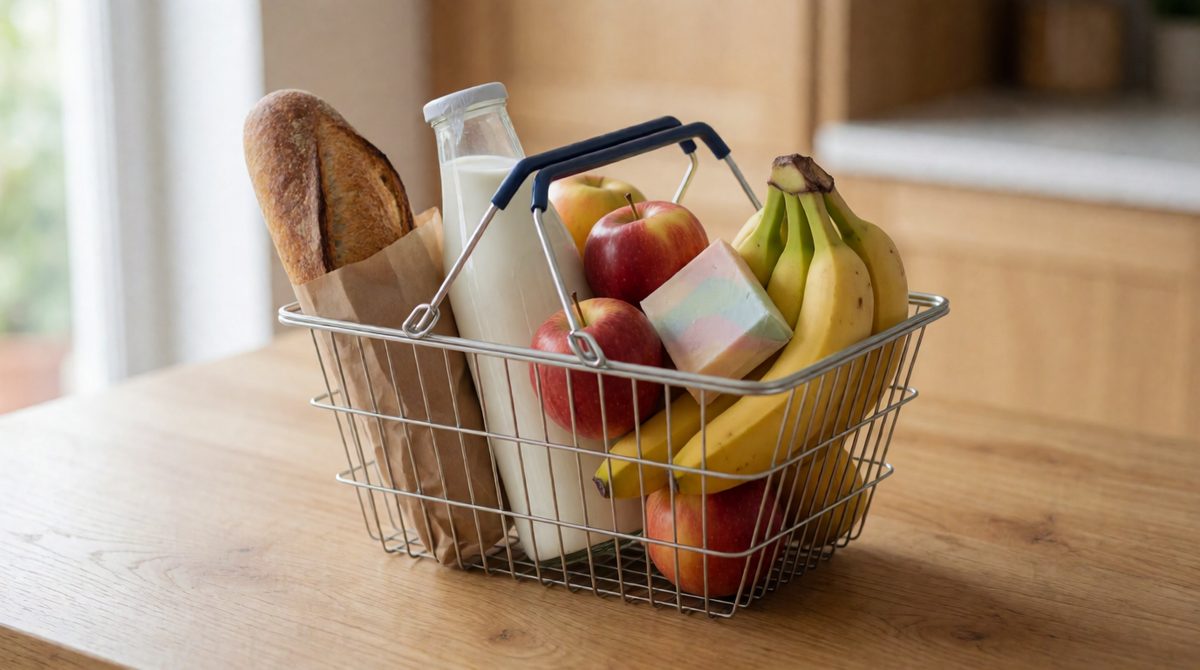
The CPI tracks the prices of a basket of goods and services that typical households buy
Officials choose the items a typical household buys, such as food, housing, transport, clothing and leisure. The basket is updated regularly as spending habits change.
Households spend more on some things than others. A big rise in the price of something people spend a lot on matters more than a rise in a small item. So big spending items get big weights.
Prices in the base year are set at 100. A CPI of 110 means prices are 10% higher than in the base year. A CPI of 95 means they are 5% lower.
Each year, the prices of the items in the basket are collected, compared with the base year and combined using the weights. The result is one number: the CPI.
In the base year a loaf of bread cost £1.20. This year it costs £1.38. Find the price index for bread.
Price index = (new price ÷ base year price) × 100
= (1.38 ÷ 1.20) × 100 = 1.15 × 100 = 115
The price of bread is 15% higher than in the base year.
Country Kelvara has a simple basket. The base year is Year 1, so every index is 100 in Year 1. The table shows the weights and the price index for each group in Year 2.
| Group | Weight | Price index, Year 2 | Weight × index |
|---|---|---|---|
| Food | 30 | 110 | 3,300 |
| Housing | 25 | 104 | 2,600 |
| Transport | 20 | 120 | 2,400 |
| Clothing | 10 | 100 | 1,000 |
| Leisure | 15 | 105 | 1,575 |
| Total | 100 | 10,875 |
CPI = total of (weight × index) ÷ total of weights = 10,875 ÷ 100 = 108.75
Prices in Kelvara are on average 8.75% higher than in the base year. Notice that transport rose the most (20%), but its weight is only 20, so it did not pull the CPI up as much as it would with a bigger weight.
The CPI itself tells you how prices compare with the base year. To find the inflation rate between two years, work out the percentage change in the CPI.
Inflation rate (%) = (new CPI − old CPI) ÷ old CPI × 100
Country Merlow's CPI was 125 last year and 130 this year.
Change = 130 − 125 = 5
Inflation rate = 5 ÷ 125 × 100 = 4%
Prices are on average 4% higher than a year ago.
Country Tolvane's CPI was 120 last year and 117 this year.
Change = 117 − 120 = −3
Inflation rate = −3 ÷ 120 × 100 = −2.5%
The rate is negative, so there is deflation. Prices are on average 2.5% lower than a year ago.
The table shows the consumer price index for Country Lumora. The base year is 2021.
| Year | 2021 | 2022 | 2023 |
|---|---|---|---|
| CPI | 100 | 104 | 109.2 |
(a) Define deflation. [2 marks]
(b) Calculate the inflation rate in Country Lumora between 2022 and 2023. Show your working. [2 marks]
(c) Explain why the government uses weights when it calculates the CPI. [3 marks]
(d) Which one of the following is the CPI in the base year? [1 mark]
A 0 B 1 C 10 D 100
(a) Deflation is a fall (1) in the general level of prices over time (1).
(b) Inflation rate = (109.2 − 104) ÷ 104 × 100 (1) = 5% (1).
(c) Households spend more of their income on some goods and services than others. (1) A price change in an item that takes a large share of spending affects households more. (1) Weights give bigger items a bigger effect on the CPI, so the index shows the true average change in prices that households face. (1)
(d) D (1)
In a calculation part, write the formula and the numbers before the answer. If you divide by the wrong CPI you may still earn a method mark for a clear working line.