📉 Cyclical
When the economy is in recession, households spend less, so firms sell less and cut staff. Builders and car factory workers often lose jobs first. When the economy recovers, many of these jobs return.
This topic is examined on Paper 2 (Macroeconomics and the Global Economy). One of the main aims of a government is low unemployment. Before we ask why it matters, we need to know what it is, how it is counted and why people end up without jobs.
Sign up to access the complete lesson and track your progress!
Unlock This Course
The ILO counts people as unemployed if they are without work, available and actively looking for a job
Unemployment is when people who are able and willing to work cannot find a job. Notice that it does not mean everyone without a job. A retired person or a full-time student who does not want to work is not unemployed.
Countries need a fair way to count the unemployed, so that figures can be compared over time and between countries. The standard method is the International Labour Organisation (ILO) measure. The ILO counts a person as unemployed if they are:
A person must meet all three conditions. Someone who wants a job but has given up looking is not counted, because they are not actively seeking work.
Key terms:
The number of people out of work is useful, but a big country will always have more unemployed people than a small one. The unemployment rate allows fair comparisons.
Unemployment rate (%) = (number unemployed ÷ labour force) × 100
Labour force = number employed + number unemployed
In Country Tarsa, 33.2 million people are employed and 1.8 million are unemployed under the ILO measure.
Step 1: labour force = 33.2 + 1.8 = 35 million.
Step 2: unemployment rate = (1.8 ÷ 35) × 100 = 5.14%, which is 5.1% to one decimal place.
Country Belmo has a labour force of 50 million and an unemployment rate of 6%.
Number unemployed = 6% of 50 million = 0.06 × 50 = 3 million.
Common slip: dividing by the whole population, or by the number employed, instead of the labour force.
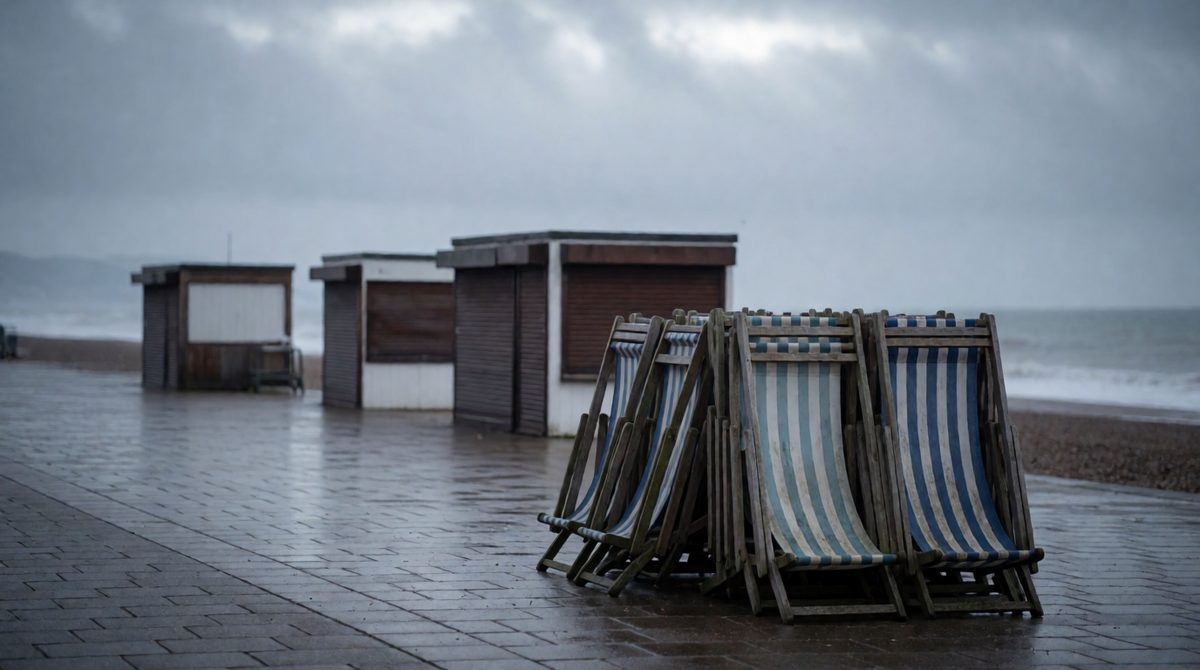
Beach cafes hire in summer and lay off staff in winter: seasonal unemployment
People become unemployed for different reasons. Economists group the reasons into five types, because each has different causes.
Key terms:
When the economy is in recession, households spend less, so firms sell less and cut staff. Builders and car factory workers often lose jobs first. When the economy recovers, many of these jobs return.
Britain's coal mines closed over many years, and miners found that their skills did not suit the new jobs. Machines replacing workers can also cause it. These jobs do not simply come back, so workers may need retraining or to move.
Seaside hotels hire fewer staff in winter. Fruit pickers are needed only at harvest. Ski instructors are busy only in the snow season.
A qualified electrician turns down a job paying £11 an hour because they want at least £15. They are choosing to stay out of work at that wage.
A shop assistant leaves one job and spends three weeks looking for a better one. A graduate spends two months finding a first job.
| Type | Key clue in a question | Likely to last |
|---|---|---|
| Cyclical | Recession, falling demand, firms cutting back | Until the economy recovers |
| Structural | Industry declines, new technology, skills mismatch | Often a long time |
| Seasonal | Time of year, tourism, farming | Months, then jobs return |
| Voluntary | Worker refuses a job or holds out for more pay | Depends on the worker |
| Frictional | Between jobs, searching | Short |
Read the clue carefully. A factory worker made redundant because the factory closed for good is structural. If the factory laid off staff only because demand fell in a recession, it is cyclical.
Do not say that everyone without a job is unemployed. Students, retired people and people who have given up looking do not count under the ILO measure. Do not mix up cyclical (a lack of demand across the economy) with structural (one industry shrinking or skills not matching). Do not call a person voluntarily unemployed just because they are searching for a job: that is frictional.
Country Ostra has the following labour market figures.
| Group | Number of people (millions) |
|---|---|
| Employed | 23.5 |
| Unemployed (ILO measure) | 1.5 |
Ostra's tourist resorts close for four months each winter. A large steelworks has also closed because of cheaper imports, and the former workers lack the skills for the new jobs in the area.
(a) Define 'unemployment'. [2 marks]
(b) Calculate the unemployment rate in Country Ostra. [2 marks]
(c) Identify the type of unemployment caused by the resorts closing each winter. [1 mark]
(d) Explain why the closure of the steelworks has led to structural unemployment. [3 marks]
(a) Unemployment is when people are without a job (1) but are able and willing to work (1).
(b) Labour force = 23.5 + 1.5 = 25 million (1). Unemployment rate = 1.5 ÷ 25 × 100 = 6% (1).
(c) Seasonal unemployment (1).
(d) The steelworks was a whole industry in the area that has closed, so its workers lost their jobs (1). Their skills are in steel making and do not match the new jobs available (1), which means they cannot easily move into other work and may stay unemployed for a long time without retraining (1).
In a calculation, show the labour force step. If your final answer is wrong, you may still earn a mark for working out the labour force correctly.