This topic is examined on Paper 2 (Macroeconomics and the Global Economy). One of the government's macroeconomic objectives is a healthy balance on the current account. To see what that means, we first need to know how a country's dealings with the rest of the world are recorded.
What is the current account?
Every country buys things from other countries and sells things to them. The balance of payments is the record of all the money flowing into and out of a country from its dealings with the rest of the world. It is split into parts. The first and most important part is the current account.
The current account records a country's earnings from selling exports and its spending on buying imports. Money coming in from abroad counts as a credit. Money going out counts as a debit. The current account also records some flows of income and transfers of money between countries, but for this course the big idea is trade: what the country sells abroad compared with what it buys from abroad.
Key terms:
- Balance of payments: the record of all money flowing into and out of a country from its dealings with the rest of the world.
- Current account: the part of the balance of payments that records the value of a country's exports and imports of goods and services (plus some income flows and transfers).
- Exports: goods and services sold to other countries. Money flows in.
- Imports: goods and services bought from other countries. Money flows out.
- Visibles: trade in goods, things you can touch and see.
- Invisibles: trade in services, things you cannot touch.
- Current account surplus: money coming in is greater than money going out.
- Current account deficit: money going out is greater than money coming in.
Visibles and invisibles
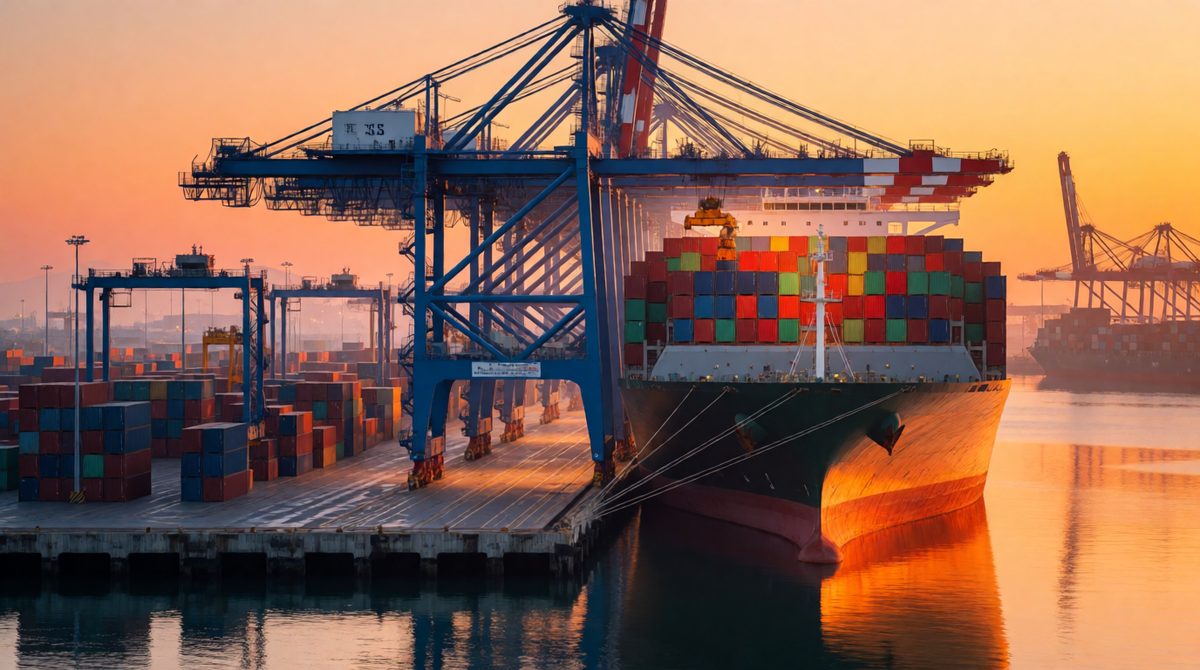
Container ships carry visible trade, physical goods like cars and clothes crossing borders
Trade between countries is split into two kinds. Economists give them names that are easy to remember.
🚢 Visibles (goods)
Physical products that can be packed in a box or a ship and carried across a border. Examples: cars, oil, wheat, clothes, mobile phones and coffee beans. When a country sells these abroad they are visible exports. When it buys them from abroad they are visible imports.
🏢 Invisibles (services)
Services that cannot be touched. Examples: a foreign tourist staying in a hotel, an overseas company using a bank or an insurance firm, a foreign student paying university fees, or a shipping company carrying goods for another country.
Watch the direction of the money
A tourist from abroad who spends money in your country is an invisible export, even though nothing leaves the country. Why? Because money flows in from abroad in return for a service. If your own citizens go on holiday overseas, that is an invisible import, because money flows out.
Surplus and deficit

Tourists spending money abroad is trade in services: invisible imports for their home country
The balance on the current account tells us whether a country is earning more from the rest of the world than it is spending. For this lesson we use the simple version, where only trade in goods and services is counted:
Learn this
Balance on the current account = value of exports − value of imports
✅ Surplus
Exports are worth more than imports. The answer is positive. More money flows in than out.
❌ Deficit
Imports are worth more than exports. The answer is negative. More money flows out than in.
💲 Balance
Exports equal imports. The answer is zero. The account is exactly in balance.
A deficit is shown with a minus sign, for example −£5 billion. Always check you have subtracted in the right order: exports first, then take away imports.
Worked example
Country Lorvane had the following trade last year.
| Exports (billion) | Imports (billion) |
|---|
| Goods (visibles) | 80 | 95 |
| Services (invisibles) | 45 | 20 |
Step 1: total exports = 80 + 45 = 125 billion.
Step 2: total imports = 95 + 20 = 115 billion.
Step 3: balance = 125 − 115 = +10 billion. This is a current account surplus of 10 billion.
Notice that the country had a deficit on goods (80 − 95 = −15 billion) but a bigger surplus on services (45 − 20 = +25 billion). The overall balance is −15 + 25 = +10 billion.
Worked example
Country Mestia exported goods worth 60 billion and services worth 18 billion. It imported goods worth 72 billion and services worth 16 billion.
Total exports = 60 + 18 = 78 billion. Total imports = 72 + 16 = 88 billion.
Balance = 78 − 88 = −10 billion. This is a current account deficit of 10 billion.
Common mistakes
Common mistakes
- Saying invisibles are not real trade. They are counted just like goods. Tourism and banking earn real money for a country.
- Subtracting the wrong way round. Imports minus exports gives the wrong sign. Use exports minus imports.
- Forgetting the minus sign on a deficit. A deficit of 10 billion should be written as −10 billion.
- Mixing up the direction of tourism. A visitor to your country is an export. Your citizens holidaying abroad is an import.
- Only counting goods. Remember to add services to both exports and imports before you subtract.
Exam-style question
Country Veltri trades with the rest of the world. Last year its exports were: goods 150 billion, services 70 billion. Its imports were: goods 140 billion, services 95 billion.
(a) Define the term 'current account'. [2 marks]
(b) Calculate the balance on the current account. Show your working. [3 marks]
(c) Identify one example of a visible export and one example of an invisible export. [2 marks]
Model answer
(a) The part of the balance of payments (1) that records the value of a country's exports and imports of goods and services (1).
(b) Total exports = 150 + 70 = 220 billion (1). Total imports = 140 + 95 = 235 billion (1). Balance = 220 − 235 = −15 billion, a deficit (1).
(c) Visible export: cars (or any good sold abroad) (1). Invisible export: tourism, where foreign visitors spend money in the country (or banking, insurance, shipping) (1).
Exam tip
In part (b), write the total for exports and the total for imports on separate lines before you subtract. If you slip on the last step you can still pick up the method marks.
Recap
- The current account records a country's exports and imports of goods and services, plus some income and transfers.
- Visibles are goods. Invisibles are services.
- Balance = exports − imports.
- A positive answer is a surplus. A negative answer is a deficit.