 By the Brainy Lemons team
The IGCSE Marine Science syllabus is Cambridge International’s course 0697, all about the oceans and the life in them. For exams in 2027, 2028 and 2029 you study six topics, then sit two written papers. Each lasts 1 hour 45 minutes, is worth 80 marks and counts for half of your A* to G grade.
This guide gives you an overview of every topic, how the two papers work, the practical skills you’ll be tested on and how hard the subject really is. Then we’ll show you how to plan two years of study, at school or at home.
If you searched for “marine biology GCSE”, this is very likely the course you’re after.
The main English exam boards (AQA, Pearson Edexcel and OCR) don’t offer a GCSE in Marine Science or Marine Biology. So the IGCSE is the one most UK students take, along with students in international schools around the world.
At a glance
- Exam board: Cambridge International
- Syllabus code: 0697
- Current syllabus: exams in 2027, 2028 and 2029 (June and November)
- Papers: two, each 1 hour 45 minutes and 80 marks (50% each)
- Tiers: none, everyone sits the same two papers
- Coursework: none, practical skills are tested in Paper 2
- Grades: A* to G
- Guided learning: about 130 hours
What is IGCSE Marine Science?
It’s a science course where everything is set in the ocean. You’ll learn some physics (density, pressure, tides) and some chemistry (pH, salinity, dissolved gases). There’s a lot of biology too: cells, classification, food webs and ecosystems. Then you’ll look at how people use and damage the sea, and how we can protect it.
The current course was first examined in 2024 and it’s open to private candidates, which makes it popular with home-educated students.
IGCSE is designed for 14 to 16 year olds. UK ENIC, the UK agency that compares qualifications, found it comparable to a UK GCSE.
The IGCSE Marine Science syllabus: what you’ll study
The content is split into six topics, and here’s what sits inside each one, using the headings from the official document.
| Topic | What’s inside |
|---|---|
| 1 The Earth and its oceans | Structure of the Earth, plate tectonics, oceans and seas, tides and currents |
| 2 Sea water | The water cycle, pH and salinity, dissolved gases, density, effects of increasing depth, upwelling |
| 3 Marine organisms | Cells, reproduction, classification, the animal kingdom, plants and protoctists, life cycles, migration |
| 4 Nutrients and energy | Nutrients, respiration, photosynthesis, feeding relationships |
| 5 Marine ecology | Ecosystem terms, fieldwork methods, the open ocean, rocky shores, sandy and muddy shores, mangroves, coral reefs |
| 6 Human influences on the marine environment | Tourism, fisheries, aquaculture, energy from the oceans, plastic pollution, eutrophication, climate change, conservation |
1. The Earth and its oceans
You start with the planet itself: its iron core, the mantle and the crust, and why the Earth has a magnetic field. Then come tectonic plates, the three types of plate boundary, earthquakes, volcanoes and how a tsunami forms.
Next you’ll learn the five oceans and sea floor features like the continental shelf, abyssal plain and ocean trench. A few numbers are worth learning early. The oceans cover 71% of the Earth’s surface and hold 97% of its water, and the Mariana Trench reaches about 11 000 metres deep. The section ends with tides, currents, gyres and rip currents.
Our first lesson, an introduction to Earth as a planet, is free to try.
Core Dive
Drill from the Pacific sea floor to the centre of the Earth and use earthquake waves to prove the outer core is liquid. Then see how the magnetic field shapes the oceans.
Play free →2. Sea water
This is the chemistry and physics part. You’ll use particle theory to explain the water cycle, then measure pH and salinity, the concentration of dissolved salts in parts per thousand (ppt). You’ll compare a typical ocean (the Pacific) with a low-salinity sea (the Baltic) and a high-salinity one (the Red Sea).
You’ll also learn why warm water holds less dissolved oxygen, use the formula density = mass ÷ volume, and explain why colder water usually sits below warmer water. Light, pressure and temperature changes with depth come last, along with upwelling and El Niño.
Start with particle theory and states of matter.
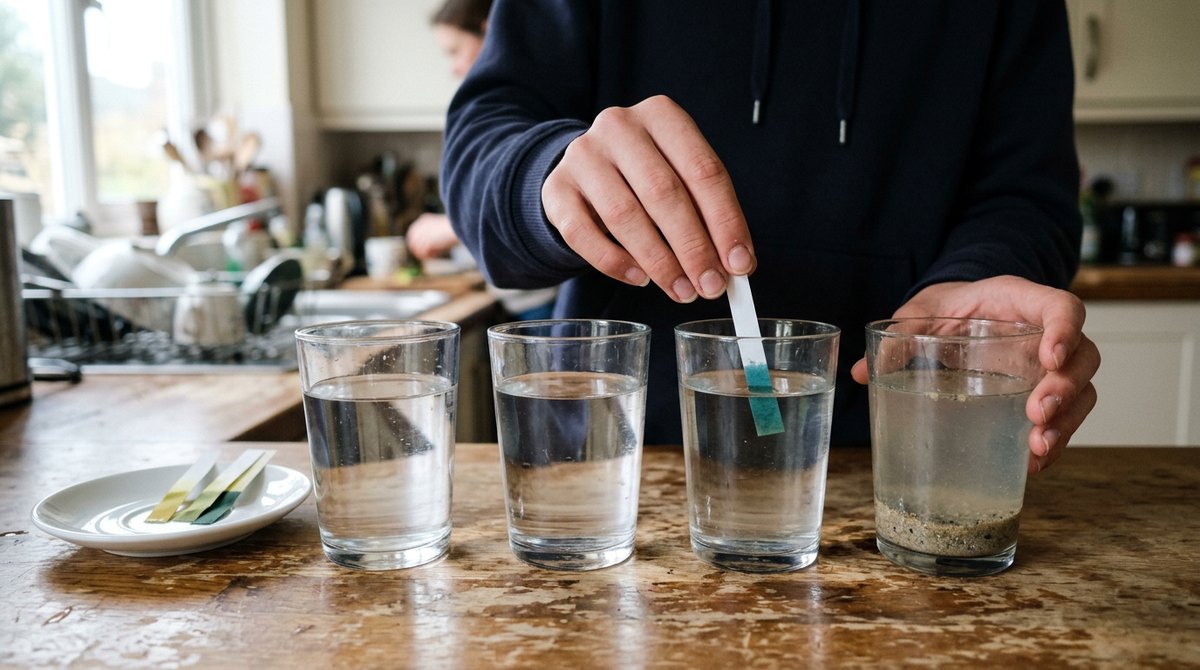
Testing the pH of sea water, fresh water and rain water is one of the set practicals in section 2, and you can do it at a kitchen table.
Sea Change
Test sea water, fresh water and rain water with universal indicator. Then bubble carbon dioxide through sea water and stop each beaker on its target colour as the pH falls.
Play free →3. Marine organisms
Here you meet the living things. You’ll compare plant, animal and bacterial cells, then learn how scientists sort life into three domains and name species with the binomial system (an orca is Orcinus orca). After that come the features of marine vertebrates and invertebrates, the parts of a fish, and seagrass, kelp, diatoms and dinoflagellates. You’ll finish with the life cycles of the leatherback turtle and the coral polyp, and why animals migrate.
It all opens with plant cell structure.
4. Nutrients and energy
What do living things need, and how does energy move through the sea? You’ll do food tests, learn the respiration and photosynthesis word equations, and see how upwellings boost productivity near the coast. Then you’ll build marine food chains and food webs and place organisms at trophic levels (their feeding position in a chain).
Our lesson on nutrients and their functions is where this part begins.
5. Marine ecology
This is the biggest section. You’ll learn key ecology terms (species, population, community, habitat, ecosystem) and how to investigate a shore with quadrats and transects.
Then you’ll study real ecosystems one by one: the open ocean and its sunlight, twilight and midnight zones, rocky shores, sandy and muddy shores, mangrove forests and tropical coral reefs. You’ll even learn the Darwin-Dana-Daly theory of how a coral atoll forms.
6. Human influences on the marine environment
The last section asks how people use the oceans and what that does to them. You’ll weigh up tourism and ecotourism, fishing methods, fish farming (aquaculture), oil spills and ocean energy. Plastic pollution and eutrophication are here too (eutrophication is when fertiliser run-off causes algal blooms and oxygen loss). It ends with climate change and conservation, such as Marine Protected Areas.
A good starting point is why marine ecosystems matter to humans.
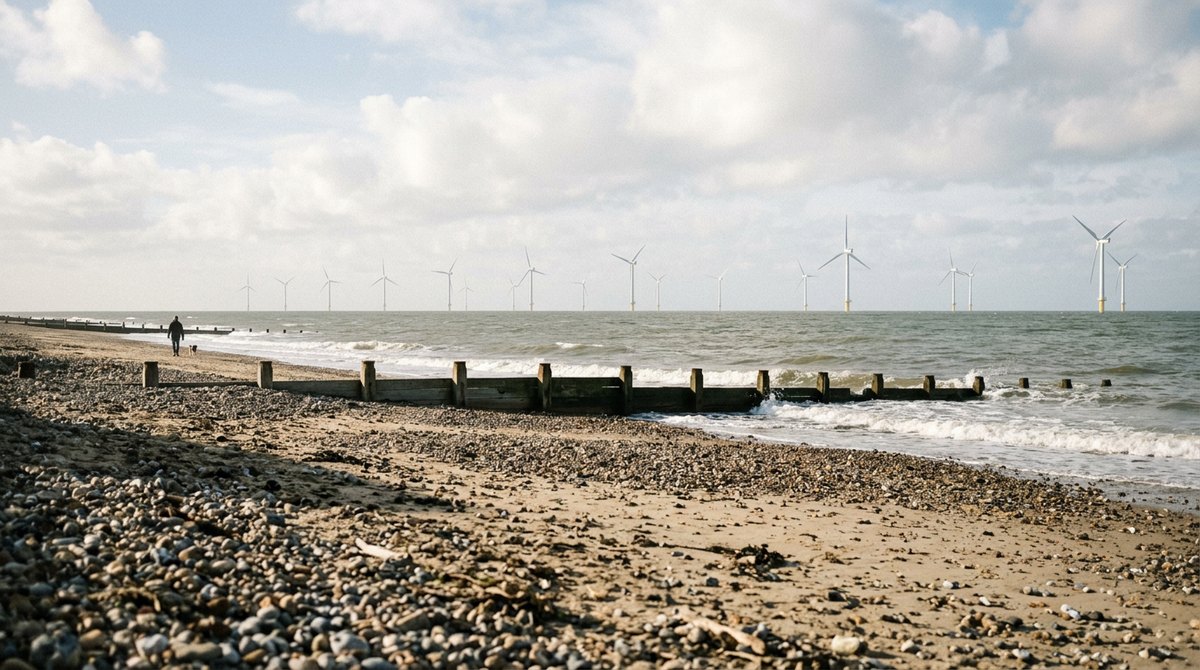
Energy from the oceans, such as offshore wind, is weighed up against its effects on marine life in section 6.
Six sections, 260 short lessons, in the same order as the syllabus. Start with the first three free.
Try 3 lessons free →How the exam papers work
Everyone sits the same two papers at the end of the course, in the June or November series. There are no tiers and no coursework.
| Paper | Time | Marks | Share of grade | What it tests |
|---|---|---|---|---|
| Paper 1: Theory and Data Handling | 1 hour 45 minutes | 80 | 50% | Knowledge (AO1) and handling information (AO2) |
| Paper 2: Theory and Practical Skills | 1 hour 45 minutes | 80 | 50% | AO1, AO2 and experimental skills (AO3) |
Source: Cambridge IGCSE Marine Science 0697 syllabus for 2027, 2028 and 2029 (published September 2024).
Paper 1: Theory and Data Handling
Paper 1 has compulsory short-answer and structured questions. About two thirds of the marks test what you know and understand. The rest test whether you can read graphs and tables, spot trends, do calculations and apply ideas to a situation that’s new to you.
Paper 2: Theory and Practical Skills
Paper 2 looks similar, but 40% of its marks are for experimental skills, which works out at 20% of your whole grade. You might be asked to plan an investigation, name the independent and dependent variables, say what to keep the same, or spot an odd result and improve a method.
The practicals you need to know
The syllabus marks a set of practical activities that every student should do as a minimum. They include testing the pH of sea water, fresh water and rain water, and the effect of temperature and salinity on water density. You’ll also use a Secchi disc, do food tests, test how light affects photosynthesis and sample a shore with quadrats and transects.
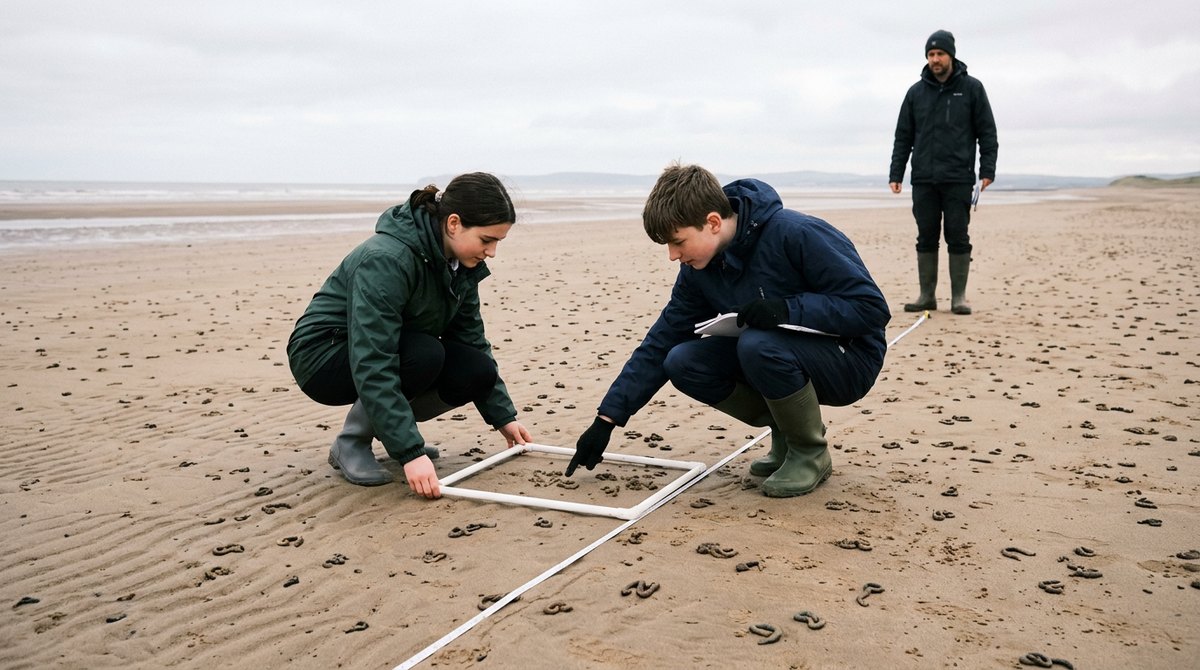
Sampling a sandy shore with a quadrat and a transect is one of the fieldwork practicals in section 5.
You won’t do practicals in the exam hall, though. Paper 2 asks about them in writing, and about new experiments that use the same skills. Our lesson on quadrat sampling methods shows how this is taught.
Command words and a sample question
Each question starts with a command word that tells you what to do. “Describe” means give the main features. “Explain” means say why or how. Mixing these up is one of the easiest ways to lose marks. Others you’ll meet include state, outline, compare, evaluate and suggest, and the syllabus lists exactly what each one means.
Here’s a question in the style of the papers. We wrote it, so it isn’t a real past paper question:
Explain why colder water usually lies beneath warmer water in the ocean. [2 marks]
A two-mark answer needs two linked points. Colder water is denser than warmer water (1 mark), because its particles are closer together, so it sinks below the less dense warm water (1 mark). Just writing “cold water sinks” says what happens but not why, so it scores nothing.
What changed for 2027 to 2029?
Very little. The new syllabus came out in September 2024, and Cambridge says there are no significant changes that affect teaching.
Textbooks endorsed for the 2024 version are still suitable, so a second-hand copy does the job. Just check you’ve got the syllabus for the year you sit the exam.
Is IGCSE Marine Science hard, and who is it for?
It’s a full science IGCSE, so it takes steady work. The ideas aren’t harder than Biology, but the course is wide: you jump from tectonic plates to chemistry to fish fins to fishing rules. The data and practical questions are where many students drop marks. Practise them little and often, not just before the exam.
About two in three candidates got a C or better, and about one in twelve got an A*. That’s lower than IGCSE Biology in the same series (75.2% got a C or above), so don’t expect an easy ride. Steady practice with data and practical questions makes the biggest difference.
It suits you if you love the sea and wildlife, you like science that links to real problems such as plastic and climate change, or you’re thinking about marine biology, oceanography or conservation later on.
How it compares with Biology and Geography
There’s overlap with both. The cells, nutrition and ecology parts feel like Biology, while tides, currents and plate tectonics feel like Geography. It also shares a lot with Environmental Management, which we cover in our IGCSE Environmental Management syllabus guide. Many students take Marine Science alongside Biology rather than instead of it.
What it leads to
Cambridge says students with grades A* to C are well prepared for further courses, including Cambridge International AS & A Level Marine Science. It’s also a good base for A level Biology, Geography or Environmental Science.
Can you study Marine Science at home?
Yes. The syllabus says private candidates can enter, so you can learn online and sit the exams at a centre that accepts private candidates.
You’ll need to find that centre yourself and book early, as fewer centres offer this subject. Many of the practicals work at home with simple kit, like testing pH with universal indicator or comparing the density of fresh and salty water. Some exam centres ask home learners about their practical work before accepting an entry. Check what yours needs before you start.
Choosing your other subjects too? Our IGCSE Geography syllabus 2027 guide works the same way.
How to prepare: a two-year plan
Cambridge plans each IGCSE around 130 guided learning hours. Spread over two school years, that’s roughly two hours a week. Here’s one way to split the six sections, using our lesson numbers as a guide.
| Term | Section | Our lessons |
|---|---|---|
| Year 1, autumn | The Earth and its oceans | 1 to 44 |
| Year 1, spring | Sea water | 45 to 84 |
| Year 1, summer | Marine organisms | 85 to 136 |
| Year 2, autumn | Nutrients and energy, then start marine ecology | 137 to 194 |
| Year 2, spring | Finish marine ecology, then human influences, then start past papers | 195 to 260 |
| Year 2, summer | Final revision and the June exams | Quizzes, flash cards, past papers |
Each week, do your new lessons, then spend 10 minutes testing yourself on last week’s work. When you start past papers, time yourself: 80 marks in 105 minutes is a little over a minute per mark.
Want a plan that fits your own start date? Pick your exam series below and it works out how many lessons a week you need.
- I can name all six sections and what’s in each one
- I know how long each paper is and what it tests
- I can use density = mass ÷ volume
- I can explain upwelling and how El Niño affects it
- I can build a marine food web and label trophic levels
- I can describe how to sample a shore with a quadrat and a transect
- I can explain eutrophication step by step
- I know the difference between “describe” and “explain”
Studying Marine Science with Brainy Lemons
Our Cambridge IGCSE Marine Science online course covers the whole Cambridge syllabus for exams in 2027 to 2029, in the same order as the official document.
- 260 lessons of about 30 minutes each, with clear explanations, pictures and key words
- A quiz after every lesson, plus the Lemonaire quiz show and the Last Stand zombie defence game
- 4,761 flash cards
- Four 3D games, Core Dive, Moonshot, Tide Turner and Sea Change, all free to play
- A study timetable: pick your finish date and it plans your lessons week by week
- Progress tracking, so you and your parents can see what needs another look
The first three lessons are free, so you can see if the style suits you. When you’re ready, the full IGCSE Marine Science course has everything else, from plate tectonics right through to conservation. You can work through it on a phone, tablet or laptop.
IGCSE Marine Science FAQs
Is there a GCSE in Marine Biology or Marine Science?
Not from AQA, Pearson Edexcel or OCR. The course people usually mean is Cambridge IGCSE Marine Science (0697), which is open to schools and private candidates in the UK and abroad.
Where can I find the official syllabus?
It’s on the Cambridge IGCSE Marine Science 0697 page.
What about the 2026 syllabus?
Exams in 2026 use the 2024 to 2026 version. The 2027 to 2029 syllabus has no significant changes that affect teaching. So if you started on the old one, you’ve lost nothing.
Is there a textbook?
Yes, there are Cambridge-endorsed textbooks, and ones endorsed for exams from 2024 are still suitable now.
Where can I get past papers?
Cambridge keeps past papers and mark schemes on its School Support Hub for schools. If you’re a private candidate, ask your exam centre. Also check the resources listed on Cambridge’s 0697 page.
Is there an A level in Marine Science?
Yes, Cambridge International AS & A Level Marine Science. Cambridge says students with IGCSE grades A* to C are well prepared for it.
Learn every part of the Marine Science syllabus, one short lesson at a time
From plate tectonics to coral reefs, our course follows the Cambridge 0697 syllabus step by step, with a quiz and two games on every lesson.
- 260 short lessons that follow the Cambridge 0697 syllabus
- A quiz, a quiz show and a zombie defence game on every lesson
- 4,761 flash cards, from easy to exam-hard
- 4 3D Marine Science games for the hardest topics
No card needed. Works on any device.