 By the Brainy Lemons team
Yes, you can study GCSE Biology online. You learn every topic at home with an online course, then sit the written papers at an exam centre. You can choose AQA GCSE Biology (8461), which comes with ten lab practicals. Or you can take Pearson Edexcel International GCSE Biology (4BI1), which tests practical skills in the written papers only.
This guide is for students aged 14 to 16 and their parents, especially if you’re home educated. We’ll compare the two courses and walk through what you study and how the papers work. Then we’ll look at the lab practicals, which is the part that catches most families out.
Along the way you’ll see how real students did in summer 2026 and set up a study plan for your own exam year. You’ll also find out what to check before you pay for any online GCSE Biology course.
At a glance
- Route 1: AQA GCSE Biology, code 8461, two papers of 1 hour 45 minutes each
- Route 2: Pearson Edexcel International GCSE Biology, code 4BI1, papers of 2 hours and 1 hour 15 minutes
- Tiers: Foundation or Higher with AQA, no tiers with Edexcel
- Coursework: none on either route
- Lab practicals: ten required with AQA, none to sit with Edexcel
- Exam series: May and June with AQA, June and November with Edexcel
- Teaching time: about 120 guided learning hours for either one
Can you do GCSE Biology online?
Almost all of GCSE Biology is about understanding and explaining things, from how a cell takes in water to how a disease spreads through a population. That makes it a great subject for online learning. You can work through the biological facts and concepts at home, at your own pace, with short lessons and plenty of recall practice to make them stick.
What you can’t do online is sit the exams. Every biology paper is a written exam taken in person at an exam centre, usually a college or school that also enters its own students. You go in as a private candidate, which simply means you sit the papers there without being enrolled. So an online course does the teaching while a centre near you runs the exams.
It’s a flexible way to work towards a full GCSE Biology qualification, with no formal entry requirements for AQA’s course. The one extra question with biology is the lab work. How you handle it depends on which course you choose.

A library makes a calm place to study when you learn online. Drawing a diagram as you go helps it stick.
AQA or Edexcel IGCSE: which biology course?
Both are full qualifications graded 9 to 1 that cover the same big ideas. The differences are in how you’re examined and what you’ll need to do in a lab.
| AQA GCSE Biology (8461) | Edexcel International GCSE Biology (4BI1) | |
|---|---|---|
| Papers | Paper 1 and Paper 2, each 1 hour 45 minutes | Paper 1B (2 hours) and Paper 2B (1 hour 15 minutes) |
| Marks | 100 per paper, 50% each | 110 (61.1%) and 70 (38.9%) |
| Tiers | Foundation (grades 1 to 5) or Higher (grades 4 to 9) | None, everyone sits the same papers |
| Lab practicals | At least ten, done at your centre | Suggested only, tested in the written papers |
| Exam series | May and June | June and November |
| Where you can sit it | UK only for home learners | Centres in the UK and worldwide |
AQA GCSE Biology (8461)
This is the separate science GCSE most UK schools teach, often as part of triple science alongside GCSE Chemistry and Physics. It has seven topics split over two equal papers. You also pick Foundation or Higher tier. It’s a great fit if you want the same qualification as friends who go to school and you can get to a centre that runs the lab sessions.
Our guide to AQA’s biology papers and required practicals goes into every topic in detail.
Edexcel International GCSE Biology (4BI1)
The International GCSE, often shortened to IGCSE, is Pearson’s version for schools around the world and in the UK. The exam board says it’s of an equivalent standard to its own regulated GCSE in Biology. Pearson’s IGCSE builds on the science you learnt in Key Stage 3 (ages 11 to 14), with five topics, two papers and no tiers.
Because every mark comes from the written papers, many home educated families choose it. The specification also lists a November series as well as June, which gives you a little more choice over timing.
Read more in our Edexcel IGCSE Biology course guide.
What you study in GCSE Biology
Whichever route you take, you’ll learn how living things are built, how they work and how they depend on each other. The topic names differ a little between the two exam boards, but you’d recognise most of the content in either one. Here’s how each board splits it up.
AQA’s seven topics
Paper 1 covers cell biology, organisation, infection and response and bioenergetics. You’ll start with eukaryotes and prokaryotes, then move on to how cells, tissues, organs and systems fit together. After that comes pathogens and how disease spreads.
Paper 2 covers homeostasis and response, inheritance, variation and evolution, then ecology. That means nerves and hormones, starting with homeostasis and control systems, followed by DNA, genetics and finally ecosystems, communities and competition.
Edexcel’s five topics
The Edexcel syllabus covers the nature and variety of living organisms, structures and functions in living organisms, reproduction and inheritance, ecology and the environment and the use of biological resources. The second topic is by far the biggest, running from cell structure all the way to nerves and hormones. Plan to spend the most time there.
Watch out for statements printed in bold with a “B” after the number, as only Paper 2B can test them.
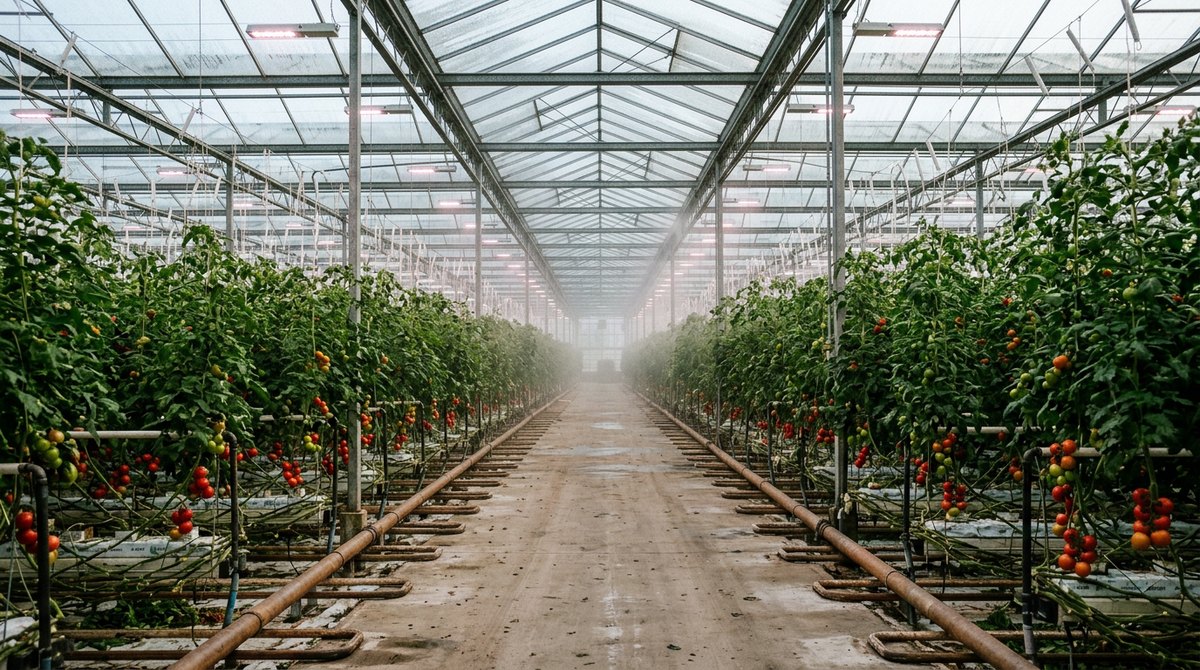
Growers control light, heat and carbon dioxide to make plants photosynthesise faster, which you’ll learn about in both courses.
Biology is everywhere once you start looking! Big tomato glasshouses like this one are a real example of limiting factors and greenhouses, a favourite topic for exam questions.
See how an online biology lesson works. The first three lessons of our AQA course are free, quizzes and games included.
Try 3 lessons free →How the GCSE Biology exams work
Both boards use written assessment only, with a mix of question types. AQA’s papers have multiple choice, structured, short answer and longer open response questions. Edexcel’s papers mix multiple-choice, short-answer, calculation and extended open-response questions.
Command words tell you what the examiner wants. “Describe” means say what happens and “explain” means say why it happens. “Evaluate” asks you to weigh up both sides and reach a judgement.
A question in the exam style
Here’s a question we’ve written in the same style as the real papers.
Give two differences between a plant cell and an animal cell. (2 marks)
You’d get a mark for each of two differences. A plant cell has a cellulose cell wall, chloroplasts and a permanent vacuole, but an animal cell has none of these. Short, exact answers win marks, so learning the right words matters as much as understanding the ideas.
Foundation or Higher tier?
With AQA you choose a tier for both papers. Foundation tier gives grades 1 to 5, while Higher tier gives grades 4 to 9, so if you’re aiming for a 6 or above you’ll need Higher. A timed mock exam at each tier is a good way to see which suits you.
Edexcel’s IGCSE has no tiers at all. Everyone sits the same papers and can get any grade.
Lab practicals when you learn online
This is the part to plan first, because it’s the biggest difference between the two routes.
The AQA route
AQA says every GCSE science student needs to carry out experiments, with at least ten for biology. If you learn at home, you’ll need to find a school or college that will let you do these required practicals. You must also be based in the UK. Questions on the experiments are worth at least 15% of the marks in the exams.
Some colleges and exam centres run lab sessions for home educated students. They usually cost extra on top of the exam fee, so ask about both when you get in touch. It’s worth asking early too, as places on these sessions can be limited. Our guide to finding a GCSE exam centre as a private candidate shows you how to search.
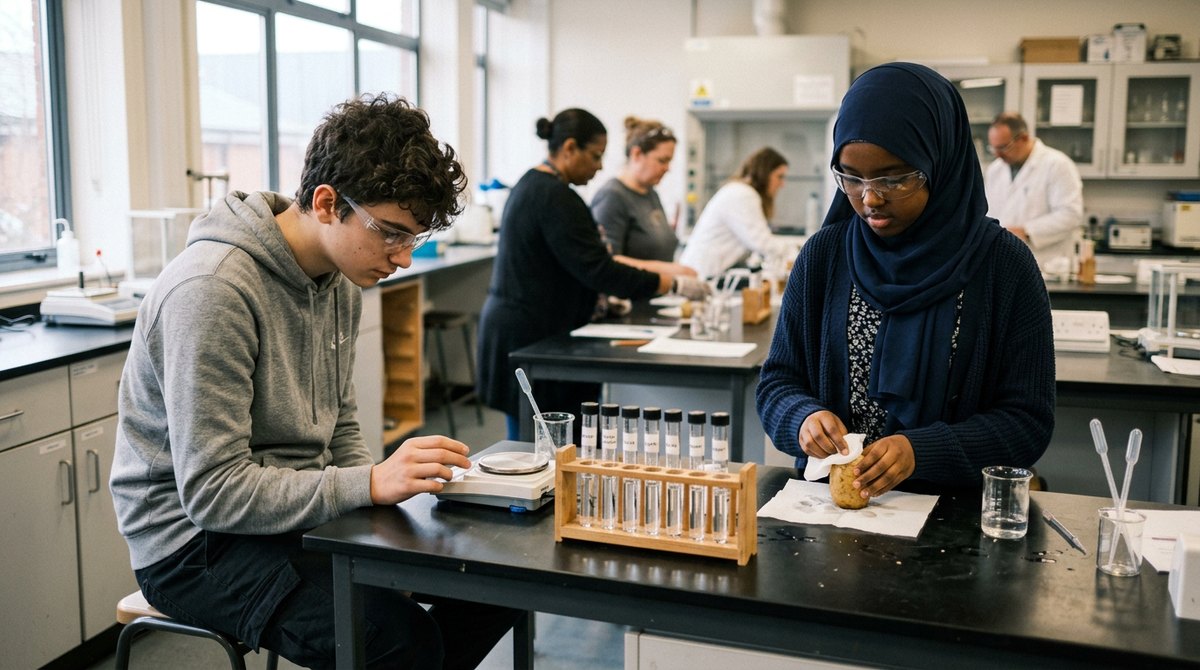
Some colleges run practical sessions like this osmosis experiment for students who learn at home.
The Edexcel IGCSE route
The International GCSE has no practical assessment and no teacher sign-off. The suggested investigations are tested through exam questions instead. Pearson’s science FAQ still recommends doing them. It says learners who can’t, including many private candidates, can learn the techniques from online simulations and videos.
Whichever route you choose, a simple student microscope at home goes a long way. Looking at real onion cells makes a topic like looking at cells under a microscope much easier to remember.
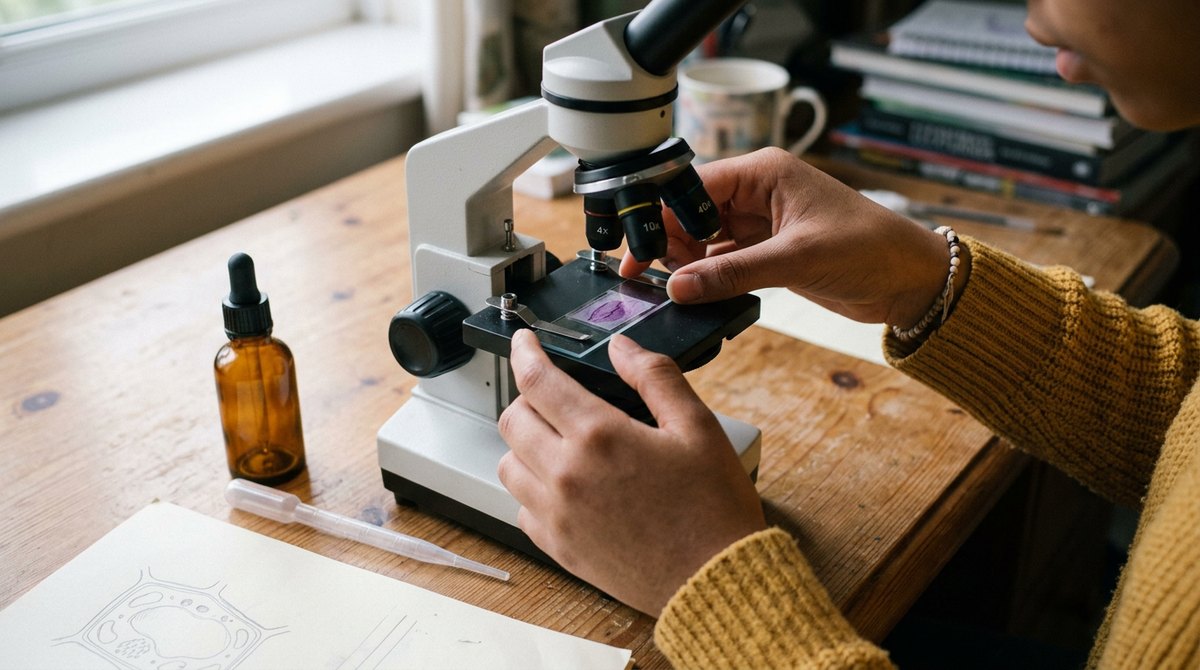
Onion cells stained purple under a home microscope are a simple way to see the cells you draw in your notes.
Is GCSE Biology hard? The 2026 results
There’s a lot to learn and you’ll need to apply it to situations you’ve never met before. But most students who take biology do well, as the summer 2026 results show.
Nearly nine in ten AQA students got a grade 4 or above. The IGCSE figures look even higher, but don’t read that as an easier exam. Results depend a lot on who sits each paper, so the best thing you can do is learn steadily and practise past papers.
Biology suits you if you’re curious about your own body and the natural world. It’s a strong base for A level Biology and other further education courses. It can also lead to a career in medicine, nursing, vet science, sport or conservation. Plenty of other careers value a good science grade too.
What to look for in an online GCSE Biology course
There are lots of online providers and they vary a lot in what you get for your money. Before you pay, check that the course ticks these boxes.
- names the exact specification it follows (AQA 8461 or Edexcel 4BI1) and teaches it in order
- explains every practical, with the method, variables and expected results
- has lots of practice questions and a topic test for each area, not just revision notes to read
- gives worked answers or written solutions, so you can see where marks come from
- has progress tracking so you can see which topics need another look
- is written for learners your age, with exam dates that match your plans
- lets you try some lessons free first
Some courses also include tutor support, video lessons or marked mock exams, usually for a higher fee. Ask how long you’ll have access too, as some providers limit it to 12 months. Exam fees are almost always extra because you pay them to the centre when you book your GCSE exams.
- Choose your route: AQA GCSE or Edexcel IGCSE
- Download the syllabus from the exam board’s website
- Find an exam centre that takes home educated students
- If you’re doing AQA, ask the centre about the lab practicals and their cost
- Pick your exam series and work back from it
- Get a calculator, ruler and sharp pencil for graphs and drawings
- Set a regular weekly time for biology
How long does it take to study GCSE Biology online?
Both boards expect about 120 guided learning hours, the teaching time a typical student needs. Schools usually spread that across two years. With distance learning you can go faster if you put in a little time most days, as long as you leave a few months at the end for past papers. Pick your exam series below and how many days a week you can study, then the planner will work out your pace.
Over two years, a simple plan could look like this.
- Year one, autumn and spring: cells, organs, disease and energy
- Year one, summer: nerves, hormones and homeostasis
- Year two, autumn: genetics and evolution
- Year two, spring: ecology, then your first full timed papers
- Year two, summer term: past papers, mark schemes and your weakest topics
If you’re sitting AQA in 2027, Paper 1 is on the morning of Tuesday 11 May and Paper 2 on Thursday 10 June, according to the board’s timetable.
Studying GCSE Biology online with Brainy Lemons
We have a GCSE course for each route, both written straight from the exam board’s specification. You can enrol at any time and study on any device. Our AQA GCSE Biology online course has 106 short lessons for the 2027 to 2029 exams, from microscopes to food production. Every lesson has a quiz, a quiz show and a zombie defence game. There are also 1,460 flash cards, from easy to exam-hard.
A study timetable plans your lessons week by week and your dashboard shows quiz scores and what to go back over.
Our Edexcel IGCSE Biology online course covers the whole syllabus in 265 lessons, with 4,419 flash cards and the same quizzes and games. It also has ten 3D biology games for the hardest topics, all free to play.
Slice Lab
Slice flying agar jelly so the acid reaches the middle in time, then beat cold snaps and weak acid. It’s surface area to volume ratio in action, a topic in both courses.
Play free →The best way to decide is to try one before you enrol. Start with the free first lesson of AQA Biology or the first IGCSE Biology lesson. Then you can see everything that’s included in the full GCSE Biology online course.
GCSE Biology online FAQs
Can I do GCSE Biology online for free?
You can learn a lot from free revision sites, but a free course rarely covers the whole specification in order. Our first three lessons are free to try with no card needed. You’ll always pay an exam fee to the centre where you sit the papers.
Can I sit the GCSE Biology exam online?
No, every GCSE and IGCSE Biology paper is a written exam taken in person at an exam centre. Only the learning happens online.
Is IGCSE Biology the same as GCSE Biology?
Not quite, as they’re different qualifications with their own specifications, but both are graded 9 to 1. Pearson describes its International GCSE as comparable to its regulated GCSE in standard. If you’re applying to a sixth form, check which qualifications it accepts.
Which is better for home educated students?
Many choose Edexcel’s IGCSE because there are no lab practicals to arrange. If you can get to a centre that runs the AQA practicals, the GCSE works just as well. Our IGCSE vs GCSE guide compares them across every subject.
How long does an online GCSE Biology course take?
Each board suggests roughly 120 hours of teaching time. Most students spread that over two years, but you can go faster at home with steady weekly study.
Can I study GCSE Biology online from outside the UK?
AQA says private candidates must be based in the UK. Edexcel’s International GCSE is sat at centres around the world. That makes it the usual route for students living abroad.
What’s the difference between Biology and Human Biology?
Human Biology is a separate Edexcel IGCSE that focuses on the human body. Biology is the wider course, covering plants, microorganisms, ecology and food production too.
Study GCSE Biology online, one short lesson at a time
Every AQA topic and all ten required practicals are taught in order, with quizzes, games and flash cards to make them stick.
- 106 short lessons that follow the AQA 8461 specification
- A quiz, a quiz show and a zombie defence game on every lesson
- 1,460 flash cards, from easy to exam-hard
No card needed. Works on any device.