 By the Brainy Lemons team
AQA GCSE Psychology (8182) is a two-year GCSE with no coursework. You sit two written papers at the end: Paper 1, Cognition and behaviour, and Paper 2, Social context and behaviour. Each lasts 1 hour 45 minutes, is worth 100 marks and makes up 50% of your grade, graded 9 to 1.
Psychology is the science of how people think, feel and behave. If you’ve ever wondered why you forget things, why crowds act differently from people on their own, or why your eyes can be fooled by an illusion, you’ll enjoy it.
This guide covers every topic on both papers, the key studies, how the exams work, the maths, whether it’s hard, and how to learn it online. Every exam fact comes from the board’s own psychology specification (version 1.1) and its May/June 2027 timetable.
At a glance
- Board: AQA
- Specification code: 8182
- Exams: every May/June, all taken at the end of the course
- Papers: Paper 1 and Paper 2, each a written exam of 1 hour 45 minutes, 100 marks, 50% of GCSE
- Tiers: none, everyone sits the same papers
- Coursework: none
- Grades: 9 (top) to 1
- Calculator: allowed
What is GCSE Psychology with AQA?
This GCSE was first taught in September 2017, and the first exams were in 2019. It’s still the same GCSE Psychology specification today. A specification (or “spec”) is the official list of everything you can be tested on.
The qualification is linear. That means you sit all your exams at the end, in the same series, rather than in bits along the way.
It’s designed to take two years, and there are no entry requirements, so you don’t need to have done any psychology before. The content is split into two halves, one per paper, with four topics in each. Research methods, the “how do psychologists find things out” topic, sits on Paper 1 but can be tested across both papers.
What you study on Paper 1: Cognition and behaviour
Cognition means mental processes like remembering, seeing and thinking, and Paper 1 looks at how these work and develop as you grow up.
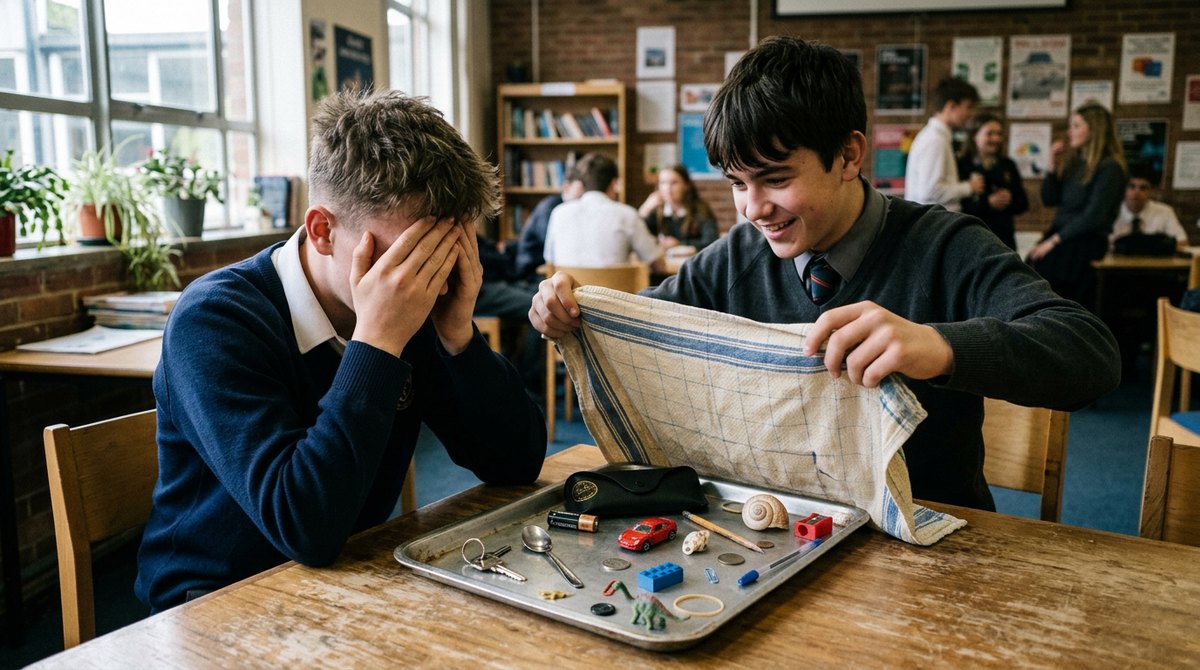
Look at the tray, cover it, then list what you saw: a simple test of encoding, storage and retrieval.
1. Memory
Our free first lesson, encoding, storage and retrieval, shows how this topic starts. You learn:
- the three processes: encoding (taking information in), storage and retrieval (getting it back out)
- episodic, semantic and procedural long-term memories
- the multi-store model: sensory, short-term and long-term stores
- why we forget or misremember, and the key studies by Murdock and Bartlett
2. Perception
This starts with the difference between sensation and perception, then covers:
- depth cues, such as relative size, occlusion and retinal disparity
- illusions like the Ponzo, the Müller-Lyer and the Ames Room
- Gibson’s direct theory (nature) against Gregory’s constructivist theory (nurture)
- perceptual set, and the studies by Gilchrist and Nesberg, and Bruner and Minturn
3. Development
You begin with how the brain develops from the womb onwards. After that, it’s:
- Piaget’s four stages of cognitive development
- McGarrigle and Donaldson’s “naughty teddy” study and Hughes’ policeman doll study
- Dweck’s fixed and growth mindsets, and the role of praise
- learning styles, and Willingham’s criticism of them
4. Research methods
This is the biggest topic, and it’s worth learning well because it can come up anywhere. Our lesson on the null hypothesis shows the detail you need. It covers:
- hypotheses, variables and sampling
- experiments, interviews, questionnaires, case studies and observations
- correlation, and ethics from the British Psychological Society
- data handling, including the maths
What you study on Paper 2: Social context and behaviour
Paper 2 moves from the single mind to the people around you, and then to the biology underneath it all.
1. Social influence
Why do we go along with the group? Start with what conformity is, and you’ll soon spot it everywhere. The topic covers:
- conformity and Asch’s line study
- obedience: Milgram’s agency theory and Adorno’s authoritarian personality
- bystander behaviour and Piliavin’s subway study
- how people behave in crowds

When everyone around you looks up, you probably will too, and social influence explains why.
2. Language, thought and communication
Does language shape how you think, or does thinking come first? You compare Piaget’s view that language depends on thought with the Sapir-Whorf hypothesis. You also cover:
- animal communication and Von Frisch’s bee study
- eye contact, body language and personal space
- whether non-verbal behaviour is learned or innate, including Yuki’s emoticon study
3. Brain and neuropsychology
This topic starts with the central and peripheral nervous system. Then you learn:
- the fight or flight response
- how neurons pass messages across a synapse
- the lobes of the brain and Penfield’s study of the interpretive cortex
- CT, PET and fMRI scans, and Tulving’s “gold” study
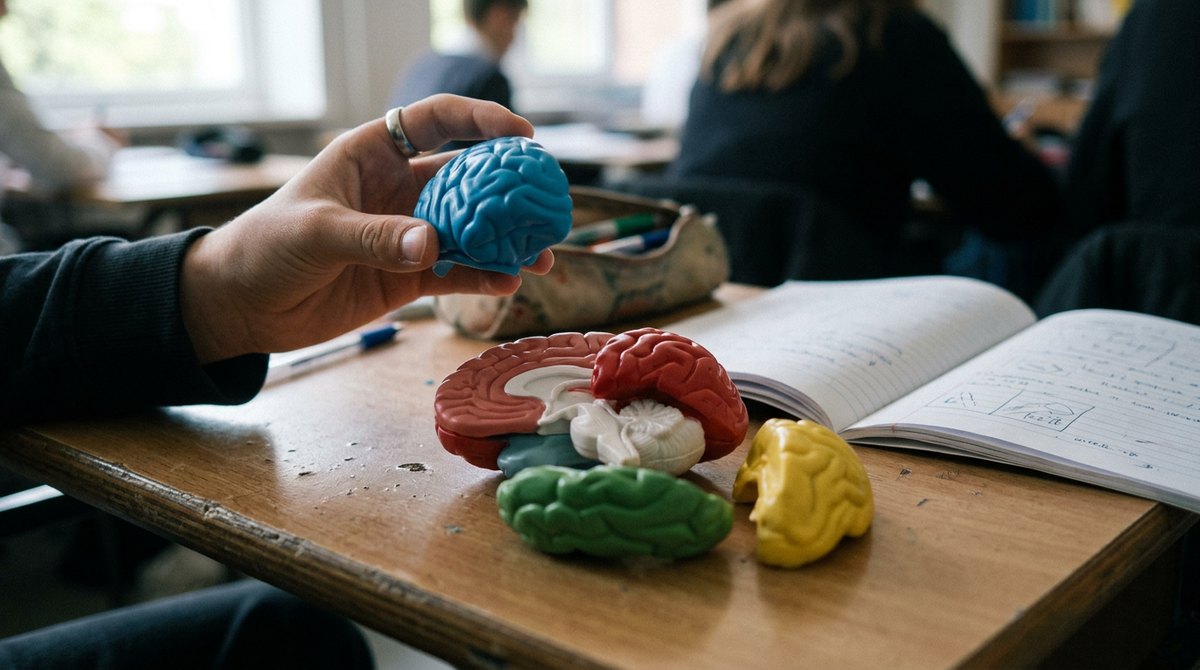
A model brain that comes apart makes the lobes, and what each one does, much easier to remember.
4. Psychological problems
The last topic is about mental health, and how attitudes to it have changed. Then you look at clinical depression and addiction in detail. For each one, you learn a biological explanation, a psychological explanation and treatments, such as antidepressants, CBT (cognitive behaviour therapy) and aversion therapy. The named studies are Wiles and Kaij.
Want to see a real lesson first? The first three lessons of our psychology course are free.
Try 3 lessons free →| Paper | Topic | Named studies and theories |
|---|---|---|
| Paper 1 | Memory | Multi-store model, Murdock, Bartlett |
| Paper 1 | Perception | Gibson, Gregory, Gilchrist and Nesberg, Bruner and Minturn |
| Paper 1 | Development | Piaget, McGarrigle and Donaldson, Hughes, Dweck, Willingham |
| Paper 1 | Research methods | Hypotheses, sampling, methods, ethics, data handling |
| Paper 2 | Social influence | Asch, Milgram, Adorno, Piliavin |
| Paper 2 | Language, thought and communication | Piaget, Sapir-Whorf, Von Frisch, Darwin, Yuki |
| Paper 2 | Brain and neuropsychology | Hebb, James-Lange, Penfield, Tulving |
| Paper 2 | Psychological problems | Wiles, Kaij |
How the AQA GCSE Psychology exams work
Both papers have the same shape. There are four sections (A to D), one per topic, and each is worth 25 marks. Every section mixes multiple choice, short answer and extended writing questions.
| Paper | Topics | Assessment | Share | 2027 date |
|---|---|---|---|---|
| Paper 1: Cognition and behaviour (8182/1) | Memory, perception, development, research methods | Written exam, 1 hour 45 minutes, 100 marks | 50% of GCSE | Mon 10 May 2027, afternoon |
| Paper 2: Social context and behaviour (8182/2) | Social influence, language, brain, psychological problems | Written exam, 1 hour 45 minutes, 100 marks | 50% of GCSE | Mon 17 May 2027, afternoon |
The dates come from the board’s May/June 2027 GCSE timetable (version 1.2). Always check the final version with your school or exam centre.
Question types
- Multiple choice: choose the right answer from a short list. Multiple choice questions often test key terms, so learn your definitions.
- Short answer: identify, describe or explain something in a few lines. Many short answer questions ask you to apply an idea to the stem.
- Extended writing: longer answers where you describe and evaluate a theory or study.
What the examiners look for
Marks are split across three assessment objectives. AO1 is knowledge and understanding (about 35%), AO2 is application to a new situation (about 35%), and AO3 is analysis and evaluation, which means weighing up strengths and weaknesses (about 30%).
AO2 is where lots of students drop marks. Many questions start with a short story about a made-up piece of research, called a stem. The examiner report on the June 2023 Paper 1 said a significant number of answers weren’t linked to the stem, so they missed out on full credit.
Extended writing tips
In June 2023, Paper 1 had a 9-mark extended writing question on the naughty teddy study. The examiners said many students described the method well but forgot the results and conclusion. Some labelled their margin A, M, R and C (aim, method, results, conclusion), and that helped them include everything. It’s a simple habit to copy!
The maths you need
Maths is tested across both papers, always inside a psychology question. You need to:
- find the mean, median, mode and range
- use fractions, ratios, percentages and standard form
- draw and read bar charts, histograms and scatter diagrams
- know what a normal distribution looks like
You can use a calculator, and our mean, median and mode lesson covers the calculations that come up most.
Is GCSE Psychology hard?
It’s a new subject for most students, so nobody starts ahead. The topics link to real life, which makes them easier to remember.
The tricky parts are the detail and the skills. For each key study you need the aim, method, results and conclusion, plus a strength and a weakness. You also need research terms off by heart, the maths, and the habit of linking every answer to the stem. Keep up with it each week and it’s very manageable.
The grades are spread out. In June 2026, 63.0% of students got a grade 4 or above, and 21.0% got a 7 or above. A year earlier, in June 2025, 66.9% got a 4 or above (AQA results statistics, August 2025).
So most students pass, but a top grade takes real work. The students who do best are the ones who learn every study in detail and practise applying it to the stem. That means solid knowledge and understanding of each study, plus lots of practice at multiple choice, short answer and extended writing questions.
It suits you if you’re curious about people, like a mix of science and essay-style writing, and don’t mind some numbers. It’s a good step towards A-level Psychology, and it helps in subjects like biology, sociology and English, because you’re always weighing up evidence.
Can you study GCSE Psychology online?
Yes. Not every school offers psychology, so lots of students learn it online at home alongside their other GCSEs, and home-educated students often do the same.
To get the grade, you still sit the papers. The spec says the course is open to private candidates: students who are self-taught, home-schooled, or taught by a tutor or online course, and who sit the exams at an approved school or college without being enrolled there. They must be based in the UK. The board’s private candidates page explains how to find an exam centre, so book early.
How to prepare: a two-year plan
If you’re starting later, squeeze this plan but keep the order.
- Year 1, autumn: memory and perception, plus a little research methods each week.
- Year 1, spring: development, then the rest of research methods and the maths.
- Year 1, summer: social influence, and one timed Paper 1 section.
- Year 2, autumn: language, thought and communication, then brain and neuropsychology.
- Year 2, spring: psychological problems, then full past papers under timed conditions.
- Year 2, Easter to May: revise weak topics from your quiz scores and practise extended writing.
Want to see what that means week by week? Pick your exam series, when you start and how many days a week you can study, and the planner works out your pace through our 260 lessons.
The 120 hours is the guided learning time Ofqual lists for this GCSE, the teaching time it’s designed around.
Use the free past papers, mark schemes and examiner reports on the board’s assessment resources page. Each mark scheme shows exactly what earns the marks, and Exampro (the board’s bank of past questions) is there too if your school uses it. You can also tick off every point in the full 8182 psychology specification.
Comparing boards? Our guide to the Cambridge IGCSE Psychology syllabus explains how that course is different.
Study GCSE Psychology online with Brainy Lemons
Our online AQA GCSE Psychology course has 260 short lessons of about 30 minutes each, written from the 8182 spec for exams in 2026 to 2029. They follow the order of the spec, from memory and perception through research methods, social influence, language and the brain.
Every lesson has its own quiz, a quiz show game (Who Wants to Be a Lemonaire?) and a zombie defence game (Last Stand), so you keep pulling ideas back out of your head. There are 4,647 flash cards from easy to exam-hard. A study timetable plans your lessons week by week up to your finish date, and your dashboard shows your quiz scores so you can spot weak topics early.
The course also has a 3D game, Mind Vault: The Heist. You break into a vault built like the multi-store model, outsmart WARDEN the security AI and test your own memory as you go, covering the whole Memory topic.
You can try it first: lesson 1 on memory processes and the next two are free. New to the site? Our quick start guide shows how the lessons, quizzes and timetable fit together, and the GCSE Psychology course page has everything else. You’ll find free games for other subjects on our free resources page.
GCSE Psychology FAQs
What topics are in GCSE Psychology?
There are eight. Paper 1 covers memory, perception, development and research methods. Paper 2 covers social influence, language, thought and communication, brain and neuropsychology, and psychological problems.
Is there coursework in GCSE Psychology?
No, it’s assessed only by the two written papers at the end, and practical research skills are tested through questions in those papers.
Is GCSE Psychology hard?
It’s new for most people, so everyone starts from the same place. The hard parts are the detail of each study, research methods, the maths, and applying what you know to the stem. Steady weekly work makes it very doable.
Can I study my GCSE Psychology online?
Yes. You can learn the whole course online, then sit the papers as a private candidate at an approved school or college in the UK.
What types of questions are in AQA GCSE Psychology?
Every section mixes multiple choice, short answer and extended writing questions. Multiple choice and short answer questions check your knowledge and understanding and how you apply it, while extended writing asks you to describe and evaluate a theory or study.
Are there tiers?
No, everyone sits the same two papers, and every grade from 9 to 1 is open to you.
When are the exams in 2027?
The May/June 2027 timetable lists Paper 1 on Monday 10 May and Paper 2 on Monday 17 May, both in the afternoon. Check the final timetable with your centre.
Can I use a calculator?
Yes, in both papers, as long as it meets the JCQ rules.
Learn GCSE Psychology one short lesson at a time
Follow the 8182 spec topic by topic, then test yourself with quizzes, games and flash cards until it sticks.
- 260 short lessons that follow the AQA 8182 specification
- A quiz, a quiz show and a zombie defence game on every lesson
- 4,647 flash cards, from easy to exam-hard
- 1 3D Psychology game for the hardest topics
No card needed. Works on any device.