 By the Brainy Lemons team

Is GCSE Psychology hard? It’s a medium-difficulty GCSE. The ideas are interesting and easy to follow, but you’ve got to learn a lot of named studies and key terms, handle some maths in research methods and write evaluations. In June 2026, 21% of AQA students got grade 7 or above.
That 21% is a little below the average AQA GCSE. The good news is that the difficult parts are very learnable once you know what to expect.
In this guide we’ll look at the real grade data, what you study in AQA GCSE Psychology, the bits students find tricky, the bits that feel easier and a study plan that makes the whole course more manageable, whether you study it at home or alongside school.
At a glance
- Exam board: AQA, GCSE Psychology (8182)
- Exams: every May/June, all sat at the end of the course
- Papers: two written exams, 1 hour 45 minutes each, 100 marks each, 50% each
- Questions: multiple choice, short answer and extended writing
- Tiers: none, everyone sits the same papers and can get grades 9 to 1
- Coursework: none, your grade comes from the two exams
- Guided learning hours: 120 (Ofqual register)
- Grade 7 or above in June 2026: 21% of AQA students
Is GCSE Psychology hard? The honest answer
GCSE Psychology is usually easy to understand but challenging to do well in. The topics are about things you already know from everyday life: memory, friendships, peer pressure, the brain and mental health. You’ll rarely sit there thinking “I have no idea what this means”.
The challenge is the amount you need to remember and how precisely you need to write it. The AQA specification names 14 key studies, more than ten theories and models and a long list of research methods terms. In the exam you need to describe them accurately, apply them to a new situation and say how good the evidence is.
So how difficult the subject feels depends on you.
If you’re happy learning terms and writing clear paragraphs, it can feel quite comfortable. If you’d rather work things out than memorise them, it will take more effort.
What the GCSE Psychology results say
Opinions only go so far, so let’s look at real numbers. AQA publishes the results for every GCSE each August. Here’s how the 12,019 students who sat AQA GCSE Psychology in June 2026 did.
About one student in five got a 7 or higher and just under two thirds got a grade 4 (a standard pass) or above. Across all AQA GCSEs that summer, the figures were 25.4% at grade 7 or above and 71.8% at grade 4 or above.
So Psychology results sit a little below the average. That doesn’t prove it’s the hardest subject, because results also depend on who takes it and how much teaching time they get. But it does tell you not to treat it as an easy extra GCSE.
What you study in AQA GCSE Psychology
The course has eight topics split across two papers. Research methods sits in Paper 1 but can come up in any topic, so here’s the full list of GCSE Psychology topics with some of the named studies in each.
| Paper | Topic | What it covers | Some named studies |
|---|---|---|---|
| Paper 1: Cognition and behaviour | Memory | Encoding, storage and retrieval, the multi-store model, reconstructive memory | Murdock, Bartlett |
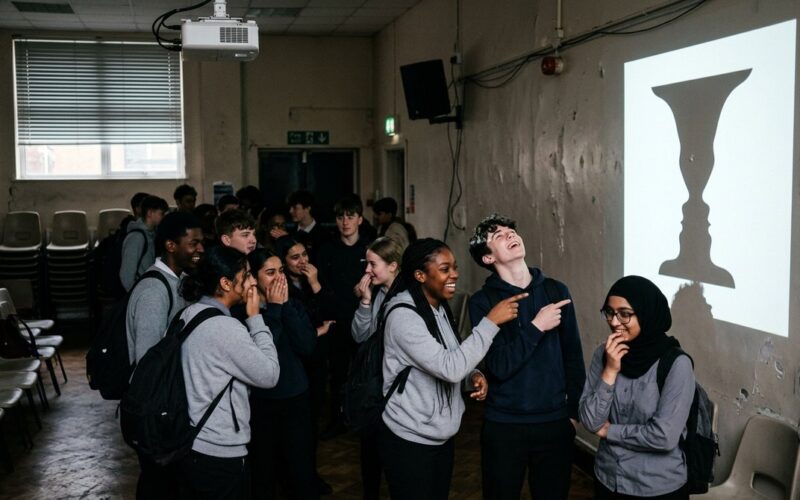
| Paper 1 | Perception | Depth cues, visual illusions, Gibson’s and Gregory’s theories, perceptual set | Gilchrist and Nesberg, Bruner and Minturn |
| Paper 1 | Development | Early brain development, Piaget’s stage theory, mindset and learning styles | McGarrigle and Donaldson, Hughes |
| Paper 1 | Research methods | Hypotheses, variables, sampling, designing research, ethics, data handling | Applied to every topic |
| Paper 2: Social context and behaviour | Social influence | Conformity, obedience, helping behaviour, crowds | Asch, Piliavin |
| Paper 2 | Language, thought and communication | Language and thought, animal communication, non-verbal communication | Von Frisch, Yuki |
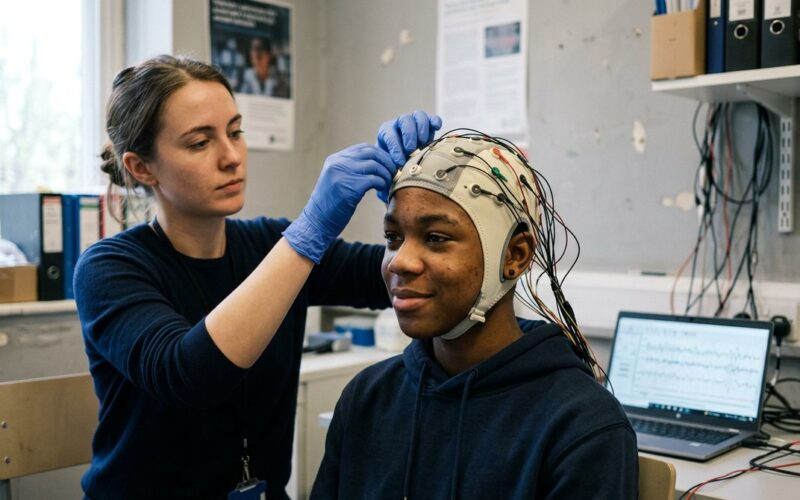
| Paper 2 | Brain and neuropsychology | Nervous system, neurons, brain structure, scanning | Penfield, Tulving |
| Paper 2 | Psychological problems | Mental health, depression, addiction and their treatments | Wiles, Kaij |
Paper 1: Cognition and behaviour
Paper 1 is about how your mind works. You start with memory, for example the three processes in our lesson on encoding, storage and retrieval. Then you look at perception, which starts with the difference between sensation and perception and moves on to illusions like the Ames Room.
Development covers how the brain grows before and after birth, Piaget’s theory and Dweck’s growth mindset. Research methods finishes the paper and it’s the single topic that matters most for your grade because it can come up in any topic.
Paper 2: Social context and behaviour
Paper 2 is about the people around you and your biology. Social influence is a favourite with students: why we follow the crowd, as in the lesson what is conformity? It also covers why people obey orders (Milgram’s agency theory).
You then cover language and communication, the central and peripheral nervous system and the brain. Finally, you study what mental health is, plus depression and addiction.
For a deeper look at every topic, read our AQA GCSE Psychology course guide. It goes through the full subject content in order.
The tricky bits of GCSE Psychology
When students say a GCSE Psychology topic is difficult, they usually mean one of these four things.
1. Research methods and statistics
Research methods is the topic that catches most students out. You need to write hypotheses, spot variables, choose a sampling method, design a study and analyse the data. Our lesson on the null hypothesis is a good taste of the style.
There’s some maths. The AQA specification lists the skills you need:
- decimals, standard form, ratios, fractions and percentages
- mean, median, mode and range
- frequency tables, bar charts and histograms
- scatter diagrams and correlation
- the shape of a normal distribution
- the difference between qualitative and quantitative data and primary and secondary data
None of this goes beyond what you meet in GCSE Maths. The tricky part is reading a table of data under time pressure and picking the right skill. Practice with real past paper questions fixes that quickly.
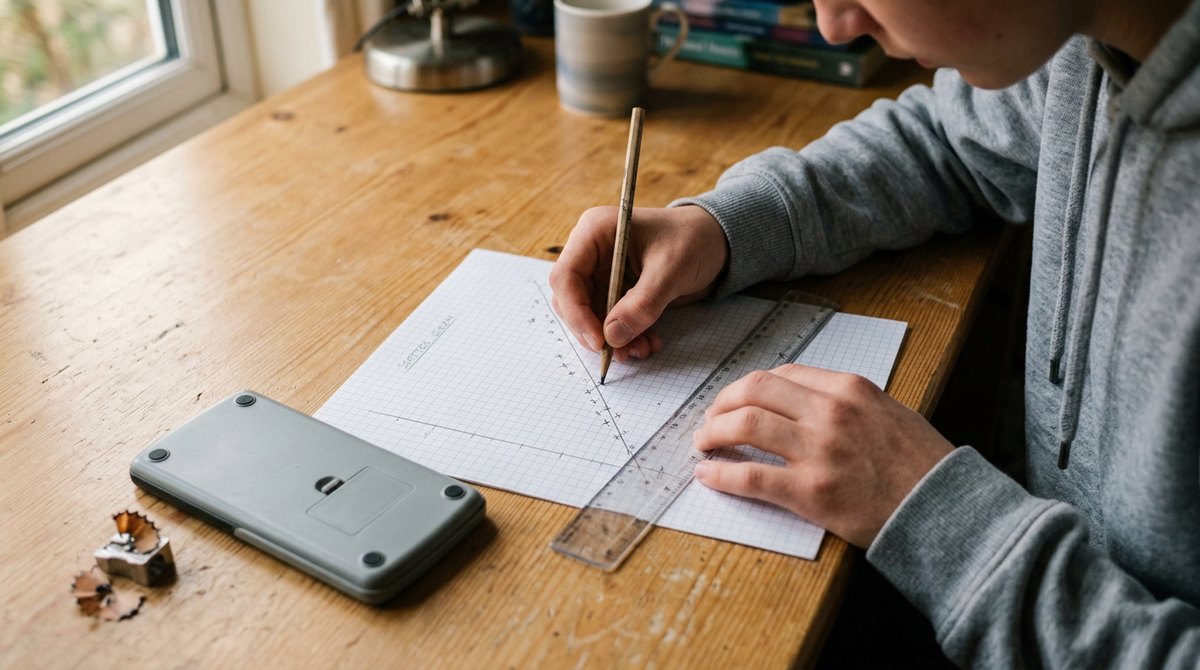
Scatter graphs, averages and percentages: the statistics in GCSE Psychology are all GCSE Maths level, used on real study data.
2. Lots of named studies and key terms
For each key study you need the researcher, the aim, the method, the results, the conclusion and at least one strength and weakness. Multiply that by 14 studies, then add the theories and you can see why revision takes time.
Terminology matters just as much. Examiners want “informational social influence”, not “they copied because they weren’t sure”. Plenty of students understand the ideas well but lose marks for loose wording.
3. Evaluation and extended writing
About 30% of the marks are for evaluation (AO3). That means saying how strong a study or theory is and why. “It lacks validity” earns little on its own. “It used a line task that isn’t like real life, so we can’t be sure people conform the same way with friends” earns the marks.
The longer essay questions mix description and evaluation, so you need to plan a short, balanced answer quickly. This is where critical thinking comes in: does it have reliability (would you get the same results again?) and does it have validity (does it measure what it claims to?).
4. It’s a brand new subject
Unlike English or science, you probably won’t have studied psychology at school before. Some students find that a fresh start is exciting. Others find it takes a term to get used to the way psychologists talk about evidence.
See how we teach research methods, one short lesson at a time. The first three lessons are free.
Try 3 lessons free →The easier bits
It’s not all hard work. Here’s what many students enjoy and find easier:
- It’s relatable. Peer pressure, memory tricks, body language and mental health all link to your own life, which makes them easier to remember.
- No coursework. Everything is in two exams, so there’s no project to manage.
- No tiers. Everyone sits the same papers and can reach a grade 9.
- The studies are stories. Asch’s line study or Piliavin’s subway study are easy to picture once you know them.
- Skills overlap. The nervous system links to biology and the data handling links to statistics, so you’re often revising two subjects at once.

Running your own small memory experiment with a friend is one of the easiest ways to make research methods stick.
How the GCSE Psychology exam works
Question types
Both papers have four sections worth 25 marks each, one per topic. Each section mixes multiple choice, short answer and extended writing questions. You’ll also be expected to draw on the whole course, so a memory question might ask you to design a study.
| Paper | Topics | Time | Marks | Share of GCSE |
|---|---|---|---|---|
| Paper 1: Cognition and behaviour | Memory, perception, development, research methods | 1 hour 45 minutes | 100 | 50% |
| Paper 2: Social context and behaviour | Social influence, language, thought and communication, brain and neuropsychology, psychological problems | 1 hour 45 minutes | 100 | 50% |
The three assessment objectives
Every mark in the exam tests one of three skills, called assessment objectives. These are set by Ofqual and are the same for every exam board.
- AO1, knowledge and understanding (35%): describe a theory, a study or a key term.
- AO2, application (35%): use what you know to explain a new situation in the question.
- AO3, analyse and evaluate (30%): weigh up strengths and weaknesses and reach a judgement.
AO2 is the one that’s easy to forget. If a question gives you a short story about a person, every point you make needs to link back to that person.
A sample exam question
Here’s an exam-style question from our lesson on mental health, with the marks shown:
Sample question
- Question: Explain one way in which cultural variations in beliefs about mental health problems might affect a person getting help. [3 marks]
- Model answer: In some cultures, a mental health problem is seen as shameful for the whole family (1). So the person may hide their problem and not visit a doctor (1), which means they don’t get help or diagnosis for a long time (1).
Notice the pattern: make a point, then add “so” and finish the idea. In “describe” and “explain” questions, the extra marks are nearly always for an example or a consequence. For a closer look at the first paper, see our guide to GCSE Psychology Paper 1.
Is GCSE Psychology harder than other GCSEs?
Here’s how Psychology compares with similar AQA GCSEs on the share of students getting a grade 4 or above in June 2026. It’s the fairest quick test of difficulty we have.
Psychology sits close to Geography, History and Sociology, a few points below. Biology’s figure is much higher, but it’s taken by students doing separate sciences, so it isn’t a fair like-for-like test.
Psychology vs Sociology
Compared with Sociology, the closest subject, Psychology has more science in it: experiments, the brain and data. Sociology has more essays about society. If you like science, you may find psychology the easier of the two.
AQA vs OCR and Pearson Edexcel
OCR and Pearson Edexcel also offer GCSE Psychology, with a different mix of topics and papers. For example, the Pearson Edexcel specification (1PS0) has a 1 hour 45 minute Paper 1 (98 marks, 55%) and a 1 hour 20 minute Paper 2 (79 marks, 45%). In Edexcel’s Paper 2 you study two optional topics from five: criminal psychology, the self, perception, sleep and dreaming, or language, thought and communication.
AQA has no criminal psychology or sleep and dreaming topics, but everyone studies the same eight topics, so there are no choices to make. No exam board is “easy”, so pick the one your course and exam centre use, like our GCSE Psychology online course, which follows AQA.
Who GCSE Psychology suits (and where it leads)
You’ll probably enjoy it and do well if you:
- are curious about why people think and act the way they do
- don’t mind learning lists of terms and studies
- like writing short, clear paragraphs
- are comfortable with basic numbers like averages and percentages
It’s harder going if you strongly dislike memorising or writing. It’s still possible, but plan more revision time.
Do you need anything before you start?
AQA says there are no previous learning requirements, so you don’t need any psychology background to start a psychology GCSE. It helps to be reading and writing confidently and to have met averages and percentages in maths.
Where it leads
The GCSE is a strong first step if you’re thinking about A-level Psychology and later a psychology degree at university. It’s also useful for any career that involves people, like health, education, social work, sport and marketing. Even if you never study psychology again, knowing how memory works will help you revise every other subject.
How to make GCSE Psychology easier: a study plan
The fastest way to make the course feel easier is little and often. The Ofqual register lists 120 guided learning hours for AQA GCSE Psychology. Over a two-year course that’s about an hour and a half a week, plus revision. Use the planner to see what it means for you.
A simple term-by-term plan
- Term 1: memory and perception. Start a study grid (researcher, aim, method, results, conclusion, evaluation) for every key study.
- Term 2: development and research methods. Run a small study of your own and work out the mean, median and mode.
- Term 3: social influence and language, thought and communication.
- Term 4: brain and neuropsychology and psychological problems.
- Final terms: past papers under timed conditions, then mark them with the mark scheme.
How to revise for GCSE Psychology
- Test yourself, don’t re-read. Flashcards and quizzes use active recall, which is exactly what the memory topic teaches.
- Space it out. Come back to each topic every few weeks rather than cramming.
- Practise the “so”. After every point, add an example or a consequence.
- Draw a mind map per topic. Put the theories in the middle and the studies and evaluation points on the branches.
- Do past papers. Start with one section at a time, then whole papers under timed conditions to build your exam technique.
- Read examiner reports. AQA publishes them after each exam and they show where students lose marks.
AQA’s free resources are worth using too: the specification (the full subject content list), past papers, mark schemes and examiner reports are all on its website. If you’re studying without a teacher or tutor, the mark schemes are the best way to check your own answers.

Testing yourself with flashcards is the quickest way to learn the key studies and terms that make GCSE Psychology feel tough.
Studying GCSE Psychology at home or online with Brainy Lemons
Our AQA GCSE Psychology online course breaks the whole specification into 279 short lessons, most around 30 minutes. Every lesson has a quiz, a quiz show and a zombie defence game. There are also 4,912 flash cards from easy to exam-hard to make the key terms stick.
Research methods gets its own run of lessons, from hypotheses and variables to the mean, median and mode, so the statistics are never a surprise. Key studies like Asch’s study of conformity each have a lesson of their own.
The full course also has a 3D game, Mind Vault: The Heist, covering all of Memory. You break into a vault built like the multi-store model, outsmart WARDEN the security AI and test your own memory as you go.
Because the GCSE is exam only, it works well for home educated students. You’ll need to sit the two papers as a private candidate at an exam centre that offers AQA. Our guide to GCSEs for home educated students explains how. You can start with the first free lesson on memory today.
- Check your course follows AQA GCSE Psychology (8182)
- Download the AQA specification and keep it as a checklist
- If you’re home educated, find an exam centre that takes AQA private candidates
- Get a calculator, a ruler and some squared paper for research methods
- Set up a study grid for the key studies
- Block out about two hours a week for study and revision
GCSE Psychology difficulty FAQs
Is psychology a hard GCSE?
It’s a medium-difficulty GCSE. The ideas are easy to follow, but you need to learn lots of studies and key terms, handle some data and evaluate research. In June 2026, 63% of AQA students got grade 4 or above, a little below the 71.8% for all AQA GCSEs.
What is the hardest part of GCSE Psychology?
Research methods is often the trickiest part, because it can come up in any topic and includes data handling. Evaluation (AO3) is the other big one: you’ve got to explain why a study is strong or weak, not just say it.
Is there a lot of maths in GCSE Psychology?
There’s some, all within research methods: percentages, ratios, standard form, mean, median, mode, range, bar charts, histograms, scatter diagrams and normal distributions. It doesn’t go beyond GCSE Maths level.
How hard is it to get a 9 in GCSE Psychology?
It’s tough but possible. In June 2026, 4.1% of AQA GCSE Psychology students got a grade 9 and 11.3% got an 8 or 9. To get a 9 in GCSE Psychology you need accurate terminology, detailed studies and well-planned evaluations.
Is GCSE Psychology harder than Sociology?
The results are close: 63.0% got grade 4 or above in AQA Psychology in June 2026, against 67.4% in Sociology. Psychology has more science and data, while Sociology has more essay writing, so it depends which style suits you.
Do I need GCSE Psychology to take A-level Psychology?
No. AQA says its A-level Psychology has no previous learning requirements, though each sixth form or college sets its own entry rules, so check with them. The GCSE does give you a big head start on key studies and research methods.
Can I study GCSE Psychology at home?
Yes. AQA GCSE Psychology has no coursework, so you can learn it at home or online and sit the two exams as a private candidate at an exam centre.
Make GCSE Psychology feel easier, one short lesson at a time
Learn every key study, key term and research methods skill on the AQA specification with short lessons, games and flash cards, starting with three free lessons.
- 279 short lessons that follow the AQA 8182 specification
- A quiz, a quiz show and a zombie defence game on every lesson
- 4,912 flash cards, from easy to exam-hard
- 1 3D Psychology game for the hardest topics
No card needed. Works on any device.