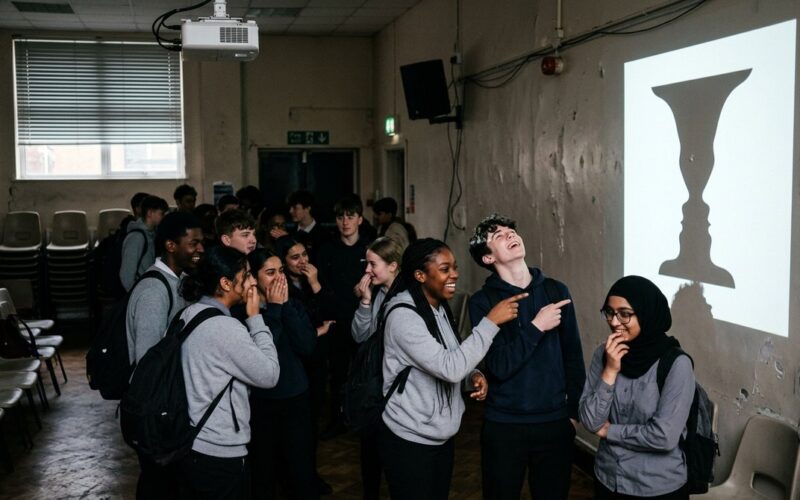
 By the Brainy Lemons team
GCSE Psychology Paper 2 is AQA’s “Social context and behaviour” exam (8182/2). It lasts 1 hour 45 minutes, is worth 100 marks and makes up 50% of your GCSE. It has four 25-mark sections: social influence, language, thought and communication, brain and neuropsychology and psychological problems.
This guide walks you through every topic on the paper, the key studies you need, how the questions are marked and how to revise. Everything about the exam comes from AQA’s own specification and timetable.
The next sitting is on Monday 17 May 2027, in the afternoon (AQA May/June 2027 timetable). Preparing for the first exam as well? Read our GCSE Psychology Paper 1 guide too.
At a glance
- Exam board: AQA, GCSE Psychology (8182)
- Paper: Paper 2, Social context and behaviour (8182/2)
- Length: 1 hour 45 minutes, 100 marks, 50% of the GCSE
- Sections: four, 25 marks each, one per topic
- Questions: multiple choice, short answer and extended writing
- Tiers: none, everyone sits the same paper
- Coursework: none, the GCSE is two exams
- Calculator: allowed
- Next exam: Monday 17 May 2027, afternoon
What is GCSE Psychology Paper 2?
AQA GCSE Psychology is examined with two written papers, both sat at the end of the course in the same May/June series. Paper 1 is “Cognition and behaviour”. Paper 2 is “Social context and behaviour”. Each one counts for exactly half your grade.
Cognition and behaviour is about what goes on inside one person’s head: memory, perception and development. The second paper looks at people together and at the body: how others change what we do, how we communicate, how the brain works and what happens when mental health goes wrong.
| Paper | Topics | Time | Marks | Share of GCSE |
|---|---|---|---|---|
| Paper 1: Cognition and behaviour (8182/1) | Memory, perception, development, research methods | 1 hour 45 minutes | 100 | 50% |
| Paper 2: Social context and behaviour (8182/2) | Social influence, language, thought and communication, brain and neuropsychology, psychological problems | 1 hour 45 minutes | 100 | 50% |
Searched for “psychology paper 2 OCR” or “Edexcel”? OCR (J203) and Pearson Edexcel (1PS0) also run GCSE Psychology. Their second papers have different content and lengths. This guide is for AQA 8182, the course we teach, so check with your exam centre which board you’re entered for.
What’s on AQA GCSE Psychology Paper 2 Social Context and Behaviour?
The paper follows the specification in order. In June 2023, for example, Section A was social influence, B was language, thought and communication, C was brain and neuropsychology and D was psychological problems. Here’s what each section asks you to know, taken from the AQA 8182 specification.
Section A: Social influence
This section is about how other people change our behaviour. It has four parts:
- Conformity: going along with a majority. You need the social factors (group size, anonymity, task difficulty), the dispositional factors (personality, expertise) and Asch’s study. Start with our lesson What is conformity?
- Obedience: following orders from an authority figure. You learn Milgram’s agency theory (agency, authority, culture, proximity) and Adorno’s theory of the authoritarian personality. Our lesson What is obedience? sets it up.
- Prosocial behaviour: when bystanders help, or don’t. The social factors are the presence of others and the cost of helping. The dispositional ones are similarity to the victim and expertise.
- Crowd and collective behaviour: prosocial and antisocial behaviour in crowds, explained by social loafing, deindividuation and culture, plus personality and morality.
“Dispositional” just means something about the person, like their personality. “Social” means something about the situation. Lots of questions ask you to tell the two apart, so make sure you can.

Piliavin’s study took place on the New York subway, where researchers watched whether passengers helped a man who collapsed.
Section B: Language, thought and communication
Which comes first, language or thought? Piaget said language depends on thought. The Sapir-Whorf hypothesis says the opposite: thinking depends on language. You also look at how language might change the way we recall events and recognise colours, for example in Native American cultures.
Next you compare human and animal communication. Animals communicate for a few limited reasons (survival, reproduction, territory and food) and you need Von Frisch’s bee study. Humans can do things animals can’t, such as plan ahead and talk about the future.
The last part is non-verbal communication: eye contact, body language, posture, touch and personal space. You’ll weigh up Darwin’s idea that it evolved, evidence that it’s innate (in newborn babies and people who are sensory deprived) and Yuki’s study of emoticons, which suggests some of it is learned.
Section C: Brain and neuropsychology
This is the most biological part of the course. You learn the central and peripheral nervous system, the fight or flight response and the James-Lange theory of emotion. Then come neurons: sensory, relay and motor neurons, synaptic transmission and Hebb’s theory of learning and neuronal growth.
After that you study the brain’s four lobes and the cerebellum, localisation of function and Penfield’s study of the interpretive cortex. The topic ends with neuropsychology, which covers brain scanning with CT, PET and fMRI, Tulving’s “gold” memory study and how a stroke or injury can affect behaviour.
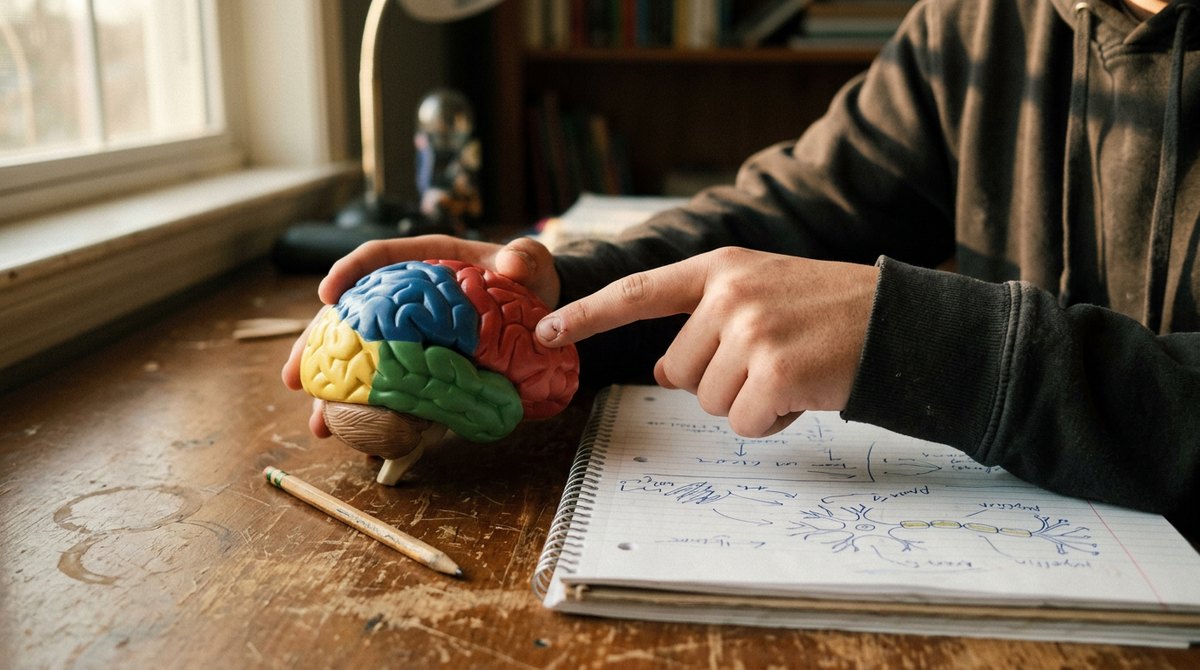
Labelling the frontal, temporal, parietal and occipital lobes on a model is a quick way to learn Section C.
Section D: Psychological problems
The final section starts with what mental health is. You learn what good mental health looks like, how beliefs about mental health problems differ between cultures, why the number of people with significant problems has changed over time and the effects on individuals and society.
Then you study two disorders. For clinical depression, that’s how it’s diagnosed, a biological explanation (an imbalance of neurotransmitters such as serotonin) and a psychological one (negative schemas and attributions). The treatments are antidepressants and CBT (cognitive behaviour therapy), backed up by Wiles’ study.
For addiction, it’s genetic vulnerability with Kaij’s twin study, then peer influence. Its two treatments are aversion therapy and self-management programmes such as 12-step groups.
Which studies do you need for Paper 2?
| Section | Study | What it’s about |
|---|---|---|
| A | Asch | Whether people give a wrong answer about line lengths to match a group |
| A | Piliavin | Whether subway passengers help a man who collapses |
| B | Von Frisch | How bees use a dance to tell others where food is |
| B | Yuki | How people from different countries read emotions in emoticons |
| C | Penfield | Memories brought back by stimulating the brain during surgery |
| C | Tulving | Which parts of the brain are active for episodic and semantic memories |
| D | Wiles | How well CBT works for depression |
| D | Kaij | Twins and alcohol abuse, testing the genetic explanation |
For each one, learn the aim, method, results and conclusion. Add at least two evaluation points. Examiners often ask you to “describe” one part and “evaluate” another.
Every Paper 2 topic, one short lesson at a time. Start with our free lessons and see how the course works.
Try 3 lessons free →Research methods in Paper 2
Research methods is listed under Cognition and behaviour, but don’t skip it now. AQA is clear about this:
Knowledge and understanding of research methods, practical research skills and mathematical skills will be assessed across all topic areas in Paper 2.
In practice, a question might describe an experiment on bystanders or brain scans. It could then ask you to name the independent variable, suggest a sampling method, spot an ethical problem or work out a mean. You can use a calculator. For a refresher, our lesson on the experimental method is a good place to start.

An observation of personal space in a park mixes a Section B topic with research methods, just like many exam questions do.
How Paper 2 is marked
Every mark tests one of three skills, called assessment objectives (AOs). AO1 is knowing and understanding psychology. AO2 is applying it, usually to a scenario. AO3 is analysing and evaluating it.
Only about a third of the marks are for knowing facts. The other two thirds reward using and judging what you know, so learning studies off by heart isn’t enough on its own.
Question types
Each section mixes multiple choice, short answer and extended writing. In June 2023 the questions ranged from 1 mark up to 9 marks. Sections B and C each ended with a 9-mark essay.
Watch out for the synoptic question, which links different parts of the course. In June 2023, question 16 asked students to connect Dweck’s mindset theory (from Cognition and behaviour) with Hebb’s theory of learning and neuronal growth, for 9 marks. AQA expects you to “draw on knowledge and understanding of the entire course”, so keep Paper 1 fresh too.
Sample question (our own, in the AQA style)
- Question: Ellie trips over in a busy shopping centre. Many people see her fall, but nobody stops to help. Explain how one social factor could have affected bystander behaviour in this situation. [3 marks]
- Model answer: The presence of others is a social factor (1). Because so many shoppers saw Ellie fall, each person may feel less responsible and assume someone else will help (1). So everyone walks past and Ellie gets no help (1).
Notice the answer names Ellie and the shopping centre. If you’re given a scenario, you won’t get full marks unless you use it.
Command words
The command word tells you what to do. “Identify” or “name” needs a word or short phrase, while “outline” or “describe” means say what something is. “Explain” means say why or how. “Evaluate” means give strengths and weaknesses. “Discuss” usually means describe and evaluate, then reach a judgement.
Exam technique for Paper 2
You’ve got 105 minutes for 100 marks. Aim for about a minute per mark, which leaves a few minutes to read through at the end.
Short and application answers
- 1-mark items: one clear point. Don’t write a paragraph.
- Scenarios: name people or details from the scenario in every point.
- Vocabulary: use terms like “deindividuation”, “synaptic transmission” or “negative schema”. The front cover says you’re assessed on using specialist vocabulary.
9-mark essays
- Spend two minutes planning before you write.
- Describe the theory, then give two or three evaluation points, each one explained.
- Use evidence, real-world uses and problems with how research was done (sample, ethics, lab setting).
- Finish with a short conclusion that answers the question.
Psychology Paper 2 revision plan
The countdown is to 1.30pm on 17 May 2027, the afternoon start time in AQA’s timetable. Paper 1 is a week earlier, on the afternoon of Monday 10 May 2027.
Starting the whole course? Use the planner below. Put in your start date and how many days a week you can study. It works out how many lessons you need each week.
If you’ve already covered the content, this ten-week plan works well in the run-up to May:
- Weeks 1 to 2: social influence. Make one flash card per factor and one for each study.
- Weeks 3 to 4: language, thought and communication. Practise “compare Piaget and Sapir-Whorf” answers.
- Weeks 5 to 6: brain and neuropsychology. Draw and label the nervous system, a synapse and the four lobes from memory.
- Weeks 7 to 8: psychological problems. Plan a 9-mark answer on each treatment.
- Week 9: research methods and maths questions set in these topics, plus links back to Paper 1.
- Week 10: two full past papers under timed conditions, marked with the mark scheme.
All the way through, use active recall. Test yourself instead of rereading your notes. Spread each topic over several short sessions rather than one long one.

Timed past papers in the final weeks help you get used to a minute per mark.
AQA GCSE Psychology past papers and mark schemes
Where can I find GCSE Psychology past papers?
The best place for AQA GCSE Psychology past papers is AQA’s past papers page, which has question papers, mark schemes and examiner reports for both papers, plus the specimen papers. Other revision sites copy these psychology past papers, but AQA’s own page is the original.
Examiner reports are worth reading. They explain what good answers did and where students lost marks. If you study at home without a teacher, they’re the closest thing to feedback from the people who mark the exam.
How to use a mark scheme
When you mark a past paper, check you made the exact points the mark scheme wants. For 9-mark questions, read the level descriptions and decide honestly which level your answer reached.
Then redo your weakest answer a few days later, because that second attempt is where most of the learning happens.
Studying Paper 2 with Brainy Lemons
Our AQA GCSE Psychology online course follows the 8182 specification lesson by lesson. Lessons 163 to 279 cover Paper 2 Social context and behaviour, so 117 short lessons take you through social influence, language, the brain and psychological problems in the same order as the exam.
Every lesson has a quiz, a quiz show and a zombie defence game. The course also has 4,912 flash cards that go from easy to exam-hard. It works on any device, which suits students learning at home. Our honest guide to how hard GCSE Psychology is and our full AQA GCSE Psychology course guide will help you plan your two years.
The first three lessons are free, starting with encoding, storage and retrieval. You can see exactly how the lessons work before you join. When you’re ready, see everything on the AQA GCSE Psychology course page.
GCSE Psychology Paper 2 FAQs
How long is GCSE Psychology Paper 2?
AQA Paper 2 lasts 1 hour 45 minutes. It’s worth 100 marks, which is 50% of your GCSE, split into four sections of 25 marks.
When is GCSE Psychology Paper 2 in 2027?
AQA’s timetable puts Paper 2 (8182/2) on Monday 17 May 2027. It’s in the afternoon session, which starts at 1.30pm. Paper 1 is on Monday 10 May 2027, also in the afternoon.
What topics are on psychology paper 2?
Four topics: social influence, language, thought and communication, brain and neuropsychology and psychological problems. Research methods and maths skills are tested across all four.
Is Paper 2 harder than Paper 1?
Neither is officially harder. Both are 1 hour 45 minutes, 100 marks and 50% of the grade. Some students find the brain topic the trickiest, while others find the social topics easier to picture. Paper 2 can also ask you to link back to Paper 1.
Can I use a calculator in Paper 2?
Yes. AQA allows a calculator in GCSE Psychology exams, as long as it meets the JCQ rules. You may need it for means, percentages or ratios.
Is this the same as OCR or Edexcel psychology paper 2?
No. OCR (J203) and Pearson Edexcel (1PS0) have their own GCSE Psychology papers with different topics and timings. This guide covers AQA 8182 only.
Can I sit GCSE Psychology Paper 2 as a private candidate?
Yes. AQA says this specification is open to private candidates, including home educated students. You must be based in the UK and enter through an AQA approved school or college. Both papers are sat in the same series.
Get ready for every section of Paper 2
Social influence, language, the brain and psychological problems, taught in short lessons that follow the AQA specification, with quizzes, games and flash cards to make it stick.
- 279 short lessons that follow the AQA 8182 specification
- A quiz, a quiz show and a zombie defence game on every lesson
- 4,912 flash cards, from easy to exam-hard
- 1 3D Psychology game for the hardest topics
No card needed. Works on any device.