 By the Brainy Lemons team
The IGCSE Travel and Tourism syllabus is Cambridge IGCSE Travel & Tourism 0471. For exams in 2027, 2028 and 2029 it has five topics and two written papers: Paper 1 (1 hour 30 minutes) and Paper 2 (2 hours). Each is worth 80 marks and 50% of your grade, and there’s no coursework.
That’s the short version. Below we go through what you actually study in each topic, how the two papers work, what the command words mean, and how to plan two years of study so nothing is left to the last minute.
Everything about the exam here comes from Cambridge’s own syllabus. If you’re a student choosing your options, or a parent checking what’s involved, you’ll know exactly what you’re signing up for by the end.
At a glance
- Exam board: Cambridge International Education
- Syllabus code: 0471 (Cambridge IGCSE, graded A* to G)
- Current syllabus: for exams in 2027, 2028 and 2029 (June and November series)
- Papers: Paper 1 Key Terms and Concepts, 1 hour 30 minutes, 80 marks, 50%. Paper 2 Managing and Marketing Destinations, 2 hours, 80 marks, 50%
- Tiers: none, everyone sits the same two papers
- Coursework: none
- Study time: about 130 guided learning hours (Cambridge’s guide)
2026 or 2027: which syllabus do you need?
Lots of people search for the “travel and tourism IGCSE syllabus 2026”, so let’s clear this up first. The exam board publishes each version for a block of exam years. You follow the one for the year you sit your exams.
- Exams in June or November 2026: use the 2024-2026 syllabus.
- Exams in 2027, 2028 or 2029: use the 2027-2029 syllabus (version 1, published September 2024).
The good news is that the two are almost the same. The 2027-2029 version has “no significant changes which affect teaching”, and any textbook endorsed for 2024 is still fine to use. So if you start in September 2026 for exams in summer 2028, you’re on the 2027-2029 version.
The big change came earlier, in 2024. The coursework went, both papers dropped to 80 marks and became worth half each, and the content stopped being split between them. Now either paper can ask about anything. Keep that in mind with past papers from before 2024: the questions are still good practice, but the layout is different.
What’s in the IGCSE Travel and Tourism syllabus?
The content is split into five topics. The first is the foundation, the terms and ideas you’ll use everywhere else, and the rest build on it, from how tourism works around the world to how a single destination gets marketed.
Topic 1: Main definitions and concepts
This is where you learn the language of the subject. You start with the types of tourism: domestic, inbound, outbound, international, day trips and short breaks. Our free first lesson, defining domestic tourism, is a good taste of how it’s taught.
Then you look at why people travel: leisure, visiting friends and relatives (VFR), special interest (like medical, religious, adventure or sports trips) and business. Business tourism uses the term MICE, which stands for Meetings, Incentives, Conventions and Exhibitions. We cover it in business travel and the MICE sector.
Topic 1 also covers sustainability, ecotourism and responsible tourism, the characteristics of the industry (products and services that are intangible, perishable, seasonal and dynamic), the different types of tourists, and types of destinations such as beach, island, resort, rural and urban.
Topic 2: Global tourism
This is the biggest part of the course. It asks why some places are popular and others aren’t, and what happens when lots of tourists arrive. You study the factors that change how many people travel, from economic factors like disposable income to politics, technology, health and the environment.
You’ll also look at what makes a destination appealing (location, weather, accessibility, attractions, local traditions and arts), the organisations that develop and manage destinations, and how they deal with problems like overtourism, seasonality and carrying capacity.
The last part is the impacts of tourism: economic, environmental and sociocultural, both positive and negative. Expect terms like the multiplier effect, leakage, commodification and the demonstration effect.
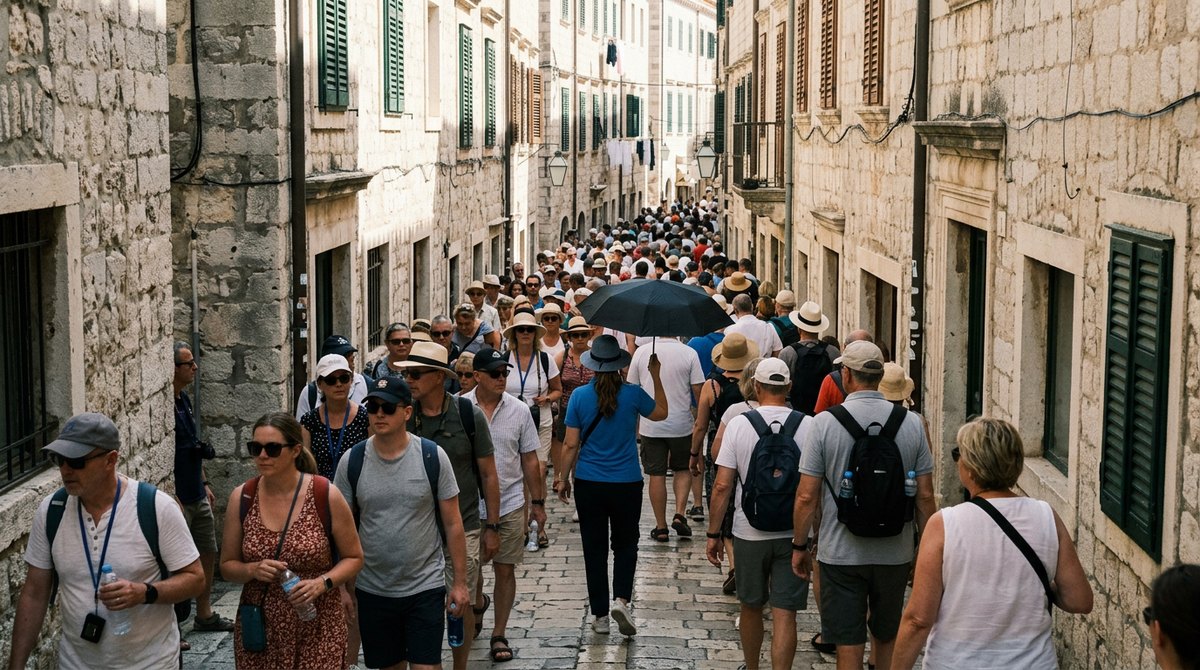
A packed street in Dubrovnik in July. Overtourism, seasonality and carrying capacity are all part of Topic 2.
Visit Aurelia
Run the national tourism organisation for the island of Aurelia: pick the right jobs for an NTO, work with partners and learn from real campaigns in New Zealand, India and Spain.
Play free →Topic 3: Travel and tourism organisations
Here you meet the businesses that make a trip happen: travel agents, tour operators, accommodation providers, food and drink providers, visitor attractions and ancillary service providers. For each one you learn what it offers, who it appeals to and how it works more sustainably.
You might be wondering what ancillary services are, because it’s one of the most searched travel and tourism terms. They’re the extra services that support a trip. The syllabus lists tour agents and guided tours, currency exchange, and car or bicycle hire. See our lesson on tour agents, guided tours and currency exchange for examples.
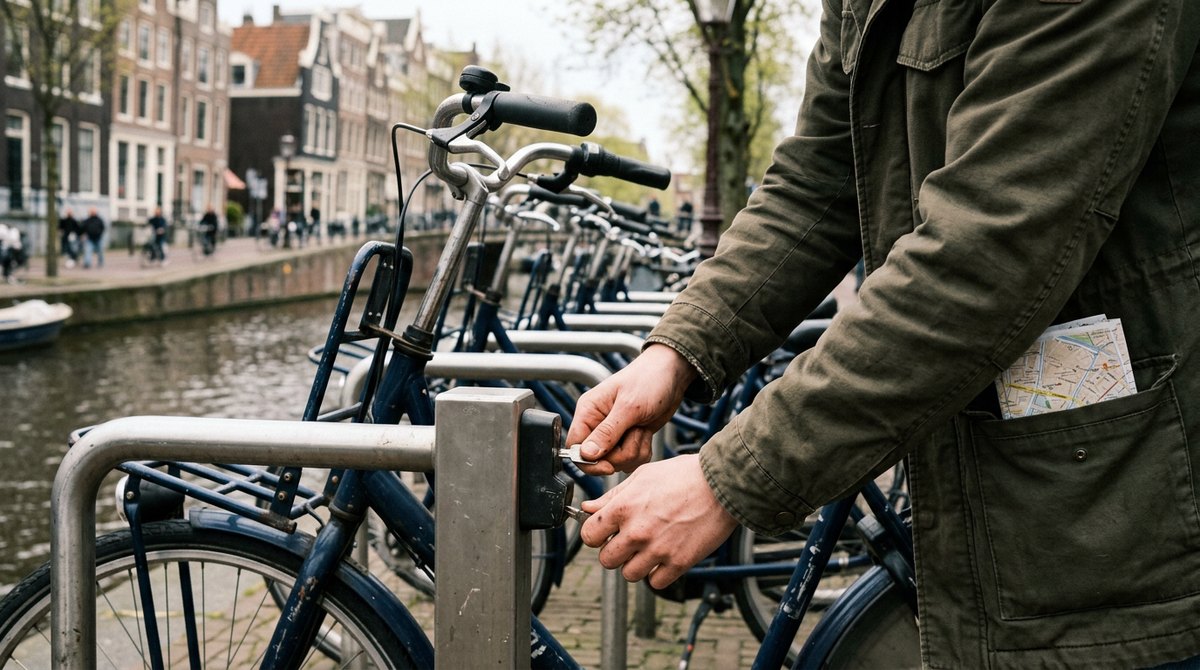
Bicycle hire in Amsterdam. Car and bicycle hire are among the ancillary services named in the 0471 syllabus.
Topic 3 also covers how organisations work together and depend on each other, the four types of transport (air, water, rail and road, including ferries and cruises), greener transport and the infrastructure that links it all together. Ferries, cruises and water taxis all count as water transport. The first lesson is types of travel agents.
Holiday Factory
Run a 3D holiday factory: sort primary, secondary and ancillary products, pack the right holiday for each customer, then follow the supply chain from hotel to beach. It’s a quick way to get Topic 3 sorted in your head.
Play free →Want all five topics taught in short, clear lessons? Start the Cambridge 0471 course free, no card needed.
Try 3 lessons free →Topic 4: Customer service
The exam board puts the customer “at the centre of travel and tourism”. This topic covers why good service matters, how it’s delivered (handling complaints and enquiries, making reservations, taking payments) and how to provide for tourists with specific needs, such as mobility, hearing, dietary or language needs. Start with service delivery in different organisations.
You’ll also learn the skills people need to work in the industry, like clear speech, numeracy, ICT, listening, patience and teamwork.
Topic 5: Destination marketing
The final topic is about how destinations compete for visitors. You study why marketing matters to tourism organisations, the factors that affect it and the marketing mix: product, promotion, price and place. You’ll need to know pricing strategies by name, such as market penetration, skimming and loss leader pricing.
It also covers market research. Primary research is data you collect yourself, like questionnaires and interviews, and secondary research is data someone else has already published. The lesson on primary research methods shows how they’re used. You finish with SWOT and PESTLE analysis and market segmentation.
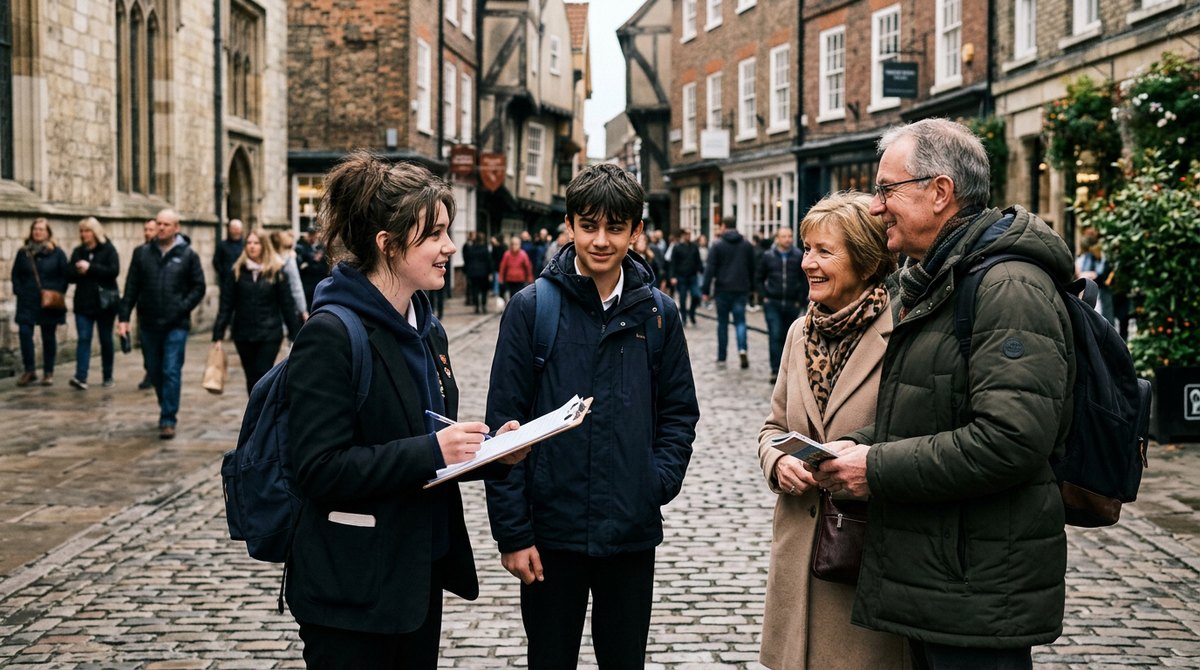
A visitor questionnaire in York is primary research: data you collect yourself, one of the methods in Topic 5.
How the 0471 exam works
Here’s the assessment for exams from 2027, straight from the official document:
| Paper | Time | Marks | Share of grade | Focus |
|---|---|---|---|---|
| Paper 1: Key Terms and Concepts | 1 hour 30 minutes | 80 (four questions of 20 marks) | 50% | Key concepts, customer service and the impacts of tourism at destinations |
| Paper 2: Managing and Marketing Destinations | 2 hours | 80 (four questions of 20 marks) | 50% | How destinations are managed and marketed |
Both papers can test any part of the course. Every question is scenario-based: it opens with a short stimulus, which might be text, numbers or a diagram, then splits into part questions. You answer all of them, on the paper itself, with no choice.
The difference is in the skills. Paper 1 leans towards knowledge, while Paper 2 asks you to apply what you know to a destination or organisation you may never have heard of. The assessment objective weightings show it clearly:
| Assessment objective | Paper 1 | Paper 2 | Whole IGCSE |
|---|---|---|---|
| AO1 Knowledge and understanding | 40% | 20% | 30% |
| AO2 Application | 20% | 40% | 30% |
| AO3 Analysis | 25% | 25% | 25% |
| AO4 Evaluation | 15% | 15% | 15% |
Command words
The command word at the start of a question tells you what kind of answer the examiner wants. “Identify” needs a name. “Explain” needs a reason, with the why or how. Writing a description when the question says explain is one of the easiest ways to drop marks. Here are the official meanings of the ones you’ll see most.
| Command word | What it asks you to do |
|---|---|
| Define | Give a precise meaning. |
| Identify | Name, select or recognise. |
| State | Express in clear terms. |
| Give | Produce an answer from a given source or from memory. |
| Describe | State the points of a topic, or give its characteristics and main features. |
| Explain | Set out purposes or reasons, make the links between things clear, say why and/or how, and back it up with evidence. |
| Suggest | Apply what you know to a situation where there are several valid answers, to make proposals or put forward considerations. |
| Discuss | Write about an issue or topic in depth, in a structured way. |
| Assess | Make an informed judgement. |
| Evaluate | Judge or calculate the quality, importance, amount or value of something. |
What a question looks like
Here’s a short practice question we wrote in the style of Paper 2. It isn’t from a real paper, and a real question has more parts and adds up to 20 marks, but it shows how the parts build up.
Lake Ora is a small mountain town. Visitor numbers have doubled in five years, and most visitors come in July and August.
- (a) Identify two types of tourist who might visit Lake Ora. [2]
- (b) Explain two negative environmental impacts of the rise in visitors. [4]
- (c) Suggest two ways the tourist information centre could reduce the effects of seasonality. [4]
- (d) Evaluate whether the town should limit visitor numbers in summer. [6]
Notice how the numbers in brackets guide you. Part (a) needs two words. Part (b) needs two impacts, each with a reason, like “more cars cause air pollution, which harms plants by the lake”. Part (d) needs both sides and a clear judgement at the end. The syllabus says to use the marks for each part as your guide to how much to write.
Is IGCSE Travel and Tourism hard, and who is it for?
You don’t need to have studied it before. The exam board doesn’t expect learners starting the course to have done any travel and tourism, so everyone starts from the same place.
Most students find the ideas easy to picture, because you’ve probably been a tourist yourself. The tricky part is the exam technique. 70% of the grade is for applying, analysing and evaluating, so learning definitions isn’t enough. You’ve got to use them on a new destination in the stimulus.
So about six in ten students got a C or above, and only 3.2% got an A*. That’s tougher than Geography (71.9% C or above) or Business Studies (71.0%) in the same series. Those students sat the 2024-2026 syllabus, which has the same two-paper layout as the 2027 one, so good exam technique really pays off.
It suits you if you like geography and business, enjoy real-world examples, or are thinking about a job working with people. Cambridge says it prepares learners for further study such as Cambridge International AS & A Level Travel & Tourism, or for going straight into work.
Can you study it online or as a private candidate?
Yes. There’s no coursework, so you can learn the whole course at home, at your own pace, and sit the two written papers at an exam centre.
Private candidates can enter for 0471 in either the June or November series. You enter through an exam centre that accepts private candidates, so check with one early. Our IGCSE Travel and Tourism online course is built for exactly this, with a timetable that plans your lessons up to your exam date.
How to prepare: a two-year study plan
Cambridge designs the course around 130 guided learning hours. Spread over two school years, that’s roughly two hours a week. Here’s a simple plan that leaves time for revision:
- Year 10 autumn: Topic 1, definitions and concepts, then make a start on global tourism
- Year 10 spring: global tourism: demand, destinations and impacts
- Year 10 summer: organisations and transport
- Year 11 autumn: customer service and destination marketing
- Year 11 spring: timed past paper practice, command words and weak areas
- Year 11 summer: final revision, then the exams
Want to see how that fits your own dates? Pick your exam series and how many days a week you can study.
A few habits make a big difference:
- Make short revision notes as you finish each section, not just before the exams.
- Keep a bank of real destinations you can quote in answers.
- Learn each key term with a one-line example.
- Practise full 20-mark past paper questions against the clock, because the timing is different on each paper.
Tick these off as you go. Your progress saves on this device.
- I can define domestic, inbound, outbound and international tourism, day trips and short breaks
- I can explain what MICE stands for and give an example of each part
- I can describe the factors affecting tourism demand (economic, social, technological, political, environmental and health)
- I can explain the multiplier effect, leakage and the demonstration effect
- I can name the ancillary services in the syllabus and say who offers them
- I can explain how travel and tourism organisations depend on each other
- I can describe how to handle a customer complaint step by step
- I can use the 4 Ps of the marketing mix, SWOT and PESTLE on a destination I’ve never seen before
- I know what every command word asks me to do
- I can finish a 20-mark question in the time I have on each paper
Study the 0471 syllabus with Brainy Lemons
Our Cambridge IGCSE Travel and Tourism course follows the 2027-2029 syllabus topic by topic, in the same order. It’s 260 short lessons of about 30 minutes, which adds up to Cambridge’s 130 hours.
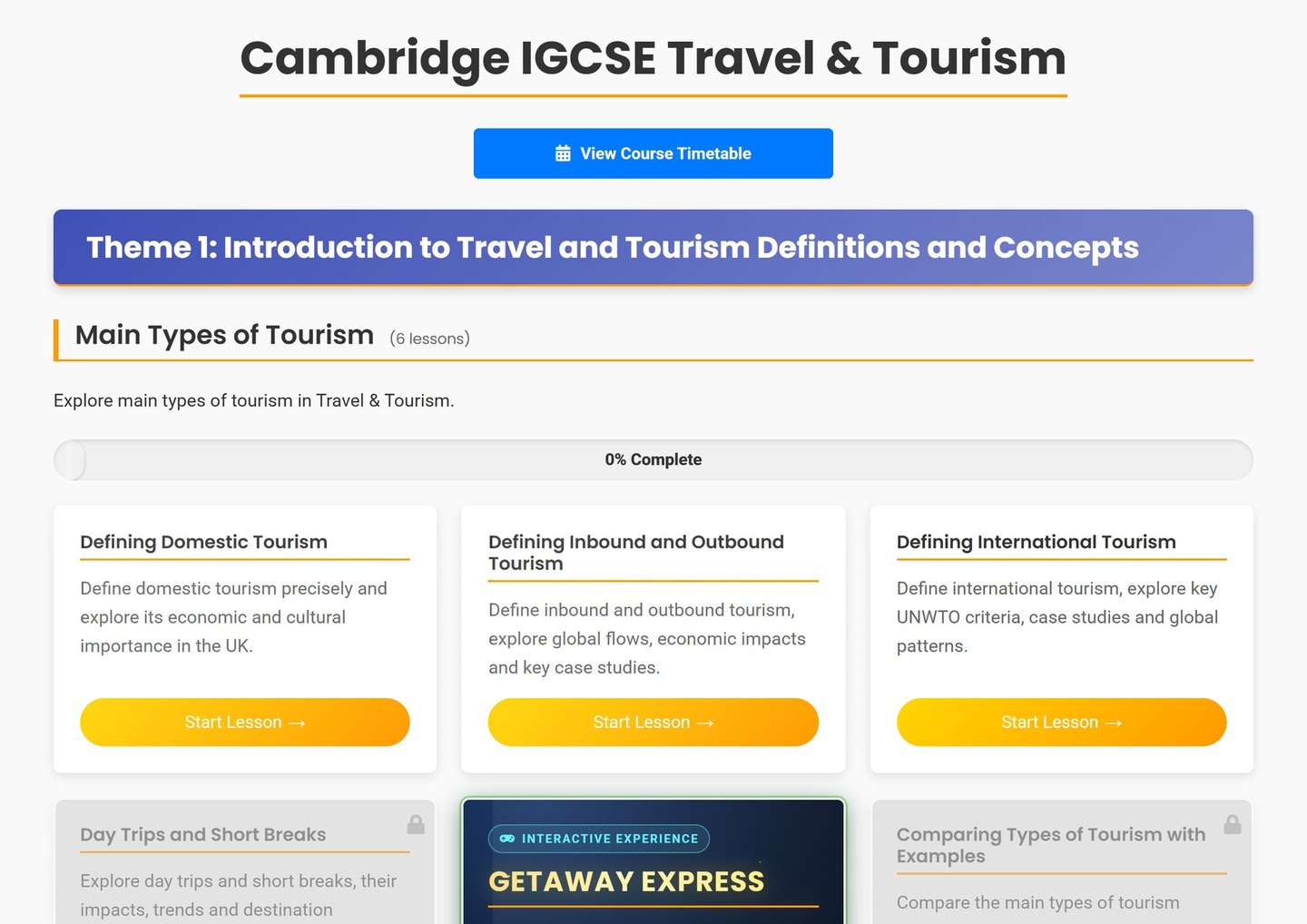
The course menu: every topic laid out lesson by lesson, with games between them.
- A quiz after every lesson, with the right answer shown the moment you get one wrong
- Two games on every lesson: the Lemonaire quiz show and the Last Stand zombie defence game
- 5,046 flash cards and 3D games for topics like MICE, ecotourism and resorts
- A study timetable and progress tracking, so parents can see how it’s going
You can try the first three lessons free, starting with lesson 1 on domestic tourism. If you’re choosing more than one subject, our IGCSE Geography syllabus 2027 guide pairs well with this one, and you can read about our Lemonaire quiz show game too.
You can download the official syllabus from the Cambridge IGCSE Travel and Tourism 0471 page or read the 2027-2029 syllabus PDF directly.
IGCSE Travel and Tourism syllabus FAQs
What is the syllabus code for IGCSE Travel and Tourism?
It’s 0471. That’s the Cambridge IGCSE, graded A* to G. Cambridge also offers an O Level in Travel & Tourism (7096). The O Level is at the same level as the IGCSE, but you can’t take both in the same exam series.
Is there a GCSE in Travel and Tourism?
The Cambridge IGCSE is the GCSE-level qualification for this subject. UK ENIC, the UK agency that compares qualifications, found Cambridge IGCSE comparable to the standard of a UK GCSE.
Does IGCSE Travel and Tourism have coursework?
No. Coursework was removed from 2024, so the grade comes from the two written papers, worth 50% each.
What’s the difference between Paper 1 and Paper 2?
Paper 1 (Key Terms and Concepts) is 1 hour 30 minutes and focuses on key concepts, customer service and the impacts of tourism. Paper 2 (Managing and Marketing Destinations) is 2 hours and focuses on managing and marketing destinations. Both are 80 marks and can use content from the whole syllabus.
What are ancillary services in travel and tourism?
They’re the extra services that support a trip, not the main transport or accommodation. The 0471 syllabus names tour agents and guided tours, currency exchange, and car or bicycle hire. Travel agents also sell ancillary services, and you study them in Topics 3 and 4.
When are the exams?
Cambridge runs 0471 exams in the June and November series. Your exact dates depend on your administrative zone, so check Cambridge’s timetable for your zone.
Where can I find past papers?
Cambridge provides specimen papers, past papers and mark schemes to schools through its School Support Hub, so ask your teacher or exam centre. Remember that papers from before 2024 follow the old layout, with different marks.
Learn the whole 0471 syllabus, one short lesson at a time
Every topic from the 2027-2029 Cambridge syllabus, in the same order, with a quiz and two games on every lesson so it sticks before exam day.
- 260 short lessons that follow the Cambridge 0471 syllabus
- A quiz, a quiz show and a zombie defence game on every lesson
- 5,046 flash cards, from easy to exam-hard
- 10 3D Travel & Tourism games for the hardest topics
No card needed. Works on any device.