 By the Brainy Lemons team

Cambridge IGCSE Sociology (0495) is an international GCSE-level course from Cambridge International. You sit two written papers worth 50% each: Paper 1 (2 hours) on research methods, identity and inequality, then Paper 2 (1 hour 45 minutes) on two of family, education and crime. There are no tiers and no coursework.
This guide explains what you study, how each paper is built, how many marks every part is worth and how hard it really is, with real grade figures from Cambridge. We’ll also compare it with AQA GCSE Sociology and show you how to study it online from home.
At a glance
- Exam board: Cambridge International (often called CIE or CAIE)
- Syllabus code: 0495
- Exam series: June and November
- Papers: Paper 1, 2 hours, 80 marks (50%). Paper 2, 1 hour 45 minutes, 80 marks (50%)
- Tiers: none, everyone sits the same papers
- Coursework: none, it’s 100% written exams
- Grades: A* to G
- Study time: about 130 guided learning hours
What is Cambridge IGCSE Sociology?
Sociology is the study of how groups of people live, why they behave the way they do and why some people get better chances in life than others. The IGCSE is the international version of a GCSE. It’s taken by students in many countries and by lots of home educated students in the UK.
You don’t need to have studied sociology before, because Cambridge doesn’t expect it.
What makes the Cambridge course different is its global view. Answers can use examples from any country, not just the UK. The syllabus also asks teachers to use local contexts and case studies from students’ own lives, so contexts from Kenya, India or Malaysia are just as good as British ones. Comparing two countries is a good way to pick up marks, because the syllabus encourages comparisons between societies.
The official Cambridge IGCSE Sociology 0495 syllabus is free to download. Everything in this guide comes from it, from the 2025 specimen paper or from Cambridge’s published results.
What you study: the six topics
The IGCSE Sociology syllabus has six topics. The first three are in Paper 1 and you study all of them. The last three are in Paper 2, but you only need two.
| Topic | Paper | Big questions in the syllabus |
|---|---|---|
| 1 Research methods | Paper 1 (compulsory) | How do sociologists study people? What data do they use? How do they plan research? |
| 2 Identity: self and society | Paper 1 | How do we learn our identity? How are we controlled? What shapes our social identity? |
| 3 Social stratification and inequality | Paper 1 | What is social stratification? What has been done to reduce inequality? How has globalisation changed it? |
| 4 Family | Paper 2 | What types of family are there? What is the family for? How is family life changing? |
| 5 Education | Paper 2 | What is schooling for? Why do some groups achieve more than others? |
| 6 Crime, deviance and social control | Paper 2 | What counts as crime? Who commits it and why? How is crime dealt with? |
1. Research methods
This is the foundation of the whole course. Cambridge says understanding research methods (with their strengths and limitations) underpins every other part of the course.
You learn the two big approaches. Positivism studies people like a scientist would, with numbers and patterns. Interpretivism tries to understand people’s own meanings, usually through words. Our lesson on positivism and studying society like a scientist is a good place to start.
Then you cover primary and secondary data, sampling, questionnaires, interviews, observations, reliability, validity and ethics. You’ll also learn to read secondary sources such as official statistics, tables and graphs, plus make clear notes on what they show. In the exam you even plan your own piece of research, which our lesson on planning your own research investigation walks you through.

Closed, tick-box questions give quantitative data that’s quick to count, but an interview often tells you more.
2. Identity: self and society
Here you ask how you became who you are. You study culture, norms, values and customs. Then you look at socialisation: how family, friends, religion, media and work teach us how to behave.
The topic also covers social control (the rules and sanctions that keep people in line), sub-cultures, online identities and whether globalisation is creating one global culture. The lesson on culture, norms, values and customs covers the key terms you’ll need.
3. Social stratification and inequality
Social stratification is the way a society is divided into layers such as social classes, so you compare open societies (where people can move up or down) with closed ones like caste systems.
You look at how age, gender, ethnicity and social class affect life chances: the things like health, income and education that shape how your life goes. Then you judge whether laws, welfare states and charities called NGOs have reduced inequality. Finally you see how migration and climate problems affect it. Start with open and closed societies: status, wealth and power.
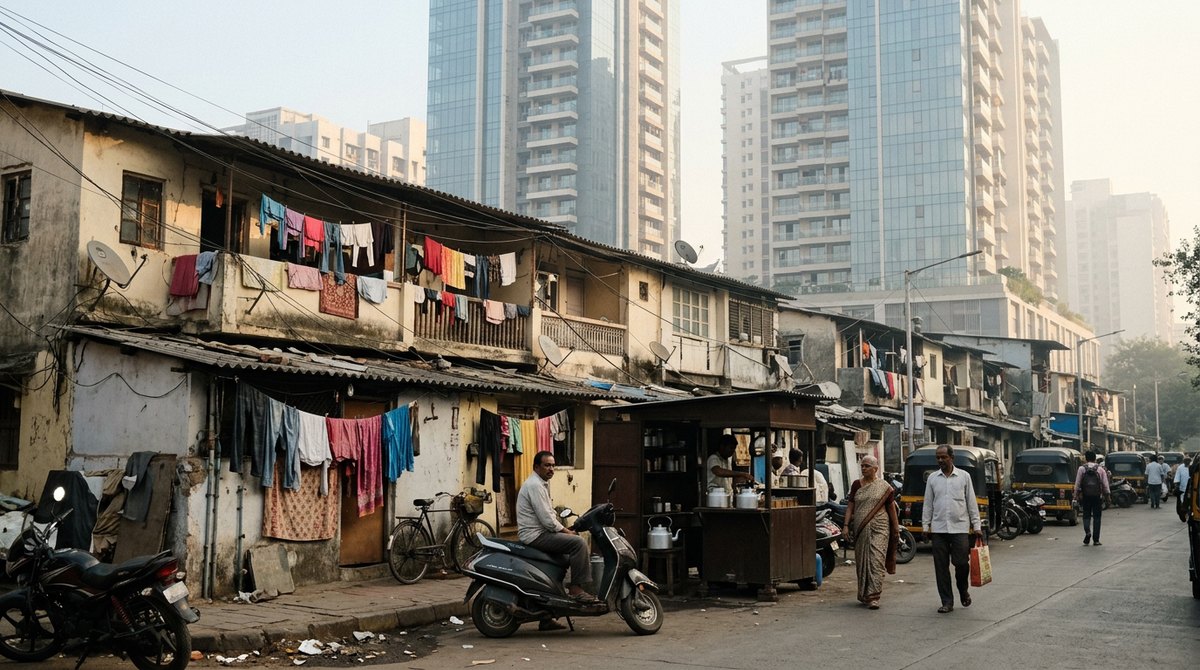
New towers beside older homes in Mumbai: the kind of global example Cambridge wants when you write about inequality and life chances.
All six 0495 topics, one short lesson at a time. Our course follows the syllabus from research methods to crime.
See the course →4. Family
You study different family structures, from nuclear and extended families to lone-parent and reconstituted ones. Then you compare what functionalists, Marxists and feminists think the family is for. The last part looks at how family life is changing: marriage, divorce, cohabitation and the changing roles of men, women, children and grandparents. See family structures for the basics.

Grandparents, parents and children at one table, an extended family like those you compare in Paper 2.
5. Education
You look at formal and informal education, the hidden curriculum, different types of schools and alternatives such as home education. Then you explain why achievement differs by social class, gender and ethnicity, plus how education differs around the world. Our lesson on the official and hidden curriculum opens the topic.
6. Crime, deviance and social control
Deviance means breaking social rules, while crime means breaking the law. You learn how crime is measured, who commits it and why, using functionalist, Marxist, feminist and labelling theories. You also judge how well punishment and policing work. Begin with crime, deviance and their relativity.
How is Cambridge IGCSE Sociology examined?
There are two papers, both marked out of 80 and both worth half your grade. Each paper has three 40-mark questions and you answer two.
| Paper | Time | Marks | Weight | What you answer |
|---|---|---|---|---|
| Paper 1: Research Methods, Identity and Inequality | 2 hours | 80 | 50% | Question 1 (research methods) plus either Question 2 (identity) or Question 3 (inequality) |
| Paper 2: Family, Education and Crime | 1 hour 45 minutes | 80 | 50% | Any two of Question 1 (family), Question 2 (education) and Question 3 (crime) |
How each part is built
Question 1 on Paper 1 is compulsory. It starts with a source, a short piece of research printed in the paper. You pick out information from it, then explain problems with it. After that come short answers on methods, a 10-mark essay judging a research approach and a 12-mark plan of your own research.
In that 12-mark part you don’t need to know anything about the topic you’re asked to research. You’re marked on your choice of methods, sampling and secondary evidence. Give a reason for each choice.
Every other part of both papers follows one pattern, parts (a) to (f). In the 2025 specimen paper the marks go 2 + 2, 2, 6, 6, 8 and 14.
- (a) define two terms (2 marks each)
- (b) give two examples (2 marks)
- (c) and (d) explain three reasons, ways or features (6 marks each)
- (e) discuss a view with at least three developed points (8 marks)
- (f) evaluate a view with arguments on both sides plus a conclusion (14 marks)
Here’s Question 3 from Cambridge’s 2025 specimen Paper 1, on social stratification and inequality:
- (a) Define the term (i) meritocracy [2] (ii) racism [2]
- (b) Give two examples of how people achieve status in society. [2]
- (c) Explain three ways societies have tried to reduce social inequalities. [6]
- (d) Explain three features of a dependency culture. [6]
- (e) Discuss how migration may have an impact on societies. [8]
- (f) Evaluate Marxist views of social inequality. [14]
Notice the climb: part (a) needs one precise sentence.
Part (f) is a short essay with three arguments for, three against and a conclusion. It carries more marks than (a) to (c) put together, so it’s where good students pull ahead.
What examiners reward
Cambridge marks three skills, called assessment objectives. AO1 is knowledge and understanding (39% of the marks). AO2 is interpretation and application, using what you know on the issue in front of you (39%). AO3 is analysis and evaluation, weighing up arguments and reaching a judgement (22%).
So more than 60% of the marks are for using knowledge, not just remembering it. Command words like define, explain, discuss and evaluate tell you which skill each part wants. Our lesson on how the exams work and what examiners reward breaks every part down with timings.
What changes for 2027 and 2028?
If you sit the exam in 2027 you use the 2025 to 2027 syllabus, but from 2028 you use the new one for 2028, 2029 and 2030, published in September 2025.
Cambridge says there are no significant changes that affect teaching. The six topics, the two papers and the marks stay the same. Textbooks written for the 2025 syllabus are still suitable too, so just check you’ve got the syllabus for your exam year.
Is IGCSE Sociology hard?
It’s a writing subject. You don’t need maths beyond reading a table or a graph, but you do need to explain ideas clearly and argue both sides. If you like talking about people, fairness and the news, you’ll probably enjoy it.
About three in four candidates got a C or better in June 2025. Half got a B or above. But only 7.8% got an A*, so the top grade goes to students who can evaluate, not just describe.
IGCSE Sociology leads on naturally to A Level Sociology and is useful for psychology, law, politics, criminology and social work later on.
Cambridge IGCSE Sociology vs AQA GCSE Sociology
Both courses teach families, education, crime and inequality with research methods running through them. The main differences are in the papers and the grades.
| Cambridge IGCSE (0495) | AQA GCSE Sociology (8192) | |
|---|---|---|
| Papers | 2 papers: 2 hours and 1 hour 45 minutes | 2 papers, each 1 hour 45 minutes |
| Marks | 80 per paper | 100 per paper |
| Choice of topics | Yes: 2 of 3 Paper 2 topics, plus identity or inequality on Paper 1 | No: all four topics are examined |
| Question types | Structured parts, a source to read, short essays | Multiple choice, short and extended answers |
| Grades | A* to G | 9 to 1 |
| Exam series | June and November | Summer |
| Examples | Global, any country | Mostly UK |
The choice of topics is a real plus for Cambridge, because you can drop one Paper 2 topic completely. If you’re weighing up the two boards, our guide to the AQA GCSE Sociology course covers the other course in detail. Our IGCSE vs GCSE guide explains how the two kinds of qualification compare.
Can you study IGCSE Sociology online?
Yes. Lots of students learn the whole course at home, then sit the exam as private candidates, which the Cambridge syllabus allows.
You’ll need an exam centre that takes private candidates and offers Sociology 0495, so ask early. Centres set their own fees and entry deadlines. Our guide to GCSEs for home educated students explains how booking works.
- Download the Cambridge 0495 syllabus for your exam year
- Pick your exam series: June or November
- Find an exam centre that takes private candidates for 0495
- Check the centre’s entry deadline and fee
- Decide which two Paper 2 topics you’ll study
- Set up a notebook or folder for revision notes and key terms
- Plan a weekly study time you can keep to
How to prepare for IGCSE Sociology
Cambridge designs the course around 130 guided learning hours. Over a two-year course that’s about an hour and a quarter a week. Over one year it’s about two and a half hours.
A simple order works well. Do research methods first, because it helps with every other topic. Then do identity and inequality to finish Paper 1. Move on to your two Paper 2 topics, then keep the last term for revision and past papers.
Past papers and mark schemes
Past papers are the best practice once you’ve learnt a topic. Cambridge publishes free specimen papers, past papers and mark schemes on its website. Teachers can find more on its School Support Hub. The mark schemes show exactly what earns each mark, so read them after every past paper you try.
Time yourself, because Paper 1 gives you about a minute and a half per mark.
Keep your revision notes short. Write an exact definition for every key term, because those win easy marks in part (a). Add one named study or example for each theory, then practise turning your notes into arguments for and against, since that’s where the higher grades are won.
Studying it with Brainy Lemons
Our Cambridge IGCSE Sociology online course follows the syllabus topic by topic, for exams from 2027 to 2030. It has 88 short lessons of about 30 minutes each. They cover all six topics plus two lessons on exam skills and command words.
- A quiz straight after every lesson, showing the right answer when you get one wrong
- A quiz show, Who Wants to Be a Lemonaire?, plus a zombie defence game, Last Stand, on every lesson
- 1,238 flash cards, from easy to exam-hard
- A timetable that plans your lessons week by week up to your exam
- Progress tracking so you (or a parent) can see which topics need another look
- Works on a phone, tablet or laptop
You can start with lesson 1 to see how the lessons work. The full IGCSE Sociology course unlocks every lesson, game and flash card.
IGCSE Sociology FAQs
What is the syllabus code for IGCSE Sociology?
The syllabus code is 0495. Cambridge O Level Sociology is a separate syllabus (2251), so you can’t take both in the same exam series.
How many papers are there in IGCSE Sociology?
Two. Paper 1 is 2 hours and Paper 2 is 1 hour 45 minutes. Each is out of 80 marks and worth 50% of the grade.
Is there coursework in IGCSE Sociology?
No, it’s assessed by the two written papers only, which makes it easier to study at home.
What is “theory and methods” in IGCSE Sociology?
It’s the research methods topic: positivism, interpretivism, data, sampling and methods such as questionnaires and interviews. It’s Question 1 on Paper 1, it’s compulsory and it helps in every other answer too.
Do I have to study all six topics?
No. You study all three Paper 1 topics. For Paper 2 you only need two of the three: family, education and crime.
Can I take IGCSE Sociology as a private candidate?
Yes, the syllabus allows private candidates. You enter through an exam centre that accepts them, in the June or November series.
Is IGCSE Sociology the same as GCSE Sociology?
They’re the same level and cover similar topics. The papers differ, though. Cambridge grades A* to G and lets you choose topics on both papers, while the AQA GCSE grades 9 to 1 and examines every topic.
Learn every IGCSE Sociology topic at home
Short lessons on research methods, identity, inequality, family, education and crime, written from the 0495 syllabus. Then practise what both papers test.
- 88 short lessons that follow the Cambridge 0495 syllabus
- A quiz, a quiz show and a zombie defence game on every lesson
- 1,238 flash cards, from easy to exam-hard
Works on any device.