 By the Brainy Lemons team

Edexcel IGCSE Economics (4EC1) is Pearson’s International GCSE in Economics, graded 9 to 1 with no coursework. You sit two exams at the end of the course. Paper 1 is Microeconomics and Business Economics. Paper 2 is Macroeconomics and the Global Economy. Each lasts 1 hour 30 minutes and is worth half your final result.
If you’re thinking about taking it, or you’ve just started, this guide is for you.
We’ll go through what you study topic by topic, how each paper works and which skills earn the marks. You’ll also see Edexcel’s real grade results for June 2025, the May 2027 examination dates and a study plan you can set for your own year. Every fact about the qualification comes from Pearson Edexcel’s own documents.
At a glance
- Exam board: Pearson Edexcel
- Qualification code: 4EC1 (Paper 1 is 4EC1/01, Paper 2 is 4EC1/02)
- Exams: two papers, each 1 hour 30 minutes and 80 marks, 50% each
- Tiers: none. Every student sits the same papers
- Coursework: none. Your grade is 100% exams
- Calculator: allowed in both papers
- Exam series: June and November, on paper or onscreen
- Grades: 9 (top) to 1, with U below that
What is the Edexcel IGCSE Economics course?
Economics is the study of how people, businesses and governments make choices when they can’t have everything they want. That one idea, scarcity, runs through the whole course.
The Pearson Edexcel International GCSE in Economics is a linear qualification. You’ll often see it called Edexcel Economics IGCSE. Linear means you take both papers at the end, not in chunks along the way. Pearson designs it as a two-year course that you can start with no earlier study of economics at all, with every paper set and answered in English.
The official spec sets out what you should be able to do by the end:
- apply economic ideas to real-life situations
- calculate, interpret and evaluate economic data
- make reasoned arguments and informed judgements
- understand problems facing developed and developing economies
You can read the full Edexcel International GCSE Economics specification yourself. It’s free.
What you study: the four themes
The content splits into four themes, two on each paper, as the table below shows.
| Paper | Theme | What it covers |
|---|---|---|
| Paper 1 | The market system | The economic problem; economic assumptions; demand, supply and market equilibrium; elasticity; the mixed economy; externalities |
| Paper 1 | Business economics | Production; productivity and division of labour; business costs, revenues and profit; business competition; the labour market; government intervention |
| Paper 2 | Government and the economy | Macroeconomic objectives; government policies; how objectives and policies affect each other |
| Paper 2 | The global economy | Globalisation; international trade; exchange rates |
The market system (Paper 1)
You start with scarcity, the basic economic problem: wants are unlimited but resources are finite. That leads to opportunity cost, the next best thing you give up when you choose.
Then comes the big model of the course. Demand and supply explain why the prices of things like oil, houses, gold and cocoa rise and fall. You’ll draw the diagrams to show it, label the equilibrium price and shift the curves when something changes, a skill Paper 1 tests again and again. Elasticity measures how much demand or supply reacts to a change in price or income. You’ll practise calculating price elasticity of demand, which can come up as a Paper 1 calculation.
The theme ends with how markets fail. Pollution is a negative externality, a cost that falls on people outside the deal. Education is a positive one.
Market Forces
Set the prices at Oakfield market and watch queues and crates show excess demand and excess supply. Use market forces to clear each market at its equilibrium price, then drag the curves when the news breaks.
Play free →Business economics (Paper 1)
This half of Microeconomics and Business Economics looks at firms. You learn the four factors of production: land, labour, capital and enterprise. Then you move on to:
- productivity (output per worker) and the division of labour
- costs, revenue and profit, plus economies of scale
- competition, monopoly (one firm) and oligopoly (a few big firms)
- the labour market, wages and trade unions
- government intervention, such as pollution taxes and the minimum wage
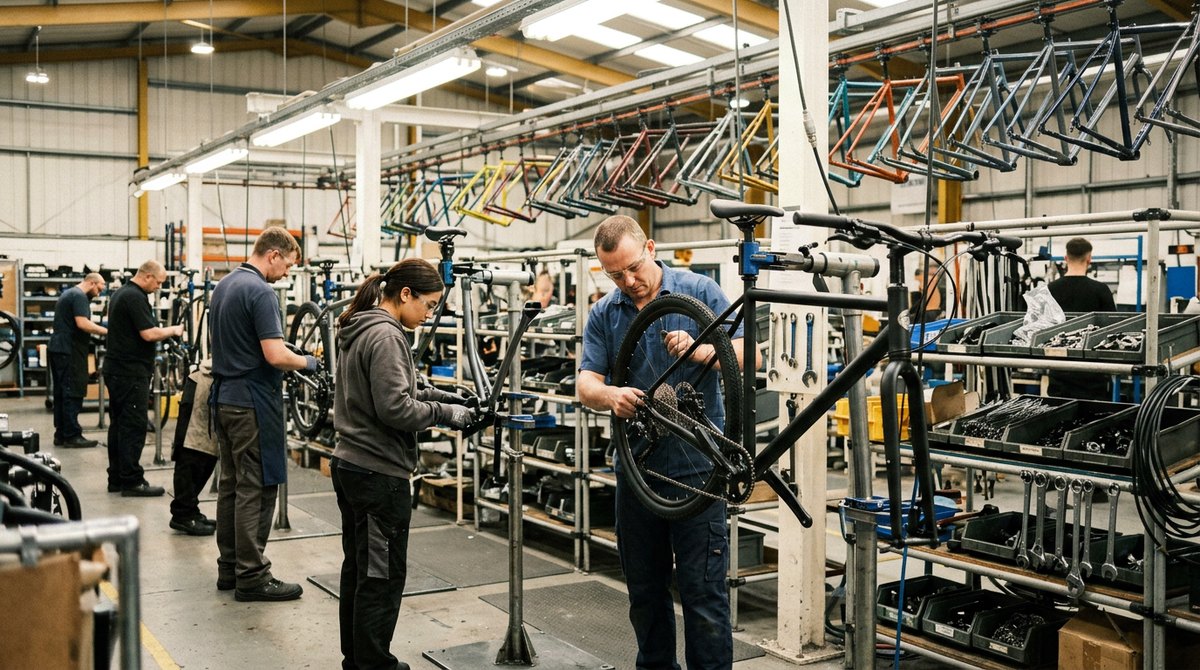
Each worker doing one step is the division of labour, a key part of the productivity topic.
Government and the economy (Paper 2)
Paper 2 zooms out to the whole economy. Governments aim for growth, low inflation, low unemployment and a healthy balance of payments. You start with economic growth and GDP, including how to work out a growth rate.
Next come the tools. Fiscal policy means taxes and spending. Monetary policy means interest rates. Supply-side policies try to make the economy produce more. A big skill here is explaining trade-offs, because pushing one objective can hurt another.
Every 4EC1 topic, one short lesson at a time. Our course follows the Edexcel spec from scarcity to exchange rates.
See the course →The global economy (Paper 2)
The last theme of Macroeconomics and the Global Economy starts with globalisation and why it happened. You look at multinational companies, free trade and why countries protect their industries with tariffs, quotas and subsidies, even though free trade usually lets people in both countries buy more for less.
It finishes with exchange rates. You’ll learn what happens to exports, imports and the current account when a currency rises or falls in value. Paper 2 questions can mix this with inflation from earlier on.
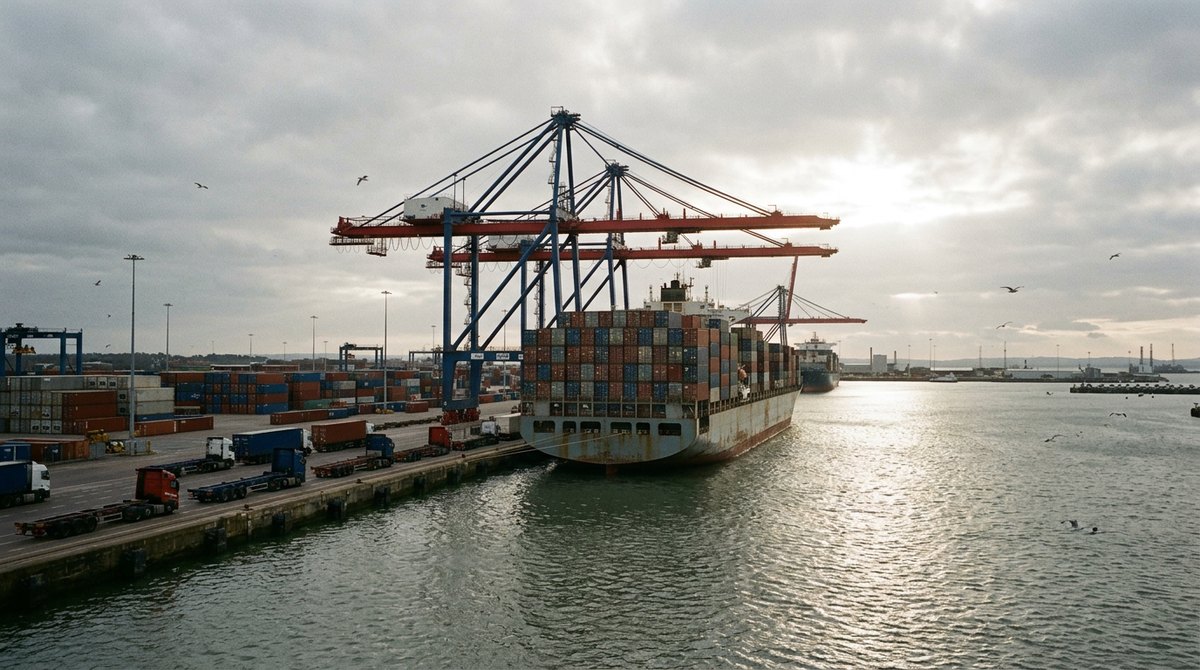
Ports like Felixstowe handle the imports and exports you study in the global economy theme.
How the Edexcel Economics papers work
Both papers are built the same way. Each has four compulsory questions worth 20 marks, so you can’t skip a question.
| Paper | Code | Time | Marks | Share of grade |
|---|---|---|---|---|
| Paper 1: Microeconomics and Business Economics | 4EC1/01 | 1 hour 30 minutes | 80 | 50% |
| Paper 2: Macroeconomics and the Global Economy | 4EC1/02 | 1 hour 30 minutes | 80 | 50% |
Each question is based on one topic. Inside it you’ll get a mix of question types:
- multiple-choice questions, some of them calculations
- short-answer questions
- data response questions, which give you a table, graph or short article to use
- open-ended questions, where you build an argument
There’s a single tier, so there’s no foundation or higher paper to pick. Calculators are allowed in both papers. Pearson Edexcel sets and marks both papers. Centres can run each assessment on paper or onscreen.
The command words
The command word tells you exactly what the examiner wants. These come from the spec’s own list:
- Define: give the meaning of a term.
- State: one short answer, no longer than a sentence.
- Calculate: use the data to reach an answer. Show your working.
- Draw: a diagram with two or three points that earn marks.
- Explain: a point, then two more steps that build on it, linked to the context.
- Analyse: a longer answer that develops an economic idea step by step.
- Assess: weigh up factors using the information you’re given.
- Evaluate: a longer answer that reaches a supported conclusion.
What the marks reward
Marks go for four skills, called assessment objectives. Look at AO2: almost half of all the marks in the qualification are for using what you know in the situation in front of you, not just remembering it.
| Skill | What it means | Share of marks |
|---|---|---|
| AO1 | Recall and communicate economic terms and ideas | 14-15% |
| AO2 | Apply economic knowledge, theories and calculations to a context | 48-49% |
| AO3 | Pick out and interpret information from sources | 23-24% |
| AO4 | Evaluate and reach reasoned judgements | 12-13% |
A sample question
Here’s the style of question you’ll meet, from our lesson on how the exams work and what examiners reward:
Country Pindor had a consumer price index of 100 in Year 1 and 105 in Year 2. Average wages rose by 3%. (a) Calculate the inflation rate. [2 marks] (b) Explain one reason why workers may be worse off. [3 marks] (c) Evaluate whether the government should be worried. [5 marks]
Here’s how to tackle each part:
- For (a), write the formula first, then the answer: (105 − 100) ÷ 100 × 100 = 5%.
- For (b), build a chain: prices rose 5% but wages only 3%, so wages buy fewer goods than before and real wages fall.
- For (c), give one side, then the other, then a judgement that says what it depends on.
A list of points with no decision at the end misses the evaluation marks.
The maths you need
Edexcel says the maths is at the level of upper secondary maths. These are the quantitative skills in the spec:
- percentages and percentage changes, including interest on savings
- averages, including average cost
- totals for revenue, costs and profit
- gross and net pay
- drawing graphs from data, such as supply and demand curves

A calculator is allowed in both papers. Write the formula first so a slip still earns method marks.
When are the 2027 papers?
Pearson’s final summer 2027 timetable puts Paper 1 on Thursday 13 May 2027 and Paper 2 on Tuesday 25 May 2027. Both are afternoon papers, which start at 1:30pm in UK centres. There’s a November series too.
Is IGCSE Economics hard?
It’s new for most students, with lots of new words and diagrams to learn. But there’s no coursework, no tiers and the maths is straightforward. Here’s how candidates outside the UK did in the June 2025 series:
So two in three got a grade 4 (a standard pass) or better. About one in nine got a 9. UK candidates did a bit better: the UK figures for the same exam show 13.1% at grade 9 and 80.3% at grade 4 or above.
What trips people up? Usually it’s evaluation and using the context. An answer that defines a term perfectly but never mentions the country, the firm or the numbers in the question won’t pick up the AO2 marks. Those are nearly half the paper. The good news is that this is a skill you can practise, because every past paper you mark against the mark scheme shows you exactly where the context marks were and what a stronger answer would have said.
Who it suits and where it leads
It suits you if you like the news, money and arguing both sides of a question. It sits well alongside Business. Our guide to Edexcel IGCSE Business shows how the two overlap. Edexcel says the qualification leads on to International AS and A Levels, in economics and other subjects.
Linear 4EC1 or modular 4XEC1?
Pearson also runs a modular version of Edexcel International GCSE Economics (code 4XEC1), first taught in September 2023. It has the same topic list, split into two unit exams that you can sit in any order and resit, in June or November.
Most students take the linear 4EC1. Don’t enter for both. Pearson warns that colleges and employers will usually count two qualifications in the same subject as one.
How to prepare for Edexcel IGCSE Economics
Steady weekly work beats cramming, because what you learn later builds on what came first. Here’s a simple two-year plan that follows the order of the spec:
| Term | Focus |
|---|---|
| Year 1, autumn | The economic problem, demand, supply and equilibrium |
| Year 1, spring | Elasticity, the mixed economy and externalities |
| Year 1, summer | Business economics: production, costs, competition, labour, government intervention. One Paper 1 past paper |
| Year 2, autumn | Growth, inflation, unemployment, balance of payments and government policies |
| Year 2, spring | Globalisation, trade and exchange rates. One Paper 2 past paper |
| Year 2, final weeks | Timed practice papers, mark schemes and revision of weak topics before May |
On one year? Do the same order at double speed. Pick your exam year below to see how many lessons a week keeps you on track.
Free support from Edexcel
Edexcel gives a lot of free support for examination practice and revision. Most of it is on the International GCSE Economics qualification page:
- Edexcel Economics past papers and mark schemes from earlier June and November series
- examiner reports, with advice on each question
- sample assessment materials, written when the spec was new
- examWizard, a free online bank of past questions for revision
Do at least one full Paper 1 and one full Paper 2 as timed practice, then mark them with the mark scheme. Past papers are the best way to learn the style of the Edexcel Economics questions. A good timing rule is about one minute per mark, which gives roughly 20 minutes per question and 10 minutes at the end to check your answers.

You can study the whole course online, at home or in a library.
- A copy of the 4EC1 specification, saved or printed
- A scientific calculator you know how to use
- A notebook for key terms and diagrams
- Your exam year and series chosen (June or November)
- An exam centre that takes private candidates, if you’re home educated
- A news app or site to follow the economy each week
If you study at home, you’ll sit the exams as a private candidate. Our guide to taking exams as a home educated student explains how to find a centre and book in. Not sure an IGCSE is right for you? Read IGCSE vs GCSE: the real differences.
Studying IGCSE Economics online with Brainy Lemons
Our Edexcel IGCSE Economics online course gives you the support of a full course at home. It has 67 lessons written from the Pearson spec for exams from 2027 to 2030. Each takes about 30 minutes.
The lessons follow the spec in order:
- Lessons 1 to 23: the market system
- Lessons 24 to 40: business economics
- Lessons 41 to 57: government and the economy
- Lessons 58 to 66: the global economy
- Lesson 67: exam skills
Every lesson has its own quiz, a quiz show game and a zombie defence game, all built from what you’ve just learned. There are 945 flash cards and 10 3D Economics games for the hardest ideas. Tell the timetable your finish date and it plans your lessons week by week, on a one-year or two-year plan, so every student knows exactly what to do next.
Sky Writer
Fly a stunt plane whose smoke trail draws real GDP across the sky. Feel the boom, downturn, recession and recovery, then label the economic cycle diagram.
Play free →Want to see a lesson first? Open lesson 1 on scarcity, or look at the full IGCSE Economics course for 4EC1.
IGCSE Economics FAQs
How many papers are there in IGCSE Economics?
Two. Paper 1 is Microeconomics and Business Economics and Paper 2 is Macroeconomics and the Global Economy. Each is 1 hour 30 minutes, 80 marks and 50% of your grade.
Is there coursework in Edexcel IGCSE Economics?
No. Your grade comes only from the two papers.
Can you use a calculator in IGCSE Economics?
Yes. Edexcel allows a calculator in both papers. In calculate questions, show your working because method marks are available.
When can you sit the papers?
Pearson Edexcel International GCSE Economics runs in a summer series (May and June) and a November series. In 2027, Paper 1 is on Thursday 13 May and Paper 2 is on Tuesday 25 May.
What is the difference between 4EC1 and 4XEC1?
4EC1 is the linear course with both papers at the end. 4XEC1 is the modular version, with the same topics in two unit exams you can sit separately and resit.
Can a home educated student take IGCSE Economics?
Yes. You enter as a private candidate at an exam centre that accepts them. Fees and rules vary by centre, so contact a few early.
Where can I find Edexcel Economics past papers?
On Pearson’s International GCSE Economics page, along with mark schemes, examiner reports and the sample assessment materials. Recent June and November papers are the best practice.
What does IGCSE Economics lead to?
Edexcel says it leads on to International AS and A Levels in economics and other subjects. Check the entry grades with the sixth form or college you want to go to.
Learn every IGCSE Economics topic, from scarcity to exchange rates
Short lessons that follow the 4EC1 specification, with games and flash cards that make the ideas stick for both papers.
- 67 short lessons that follow the Pearson Edexcel 4EC1 specification
- A quiz, a quiz show and a zombie defence game on every lesson
- 945 flash cards, from easy to exam-hard
- 10 3D Economics games for the hardest topics
Works on any device.