 By the Brainy Lemons team
An AQA GCSE Geography online course teaches the whole 8035 specification from home. You study physical and human geography and the skills, then sit three written exams in May and June: Papers 1 and 2 are 1 hour 30 minutes and worth 35% each, and Paper 3 is 1 hour 30 minutes and worth 30%.
This guide is for GCSE students choosing a course, and for the parents helping them. We cover what you study, the choices inside the course, how each exam works, the Paper 3 pre-release booklet and how fieldwork works if you learn at home.
You’ll also see the exam board’s own 2026 results, a two-year plan and what’s inside our AQA GCSE Geography online course, so you can judge it for yourself.
At a glance
- Exam board: AQA
- Qualification: GCSE Geography, code 8035, graded 9 to 1
- Exams: every May and June, all at the end of the course (it’s linear)
- Papers: three written exams, 1 hour 30 minutes each
- Tiers: none, everyone sits the same exams
- Coursework: none, but you must do fieldwork on two occasions and answer questions on it
- 2027 dates: 18 May, 26 May and 10 June
What’s in the AQA GCSE Geography course?
The GCSE qualification has four units: living with the physical environment, challenges in the human environment, geographical applications and geographical skills. All of this comes from the AQA GCSE Geography 8035 specification, the exam board’s official list of what can be examined. The first two units each have three themes. A few themes let you choose between topics, which matters a lot if you’re studying at home.
| Exam | Theme | What you study |
|---|---|---|
| Paper 1 | The challenge of natural hazards | Tectonic hazards, tropical storms, UK weather hazards and climate change (all compulsory) |
| Paper 1 | The living world | Ecosystems and tropical rainforests, plus hot deserts or cold environments |
| Paper 1 | Physical landscapes in the UK | UK relief, plus two from coastal landscapes, river landscapes and glacial landscapes |
| Paper 2 | Urban issues and challenges | Urban growth, a city in a poorer country, a UK city, sustainable cities (all compulsory) |
| Paper 2 | The changing economic world | Measuring development, the development gap, a fast-growing economy, the UK economy (all compulsory) |
| Paper 2 | The challenge of resource management | Resources in the UK, plus one of food, water or energy in depth |
| Paper 3 | Geographical applications | Issue evaluation (pre-release booklet) and fieldwork |
| All three | Geographical skills | Maps, graphs, statistics and photos, tested in every exam |
Paper 1: the physical world
Paper 1 starts with natural hazards. Our first lesson, what natural hazards are and why risk varies, explains why the same earthquake can be harmless in a desert and deadly under a city. You then learn about tectonic plate margins, tropical storms such as Typhoon Haiyan, and the evidence for climate change.
The living world moves on to ecosystems, starting with a UK pond. Then come rainforests and either hot deserts or cold environments. Physical landscapes begins with the UK’s uplands, lowlands and rivers. After that, you pick two of the three landscape topics.
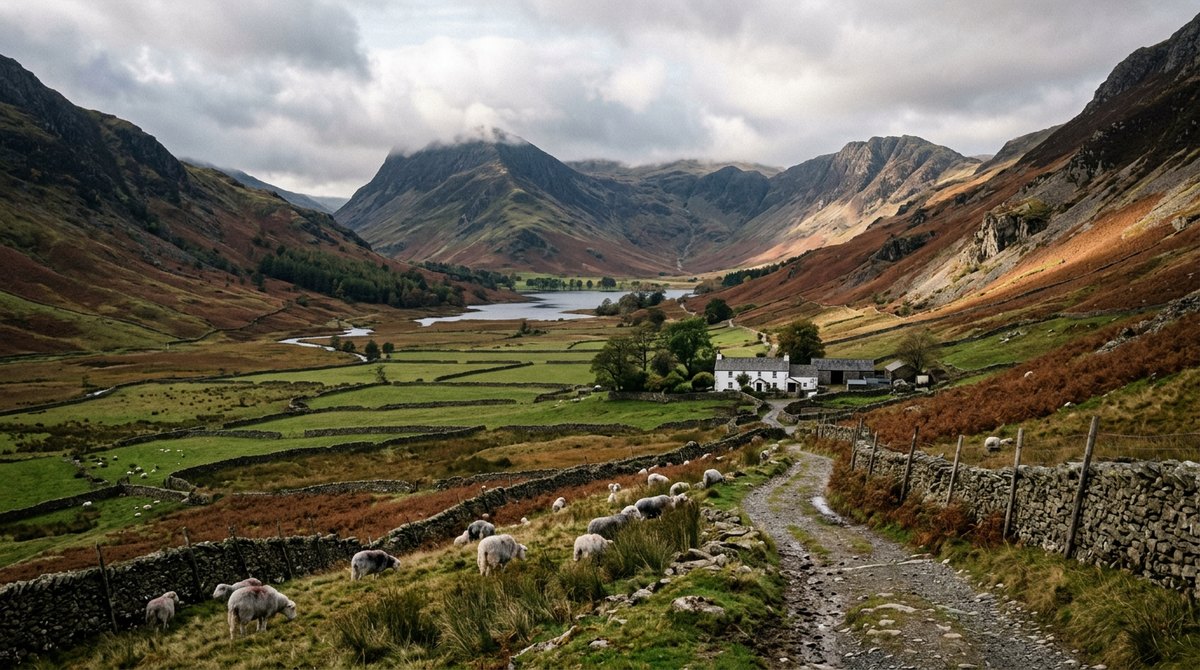
Glaciers carved valleys like this one in the Lake District. If you choose glacial landscapes, you learn how they formed and how the land is used today.
Paper 2: people and places
Paper 2 is human geography. It begins with urbanisation around the world, then a city in a newly emerging economy (NEE, a country whose economy has started to grow quickly) and a UK city. The changing economic world opens with how we measure development and ends with how the UK’s economic life has changed.
The last theme asks why food, water and energy matter. You see how the UK manages each one, then go deeper into one of the three.
Case studies: which places do you need?
The specification asks for case studies (larger, detailed studies of a place) and examples (smaller, focused ones). The exam board doesn’t name the places, so each school picks its own. Any well-learned case study can earn full marks.
Our course uses well-known ones, including:
- Chile and Nepal for earthquakes
- Typhoon Haiyan for tropical storms
- The Amazon, the Sahara and Svalbard for the living world
- Rio de Janeiro and Bristol for cities
- Nigeria for fast economic growth
- The Lake District for glacial landscapes
How the AQA GCSE Geography exams work
All three exams are sat at the end of the course, in the same summer. There’s no tiering, so every student sees the same questions and can reach any grade.
| Exam | Time | Marks | Share of GCSE | What you answer |
|---|---|---|---|---|
| Paper 1: Living with the physical environment | 1 hour 30 minutes | 88 (3 for SPaG) | 35% | Every question in Sections A and B, then two of the three landscape questions |
| Paper 2: Challenges in the human environment | 1 hour 30 minutes | 88 (3 for SPaG) | 35% | Every question in Sections A and B, the resource management question, then food, water or energy |
| Paper 3: Geographical applications | 1 hour 30 minutes | 76 (6 for SPaG) | 30% | Every question: issue evaluation and fieldwork |
Source: AQA GCSE Geography 8035 specification, version 1.1. SPaG means spelling, punctuation, grammar and specialist terms.
You only answer the landscape questions you studied, so learning two of the three is enough, and the same goes for food, water or energy, and for hot deserts or cold environments.
The kinds of questions you’ll see
Every exam mixes multiple-choice, short answers, data questions and longer written answers. The longer ones are marked by “levels of response”. That means the examiner reads the whole answer and judges its quality, rather than ticking off facts. Words like “assess” and “evaluate” mean you must weigh things up and reach a judgement. It’s a big part of the assessment, so practise it from the start.
A sample question
Here’s an exam-style question from our first lesson:
- State what is meant by a natural hazard. [1 mark]
- Name one atmospheric hazard and one biological hazard. [2 marks]
- Explain why the risk from natural hazards is increasing in many cities. [4 marks]
For the 4-mark question, a strong answer links two chains of reasoning. Cities are growing, so more people are exposed. Poorer people may live on risky land in weak homes, so they cope less well. Using “because” and “so” shows the examiner each link.
2027 exam dates
The dates come from the May/June 2027 GCSE exam timetable: Paper 1 on the morning of Tuesday 18 May, Paper 2 on the afternoon of 26 May and Paper 3 on the afternoon of 10 June.
Paper 3: the pre-release booklet and fieldwork
Paper 3 is the one people ask about most, because it works differently. It tests how you apply your knowledge, not just what you remember.
Section A: issue evaluation
The exam board releases a resource booklet twelve weeks before the exam, so for June 2027 you’ll get it in March, about three months before you sit it.
It’s about a real, current issue and can include maps, graphs, statistics, photos, satellite images and quotes from different groups. You can’t take your own copy in. You get a clean one, so the ideas need to be in your head. The questions build up to a longer answer where you choose a way forward and justify it, thinking about both people and the environment.
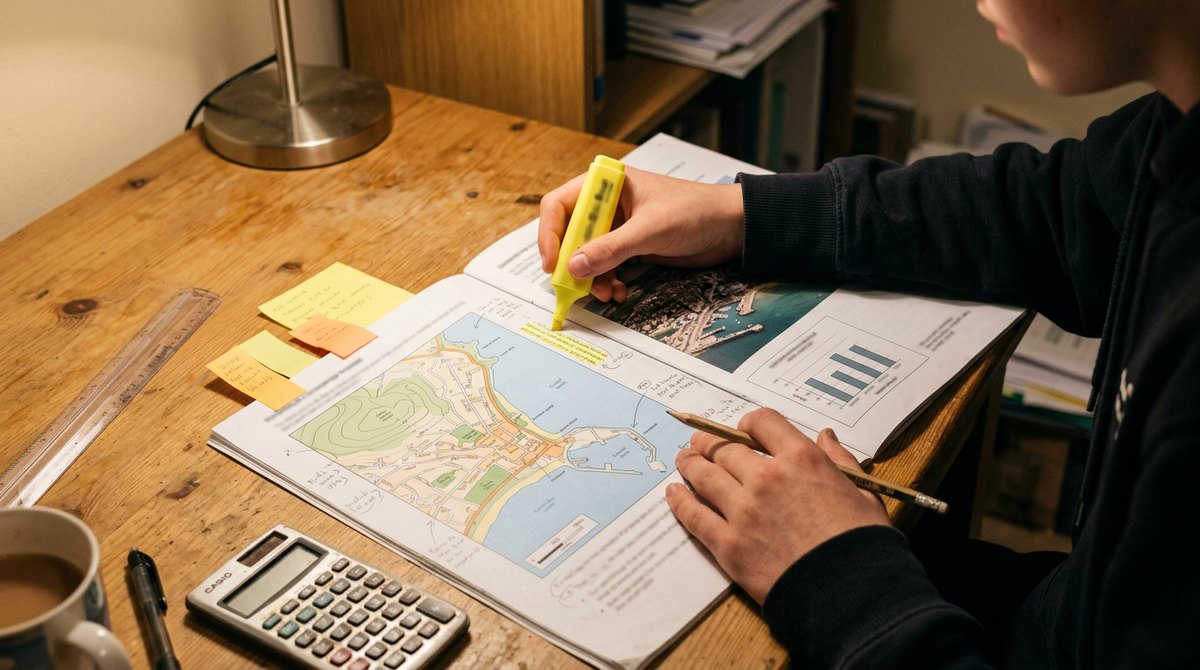
Highlighting and annotating the booklet is the best way to get ready. Your notes stay at home, so learn the key points.
Our lesson on the issue evaluation exam walks you through a full worked decision, with a model answer.
Section B: fieldwork
You must carry out two geographical enquiries. An enquiry is an investigation that answers a question using data you collect yourself, called primary data. The rules are clear:
- It must happen outside the classroom and school grounds, on at least two occasions.
- The two enquiries must be in contrasting environments, for example a coast and a town centre.
- Together they must cover physical and human geography, and at least one must look at how the two interact.
Some exam questions use fieldwork from a place you’ve never seen, while others ask about your own two enquiries, whose titles you write on the paper.
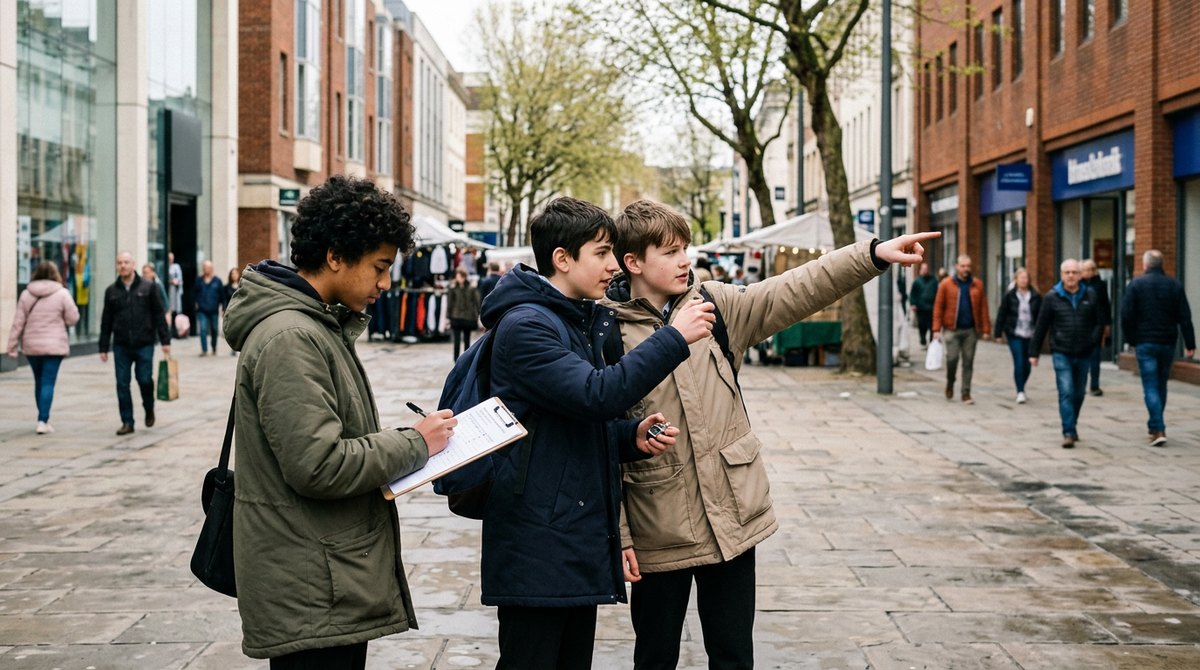
A pedestrian count and street survey in a city centre is a common human geography enquiry. A coast or river visit makes a good contrast.
Three lessons cover the enquiry process, starting with planning a geographical enquiry. You learn to choose a question, pick sites, think about risks, collect data, and then present and judge your results.
Fieldwork for home learners
If you sit your exams at a school or centre without being enrolled there, you’re a private candidate. You still have to do the fieldwork. The head of that centre must sign a statement confirming you did it. They can check your evidence and ask you about it, or have a teacher supervise you.
Our guide to GCSEs for home educated students explains how to find a centre.
- Find an exam centre that takes private candidates for AQA GCSE Geography (8035)
- Ask the centre how they’ll confirm your fieldwork, before you do it
- Plan two fieldwork days in contrasting places, one physical and one human
- Keep your evidence: data sheets, photos, maps and notes for both enquiries
- Ask how and when you’ll get the pre-release booklet
- Decide which landscapes, and which of food, water or energy, you’ll study
- Get a calculator, ruler and coloured pencils for maps and graphs
See how the course teaches fieldwork and the issue evaluation. The first three lessons are free.
Try 3 lessons free →Is GCSE Geography hard?
It’s one of the most popular GCSE subjects, with a lot to learn: two full exams of content, plus skills and fieldwork. Here’s how students did in the most recent results.
About two in three students (65.1%) got a grade 4 or above, and about one in four (24.5%) got a 7 or above. So most students pass, but the top grades go to those who learn their case studies in detail and practise longer answers. That takes steady work over time, not a last-minute cram.
The tricky parts
- Remembering detailed facts for each case study
- Longer answers that need a clear judgement, not just a list
- Map and data skills, such as grid references and reading graphs (our lesson on atlas maps, latitude and longitude starts the skills unit)
- Applying your knowledge to places you’ve never studied
Who it suits
It suits students who want to know how the world works, from why volcanoes erupt to why some cities grow faster than others. It leads on well to A-level Geography and fits alongside sciences, history or economics at A-level.
Can you study an AQA GCSE Geography online course from home?
Yes. Papers 1 and 2 can be learned online, and so can the skills and the enquiry process. The only part you must do in person is the fieldwork, which you can plan with a parent on two days out.
Most students learning online are in school and want extra help, or are in home education. There’s one limit. The specification says private candidates must be based in the UK.
What to look for in an online GCSE course
- It follows the right exam board. GCSE Geography is also offered by Pearson Edexcel and OCR, with different content, so check before you pay for course materials.
- It covers every topic, including all the choices, so you aren’t stuck with someone else’s pick.
- It tests you often, with exam-style questions and model answers.
- It’s flexible, so you can fit learning around school or a home timetable.
- It’s clear about support. Some online GCSE providers include a tutor to mark work, which usually costs more, so check what’s in the price.
GCSE or IGCSE Geography?
If you live outside the UK, an International GCSE (IGCSE) is usually the better route, because you can sit it at centres around the world. See our guide to the IGCSE Geography online course for Cambridge 0460.
How to prepare: a two-year plan
Ofqual lists 120 guided learning hours for this qualification, the teaching time a school would plan for. Our 94 lessons fit a two-year GCSE course like this:
| When | What to study | Lessons |
|---|---|---|
| Year 10, autumn | Natural hazards and the living world | 1 to 28 |
| Year 10, spring | Physical landscapes in the UK | 29 to 47 |
| Year 10, summer | Urban issues, the fieldwork lessons and your two fieldwork days | 48 to 57, 83 to 85 |
| Year 11, autumn | The changing economic world and resource management | 58 to 81 |
| Year 11, spring | Skills, issue evaluation and the pre-release booklet (out in March) | 82, 86 to 94 |
| Year 11, summer | Past papers, mark schemes and the exams in May and June | Revision |
That’s one or two short lessons a week, with a quiz after each, leaving the last term free for revision. Starting later? The calculator shows how many lessons a week you need for your exam year.
GCSE Geography revision that works
- Test yourself instead of re-reading. Close the notes and write what you remember.
- Turn each case study into a handful of key facts and figures.
- Do past papers under timed conditions in the last few months.
- Mark them with the mark scheme to see what examiners reward.
- Spend extra time on the pre-release booklet from March.
Studying GCSE Geography with Brainy Lemons
Our AQA GCSE Geography course has 94 short lessons that follow the 8035 specification in order, for the 2027, 2028 and 2029 exams. It covers every topic, including all the choices: hot deserts and cold environments, all three landscapes, and food, water and energy.
- Lessons of about 30 minutes, each with the spec points it covers, key terms, common mistakes and an exam-style question with a model answer
- A quiz, a quiz show and a zombie defence game on every lesson
- 1,886 flash cards, from easy to exam-hard
- Lessons on fieldwork, the issue evaluation and every geographical skill
- Works on a phone, tablet or laptop, any time
You can try the first three lessons free, with no card needed. We also wrote about launching our AQA GCSE Geography course and how it was built.
AQA GCSE Geography FAQs
Can you do AQA GCSE Geography online?
Yes. You can learn all the content and skills online, then sit the exams at a school or exam centre. You still need two days of fieldwork, and the centre must confirm it.
How many papers are there in AQA GCSE Geography?
Three. Paper 1 (physical geography) and Paper 2 (human geography) are 1 hour 30 minutes and 88 marks each, worth 35% each. Paper 3 (geographical applications) is 1 hour 30 minutes and 76 marks, worth 30%.
Is AQA GCSE Geography tiered?
No. Everyone sits the same exams and can get any grade from 1 to 9.
What is Paper 3 in AQA GCSE Geography?
It tests issue evaluation and fieldwork. A resource booklet about a real issue comes out twelve weeks before the exam. You study it, then get a clean copy on the day. The fieldwork questions cover unfamiliar fieldwork and your own two enquiries.
Do you need to study every topic?
No. You study either hot deserts or cold environments, two of the three UK landscapes, and one of food, water or energy. Everything else is compulsory.
How long does the course take?
Most students take two years, in Year 10 and Year 11, and Ofqual lists 120 guided learning hours. If you start late, the study plan calculator above shows the pace you need.
Can I take it if I live outside the UK?
Usually not as a private candidate. The specification says private candidates must be based in the UK. If you live abroad, an IGCSE such as Cambridge IGCSE Geography is usually easier to sit.
Get ready for all three AQA Geography papers
Learn every theme, case study and skill at your own pace, with lessons on the issue evaluation and fieldwork. Start with three free lessons on natural hazards.
- 94 short lessons that follow the AQA 8035 specification
- A quiz, a quiz show and a zombie defence game on every lesson
- 1,886 flash cards, from easy to exam-hard
No card needed. Works on any device.